

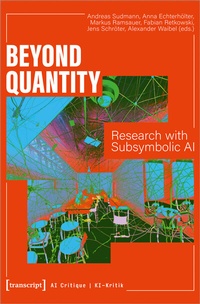
Beyond Quantity
Research with Subsymbolic AI
1st Edition
Published on 22. November 2023
Book
Paperback/Softback
360 pages
978-3-8376-6766-0 (ISBN)
Description
How do artificial neural networks and other forms of artificial intelligence interfere with methods and practices in the sciences? Which interdisciplinary epistemological challenges arise when we think about the use of AI beyond its dependency on big data? Not only the natural sciences, but also the social sciences and the humanities seem to be increasingly affected by current approaches of subsymbolic AI, which master problems of quality (fuzziness, uncertainty) in a hitherto unknown way. But what are the conditions, implications, and effects of these (potential) epistemic transformations and how must research on AI be configured to address them adequately?
Reviews / Votes
Besprochen in: Zeitschrift für Medienwissenschaft, 05.02.2025, Raphael BesenbäckMore details
Series
Language
English
Place of publication
Bielefeld
Germany
Target group
Professional and scholarly
Product notice
Klappenbroschur
Illustrations
29
6 s/w Abbildungen, 23 farbige Abbildungen
45 SW-Abbildungen
Dimensions
Height: 22.5 cm
Width: 14.8 cm
Thickness: 2 mm
Weight
558 gr
ISBN-13
978-3-8376-6766-0 (9783837667660)
Schweitzer Classification
Other editions
Additional editions
E-Book
11/2023
1st Edition
transcript
€0.00
Available for download
E-Book
11/2023
1st Edition
transcript
€0.00
Available for download
Persons
Editor
Andreas Sudmann, Privatdozent, Deutschland
Andreas Sudmann (PD Dr.) ist Medienwissenschaftler an den Universitäten in Bochum und Bonn. Seine Forschungsschwerpunkte liegen u.a. in Künstlicher Intelligenz, digitalen Kulturen, Medientheorie, Mediengeschichte und Medienkritik.
ISNI:
Jens Schröter, Rheinische Friedrich-Wilhelms-Universität Bonn, Deutschland
Jens Schröter (Prof. Dr.) ist Professor für Medienkulturwissenschaft in der Abteilung für Medienwissenschaft an der Rheinischen Friedrich-Wilhelms-Universität Bonn.
ISNI:
Alexander Waibel, Karlsruher Institut für Technologie, Deutschland