

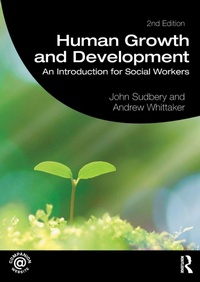
Human Growth and Development
An Introduction for Social Workers
2nd Edition
Published on 11. July 2018
Book
Paperback/Softback
374 pages
978-1-138-30409-3 (ISBN)
Description
Social workers work with people at all stages of life, tackling a multitude of personal, social, health, welfare, legal and educational issues. As a result, all social work students need to understand human growth and development throughout the lifespan.
This fully revised and expanded second edition of this introductory text for social workers provides a knowledge base about human development from conception to death. It is designed to encourage understanding of a wide range of experiences: from the developmental trajectories of children in care, to adult mental distress and the experiences of people with dementia, to bereavement. Using engaging narratives to illustrate each topic, the authors clearly introduce and analyse different theoretical approaches, and link them to real-life situations faced by social workers.
Packed with case studies, this student-friendly book includes overviews, summaries, questions and further reading in each chapter, as well as a 'Taking it further' section providing greater depth on key theoretical issues. A reference section contains a glossary and overviews of the principal theories discussed throughout the book. It is an essential read for all social work students.
This fully revised and expanded second edition of this introductory text for social workers provides a knowledge base about human development from conception to death. It is designed to encourage understanding of a wide range of experiences: from the developmental trajectories of children in care, to adult mental distress and the experiences of people with dementia, to bereavement. Using engaging narratives to illustrate each topic, the authors clearly introduce and analyse different theoretical approaches, and link them to real-life situations faced by social workers.
Packed with case studies, this student-friendly book includes overviews, summaries, questions and further reading in each chapter, as well as a 'Taking it further' section providing greater depth on key theoretical issues. A reference section contains a glossary and overviews of the principal theories discussed throughout the book. It is an essential read for all social work students.
Reviews / Votes
'An understanding of Human Growth and Development is essential to social work practice. This book is a friendly, comprehensive guide to human growth and development suitable for social work students and more experienced practitioners alike.' - Dr Anna Harvey, Senior Clinical Lecturer in Social Work and Social Care, Tavistock and Portman Clinic'This book is a wonderful resource for social workers in training and in practice. It is very accessible, with materials arranged to allow the reader to tailor the depth of their learning according to their needs. Theory and research are explained with care and there are practice examples throughout the book help the reader engage with these frameworks as tools to guide and develop understanding of service users' lived experiences.' - Dr Ducan Helm, Senior Lecturer, Faculty of Social Sciences, University of Stirling
'In this 2nd edition of John Sudbury's book, now with Andrew Whittaker, the psychodynamic orientation of the original text has been retained whilst content and form have been updated and refreshed. Developments refer to: the influence on young lives of social media; work with refugees fleeing war and conflict; gender variant and transgender identities; and recent data on culturally sensitive work with older adults.' - Clare Parkinson, Clinical Lecturer, Senior Social Worker, SFHEA, The Tavistock Centre, London
More details
Series
Edition
2nd edition
Language
English
Place of publication
London
United Kingdom
Publishing group
Taylor & Francis Ltd
Target group
College/higher education
Postgraduate and Undergraduate
Illustrations
15 s/w Abbildungen, 15 s/w Zeichnungen, 4 s/w Tabellen
4 Tables, black and white; 15 Line drawings, black and white; 15 Illustrations, black and white
Dimensions
Height: 246 mm
Width: 174 mm
Thickness: 21 mm
Weight
693 gr
ISBN-13
978-1-138-30409-3 (9781138304093)
Copyright in bibliographic data and cover images is held by Nielsen Book Services Limited or by the publishers or by their respective licensors: all rights reserved.
Schweitzer Classification
Other editions
Additional editions
E-Book
07/2018
2nd Edition
Routledge
€58.99
Available for download
E-Book
07/2018
2nd Edition
Routledge
€59.49
Available for download
Book
07/2018
2nd Edition
Routledge
€208.70
Shipment within 10-20 days
Previous edition
Book
10/2009
1st Edition
Routledge
€54.65
Article exhausted; check for reprint
Persons
John Sudbery is now retired. He is an honorary senior lecturer at the University of Salford, UK, where he carried out his teaching, writing and research. As a social worker or supervisor he worked for many years with people of all ages and was an accredited psychotherapist.
Andrew Whittaker is Associate Professor and Head of Social Work at London South Bank University, UK, where he teaches Human Growth and Development. He was a Research Fellow at the Centre for Social Work Research at the Tavistock Clinic, an area director for the mental health charity Mind and a senior social worker in child protection and child and adolescent mental health teams.
Andrew Whittaker is Associate Professor and Head of Social Work at London South Bank University, UK, where he teaches Human Growth and Development. He was a Research Fellow at the Centre for Social Work Research at the Tavistock Clinic, an area director for the mental health charity Mind and a senior social worker in child protection and child and adolescent mental health teams.
Content
List of figures; List of tables; Acknowledgments; Introduction; 1 Beginnings; 2 A secure base; 3 The developing child; 4 Transitions and adolescence; 5 Living independently; 6 Sex, love, work and children; 7 Maturity and some of its hazards; 8 Adulthood and ageing; 9 Dying, grief and mourning; 10 Fitting the pieces together; \Essential background; 1 The principles of heredity; 2 Attachment theory; 3 Bronfenbrenner's ecological model; 4 Psychoanalytic theories; 5 Piaget's theory of cognitive development; 6 Erikson's psychosocial theory of personality; 7 The humanistic models of Maslow and Rogers; 8 Learning and behavioural models; 9 Models of ageing: social disengagement theory, activity theory, feminist perspectives and political economy theory; 10 Three approaches to loss and grief; Glossary; Bibliography; Index