

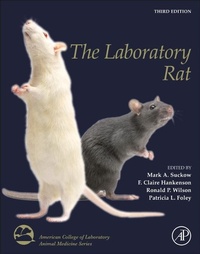
The Laboratory Rat
3rd Edition
Published on 11. November 2019
Book
Hardback
1180 pages
978-0-12-814338-4 (ISBN)
Description
The third edition of The Laboratory Rat features updated information on a variety of topics, including rats as research models for basic and translational research in areas such as genomics, alcoholism, diabetes, metabolic syndrome, obesity, neuroscience, spinal cord injury, traumatic brain injury, regenerative medicine, and infectious disease. New information related to the husbandry and veterinary care of rats is provided including topics related to nutrition, reproduction, anesthesia and surgery, infectious and noninfectious disease, and the care of surgical and other fragile models. It is a premier source of information on the laboratory rat, this book will be of interest to veterinary and medical students, senior graduate students, postdocs and researchers who utilize animals in biomedical research.
More details
Series
Edition
3rd edition
Language
English
Place of publication
San Diego
United States
Publishing group
Elsevier Science Publishing Co Inc
Target group
Professional and scholarly
veterinarians, researchers who use rats in their experiments - aging researchers, drug addiction, cancer, spinal cord injury, cardiovascular disease, Alzheimer's disease, spontaneous diabetes, arthritis, for example.
Product notice
sewn/stitched
Cloth over boards
Dimensions
Height: 284 mm
Width: 226 mm
Thickness: 66 mm
Weight
3370 gr
ISBN-13
978-0-12-814338-4 (9780128143384)
Copyright in bibliographic data and cover images is held by Nielsen Book Services Limited or by the publishers or by their respective licensors: all rights reserved.
Schweitzer Classification
Other editions
Additional editions
Mark A. Suckow | F. Claire Hankenson | Ronald P. Wilson
The Laboratory Rat
E-Book
11/2019
3rd Edition
Academic Press
€220.00
Available for download
Previous edition
Mark A. Suckow | Steven H. Weisbroth | Craig L. Franklin
The Laboratory Rat
Book
12/2005
2nd Edition
Academic Press
€201.79
Shipment within 15-20 days
Persons
Mark A. Suckow is a private consultant in laboratory animal medicine and Professor (Emeritus) in Biomedical Engineering at the University of Kentucky where he previously served as Attending Veterinarian and Associate Vice President for Research. He received his DVM from the University of Wisconsin and subsequently completed a post-doctoral residency in laboratory animal medicine at the University of Michigan. Dr. Suckow has 35 years of experience in laboratory animal medicine, regulatory compliance, and animal facility management. With an interest in the use of animal models for cancer research, vaccinology, and biomaterials development, Dr. Suckow has published greater than 115 papers in refereed journals and has seven issued patents related to vaccine adjuvants and cancer vaccines. He has written or edited over 20 books on topics related to research and laboratory animal medicine. Further, he served as the 2006 President of the American Association for Laboratory Animal Science and the 2011 President of the American Society of Laboratory Animal Practitioners; and he currently serves as an emeritus member of the Council on Accreditation of AAALAC, International and as Editor in Chief for the Journal of the American Association for Laboratory Animal Science. F. Claire Hankenson, DVM, MS, is the Director of MSU Campus Animal Resources and Attending Veterinarian at the Michigan State University. Research interests are refinements in the case and use of animals involved in research studies, particularly rodent clinical medicine, tail biopsy evaluations and humane endpoints. Ronald P. Wilson, VMA, MS, DACLAM, is the Professor and Chair of Comparative Medicine at Pennsylvania State University. Research interests are related to experimental surgery, pain, analgesia and anesthesia of laboratory animals. Patricia L. Foley, DVM, DCLAM, is the Director, Division of Comparative Medicine at Georgetown University.
Editor
Private Consultant
Director, MSU Campus Animal Resources, Michigan State University, East Lansing, MI, USA
Professor and Chair, Department of Comparative Medicine, Penn State University College of Medicine, Hershey, PA, USA
Director, Division of Comparative Medicine, Georgetown University, Washington, DC, USA
Content
Background of the laboratory rat
1. Historical Foundations
2. Taxonomy and Stocks and Strains
3. Translational Potential of Rats in Research
Biology and care
4. Functional Anatomy and Physiology
5. Clinical Pathology of the Rat
6. Reproduction and Breeding
7. Assisted Reproductive Technologies and Genetic Modification in Rats
8. Analysis of Behavior in Laboratory Rats
9. Nutrition
10. Housing and Environment
Clinical care and disease
11. Medical Management and Diagnostic Approaches
12. Bacterial, Mycoplasmal, and Mycotic Infections
13. Viral Disease
14. Parasitic Diseases
15. Neoplastic Disease
16. Metabolic, Traumatic, and Miscellaneous Diseases
17. Anesthesia, Analgesia, and Euthanasia
18. Care of Surgical and Other Fragile Models
Rats as research models
19. General Experimental Techniques
20. Integrating Biology with Rat Genomic Tools
21. Gnotobiotics and the Microbiome
22. Toxicology
23. Embryology and Teratology
24. Rat Immunology
25. Cardiovascular Research
26. Rat Models of Alcohol Use Disorder
27. Rat Models of Obesity, Metabolic Syndrome, and Diabetes
28. The Rate in Neuroscience Research
29. Rat Models of Central Nervous System Injury
30. Use of the Rat as a Model in Regenerative Medicine
31. Rat Models of Infectious Disease
1. Historical Foundations
2. Taxonomy and Stocks and Strains
3. Translational Potential of Rats in Research
Biology and care
4. Functional Anatomy and Physiology
5. Clinical Pathology of the Rat
6. Reproduction and Breeding
7. Assisted Reproductive Technologies and Genetic Modification in Rats
8. Analysis of Behavior in Laboratory Rats
9. Nutrition
10. Housing and Environment
Clinical care and disease
11. Medical Management and Diagnostic Approaches
12. Bacterial, Mycoplasmal, and Mycotic Infections
13. Viral Disease
14. Parasitic Diseases
15. Neoplastic Disease
16. Metabolic, Traumatic, and Miscellaneous Diseases
17. Anesthesia, Analgesia, and Euthanasia
18. Care of Surgical and Other Fragile Models
Rats as research models
19. General Experimental Techniques
20. Integrating Biology with Rat Genomic Tools
21. Gnotobiotics and the Microbiome
22. Toxicology
23. Embryology and Teratology
24. Rat Immunology
25. Cardiovascular Research
26. Rat Models of Alcohol Use Disorder
27. Rat Models of Obesity, Metabolic Syndrome, and Diabetes
28. The Rate in Neuroscience Research
29. Rat Models of Central Nervous System Injury
30. Use of the Rat as a Model in Regenerative Medicine
31. Rat Models of Infectious Disease