

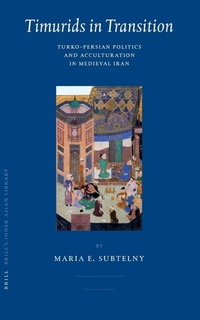
Timurids in Transition
Turko-Persian Politics and Acculturation in Medieval Iran
Published on 30. August 2007
Book
Hardback
440 pages
978-90-04-16031-6 (ISBN)
Description
How did the the descendants of Tamerlane, collectively known as the Timurids, make the transition from a nomadic empire to a sedentary polity based on the Perso-Islamic model , and what effect did the process of transition have on their Turko-Mongolian customs and identity? This volume seeks to answer these questions by utilizing the Weberian concepts of the "routinization" of charismatic authority and the patrimonial household state.
Focusing on the period of the last Timurid ruler, Sul?an-?usain Bayqara (1469-1506), the author examines the impact of the introduction of Persian modes of bureaucratic administration on the evolution of Timurid government and describes the development of the agrarian economy of the eastern Iranian province of Khorasan through the Islamic institution of the pious endowment.
Based on an exceptionally broad range of sources in Persian, Arabic, and Turkic languages, the book provides a new paradigm for understanding the Timurids within the framework of post-Mongol history and offers fresh insights into Turko-Persian relations and the problem of acculturation in medieval Iran.
Focusing on the period of the last Timurid ruler, Sul?an-?usain Bayqara (1469-1506), the author examines the impact of the introduction of Persian modes of bureaucratic administration on the evolution of Timurid government and describes the development of the agrarian economy of the eastern Iranian province of Khorasan through the Islamic institution of the pious endowment.
Based on an exceptionally broad range of sources in Persian, Arabic, and Turkic languages, the book provides a new paradigm for understanding the Timurids within the framework of post-Mongol history and offers fresh insights into Turko-Persian relations and the problem of acculturation in medieval Iran.
Reviews / Votes
"Thoroughly researched and elegantly presented, this volume offers valuable insights into questions that stand at the heart of medieval Islamic and Central Asian history."Ron Sela (Indiana University), Journal of Asian Studies Vol. 68:2 (2009)
'Subtelny has produced a fine book, which draws on an extremely impressive range of sources, many of them still unpublished, and remains clear and admirably readable even wehn dealing with intractable matters like agronomy and fiscal management.'
Peter Jackson, Keel University, Speculum July 2009.
More details
Series
Language
English
Place of publication
Leiden
Netherlands
Product notice
sewn/stitched
Cloth over boards
Dimensions
Height: 244 mm
Width: 169 mm
Thickness: 31 mm
Weight
934 gr
ISBN-13
978-90-04-16031-6 (9789004160316)
Copyright in bibliographic data and cover images is held by Nielsen Book Services Limited or by the publishers or by their respective licensors: all rights reserved.
Schweitzer Classification
Other editions
Additional editions

Software
08/2007
Brill
Unfortunately, price unknown
Available (delivery time upon request)
Person
Maria E. Subtelny, PhD (1979) in Near Eastern Languages and Civilizations, Harvard University, is Professor of Persian and Islamic Studies at the University of Toronto. She has published extensively on the Timurids and on medieval Iranian and Central Asian cultural history. Her book Le monde est un jardin: Aspects de l'histoire culturelle de l'Iran medieval (Paris, 2002) received the Saidi-Sirjani Book Award.
Content
ACKNOWLEDGEMENTS
NOTE ON TRANSLITERATION AND STYLE
MAPS, TABLES, AND ILLUSTRATIONS
INTRODUCTION
CHAPTER ONE. THE ROUTINIZATION OF CHARISMA: THE TIMURID PATRIMONIAL HOUSEHOLD STATE
CHAPTER TWO. POLITICAL VAGABOND TO POTENTATE: THE CAREER OF SUL?AN-?USAIN BAYQARA
CHAPTER THREE. THE CHALLENGE OF CHANGE: CENTRALIZING REFORMS AND THEIR OPPONENTS
CHAPTER FOUR. THE SEARCH FOR LONG-TERM SOLUTIONS: KHORASAN AND THE AGRICULTURAL IMPERATIVE
CHAPTER FIVE. PIETY AND PRAGMATISM: THE ROLE OF THE ISLAMIC ENDOWMENT
CHAPTER SIX. SAINTS AND SCRIBES: TIMURID SHRINES AS VEHICLES FOR AGRICULTURAL DEVELOPMENT AND AGROMANAGEMENT
CONCLUSION
APPENDIX ONE. SURVEY OF ENDOWMENT DEEDS FROM THE TIMURID PERIOD
APPENDIX TWO. A TIMURID DEED OF ENDOWMENT: THE VAQFIYYA OF AFAQ BEGIM
APPENDIX THREE. AN EDICT OF SUL?AN-ABU SA'ID CONCERNING COMPLETION OF THE GULISTAN DAM AT MASHHAD
APPENDIX FOUR. A DIPLOMA OF APPOINTMENT ISSUED BY SUL?AN-?USAIN FOR THE SUPERVISOR OF THE DEVELOPMENT PROJECT AT THE 'ALID SHRINE AT BALKH
APPENDIX FIVE. BILLS OF PURCHASE AND SALE RELATING TO THE PRIVATIZATION OF STATE LAND IN THE BALKH REGION BY SUL?AN-?USAIN
FACSIMILE EDITION
BIBLIOGRAPHY
INDEX
NOTE ON TRANSLITERATION AND STYLE
MAPS, TABLES, AND ILLUSTRATIONS
INTRODUCTION
CHAPTER ONE. THE ROUTINIZATION OF CHARISMA: THE TIMURID PATRIMONIAL HOUSEHOLD STATE
CHAPTER TWO. POLITICAL VAGABOND TO POTENTATE: THE CAREER OF SUL?AN-?USAIN BAYQARA
CHAPTER THREE. THE CHALLENGE OF CHANGE: CENTRALIZING REFORMS AND THEIR OPPONENTS
CHAPTER FOUR. THE SEARCH FOR LONG-TERM SOLUTIONS: KHORASAN AND THE AGRICULTURAL IMPERATIVE
CHAPTER FIVE. PIETY AND PRAGMATISM: THE ROLE OF THE ISLAMIC ENDOWMENT
CHAPTER SIX. SAINTS AND SCRIBES: TIMURID SHRINES AS VEHICLES FOR AGRICULTURAL DEVELOPMENT AND AGROMANAGEMENT
CONCLUSION
APPENDIX ONE. SURVEY OF ENDOWMENT DEEDS FROM THE TIMURID PERIOD
APPENDIX TWO. A TIMURID DEED OF ENDOWMENT: THE VAQFIYYA OF AFAQ BEGIM
APPENDIX THREE. AN EDICT OF SUL?AN-ABU SA'ID CONCERNING COMPLETION OF THE GULISTAN DAM AT MASHHAD
APPENDIX FOUR. A DIPLOMA OF APPOINTMENT ISSUED BY SUL?AN-?USAIN FOR THE SUPERVISOR OF THE DEVELOPMENT PROJECT AT THE 'ALID SHRINE AT BALKH
APPENDIX FIVE. BILLS OF PURCHASE AND SALE RELATING TO THE PRIVATIZATION OF STATE LAND IN THE BALKH REGION BY SUL?AN-?USAIN
FACSIMILE EDITION
BIBLIOGRAPHY
INDEX