

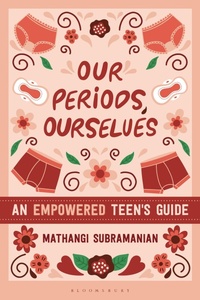
Our Periods, Ourselves
An Empowered Teen's Guide
Will be published approx. on 12. November 2026
Book
Paperback/Softback
208 pages
979-8-216-20190-8 (ISBN)
Description
An inclusive guide to menstruation and what makes everyone's experience unique
Despite what you might have been taught, periods do not happen in a vacuum. While it's important to know the facts of menstruation, it's just as important to take a holistic, inclusive, and deeper look into the ways in which everything around us--from our genetics and culture to religion and society--influences how we each experience our periods.
In Our Periods, Ourselves, Mathangi Subramanian covers how society shapes our monthly cycles just as much as science. She discusses how neurodiversity, disability, gender, adoption status, and immigration status can impact our periods while offering healthy, concrete recommendations for coping with these realities. Subramanian additionally examines how important issues such as reproductive rights, culture and religion, capitalism, and climate change affect access to the information and resources menstruators need to manage their physical and mental health.
Our Periods, Ourselves is an empowering resource for every body. It provides the information, encouragement, and support menstruators need to make informed decisions about their periods, and reminds us that our bodies and our identities are sources of power and strength.
Despite what you might have been taught, periods do not happen in a vacuum. While it's important to know the facts of menstruation, it's just as important to take a holistic, inclusive, and deeper look into the ways in which everything around us--from our genetics and culture to religion and society--influences how we each experience our periods.
In Our Periods, Ourselves, Mathangi Subramanian covers how society shapes our monthly cycles just as much as science. She discusses how neurodiversity, disability, gender, adoption status, and immigration status can impact our periods while offering healthy, concrete recommendations for coping with these realities. Subramanian additionally examines how important issues such as reproductive rights, culture and religion, capitalism, and climate change affect access to the information and resources menstruators need to manage their physical and mental health.
Our Periods, Ourselves is an empowering resource for every body. It provides the information, encouragement, and support menstruators need to make informed decisions about their periods, and reminds us that our bodies and our identities are sources of power and strength.
Reviews / Votes
Comprehensive and diverse, Our Periods, Ourselves transcends gender to offer a truly universal resource on menstrual health and hygiene. Its narrative-driven approach and authentic sharing of lived experiences make it uniquely relevant in today's landscape. -- Hyasintha Ntuyeko, founder and CEO of Kasole Secrets Company Ltd., Tanzania Reading Our Periods, Ourselves, I was shocked by how long I've gone as a menstruating person while knowing so little about the process. I see now that understanding how menstruation functions can be the foundation for a more interesting and empowered relationship with our own bodies. How I wish I'd had this warm, generous guide 30 years ago-and how glad I am that my own kid's generation will get to experience its riches. -- Vauhini Vara, Pulitzer Prize finalist and author of Searches As a parent, partner, and sibling of menstruators, I thought I knew a lot about menstruation, but Our Periods, Ourselves widened my view by revealing connections to all aspects of our lives. I was amazed for real. I wish I'd read this book as a teenager, and as a young parent, and I'm glad I've read this book now. I am forever changed, and will move through the world with more kindness and fight for menstruators. -- Steven Dunn, Whiting Award-winning author of Tannery BayMore details
Language
English
Place of publication
New York
United States
Publishing group
Bloomsbury Publishing Plc
Target group
Young adult
Interest Age: From 10 to 19 years
Product notice
Paperback (trade)
Unsewn / adhesive bound
Illustrations
3 bw images, 4 tables, 1 sidebar, 8 textboxes
Dimensions
Height: 216 mm
Width: 140 mm
Thickness: 25 mm
Weight
454 gr
ISBN-13
979-8-216-20190-8 (9798216201908)
Copyright in bibliographic data and cover images is held by Nielsen Book Services Limited or by the publishers or by their respective licensors: all rights reserved.
Schweitzer Classification
Person
Mathangi Subramanian is an award winning neurodiverse South Asian American author and educator and the founder of Moon Rabbit Writing Studio. Her novel A People's History of Heaven was longlisted for the PEN/Faulkner Award and was a finalist for the Lambda Literary Award. Her middle grade book Dear Mrs. Naidu won the South Asia book award. A former Fulbright-Nehru Scholar, Senior Policy Analyst for the New York City Council, and Assistant Vice President at Sesame Workshop, Subramanian currently serves as the Director of Early Childhood Policy at the Colorado Children's Campaign and a Commissioner of the Denver Public Library. She resides in Denver, Colorado with her child, their pets, and way too many picture books.
Content
Introduction
Chapter 1: The Menstrual Cycle
Chapter 2: Menstrual Products and the Environment
Chapter 3: Menstruation and Gender
Chapter 4: Menstruation and Neurodiversity
Chapter 5: Menstruation and Disability
Chapter 6: Menstruation and Body Size
Chapter 7: Menstruation and Culture
Chapter 8: Menstruation and Immigration
Chapter 9: Menstruation and Reproductive Rights
Chapter 10: Menstruation and Capitalism
Chapter 11: Menstruation and You
Bibliography
Index
Chapter 1: The Menstrual Cycle
Chapter 2: Menstrual Products and the Environment
Chapter 3: Menstruation and Gender
Chapter 4: Menstruation and Neurodiversity
Chapter 5: Menstruation and Disability
Chapter 6: Menstruation and Body Size
Chapter 7: Menstruation and Culture
Chapter 8: Menstruation and Immigration
Chapter 9: Menstruation and Reproductive Rights
Chapter 10: Menstruation and Capitalism
Chapter 11: Menstruation and You
Bibliography
Index