

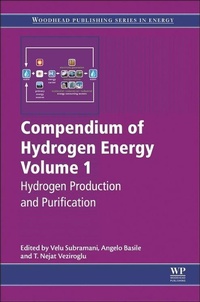
Compendium of Hydrogen Energy
Hydrogen Production and Purification
Published on 27. May 2015
Book
Hardback
550 pages
978-1-78242-361-4 (ISBN)
Description
Compendium of Hydrogen Energy: Hydrogen Production and Purification, the first text in a four-volume series, focuses on the production of hydrogen. As many experts believe that the hydrogen economy will eventually replace the fossil fuel economy as our primary source of energy, the text provides a timely discussion on this interesting topic.
The text details the methods of hydrogen production using fossil fuels, also exploring sustainable extraction methods of hydrogen production from water and hydrogen purification processes.
The text details the methods of hydrogen production using fossil fuels, also exploring sustainable extraction methods of hydrogen production from water and hydrogen purification processes.
More details
Series
Language
English
Place of publication
Cambridge
United Kingdom
Publishing group
Elsevier Science & Technology
Target group
Professional and scholarly
College/higher education
1) academic researchers and postgraduate students working in the area of the hydrogen production
2) R&D managers in power generation companies studying next generation fuels
3) academic researchers and postgraduate students working in the wider area of the hydrogen economy
Dimensions
Height: 160 mm
Width: 239 mm
Thickness: 33 mm
Weight
1000 gr
ISBN-13
978-1-78242-361-4 (9781782423614)
Copyright in bibliographic data and cover images is held by Nielsen Book Services Limited or by the publishers or by their respective licensors: all rights reserved.
Schweitzer Classification
Other editions
Additional editions
Velu Subramani | Angelo Basile | T. Nejat Veziroglu
Compendium of Hydrogen Energy
Hydrogen Production and Purification
E-Book
01/2015
Elsevier
€180.00
Available for download
Persons
Angelo Basile is a Full Professor and a leading authority in membrane science and technology. Since 2014, he has served as Full Professor in Systems, Methods and Technologies of Chemical Engineering Processes at CNR-ITM in Rende, Italy. His work covers hydrogen purification and production using membrane reactors, CO? capture, process intensification, and the treatment of industrial effluents with advanced membrane operations. Basile has edited many scientific books and authored numerous book chapters, bridging complex research with clear knowledge for engineers and scientists. Motivated by the role of AI/ML in accelerating membrane process design and automation, he supports integrating data-driven methods for smart plants and reaction-separation optimisation.
Dr. Veziroglu, a native of Turkey, graduated from the City and Guilds College, the Imperial College of Science and Technology, University of London, with degrees in Mechanical Engineering (A.C.G.I., B.Sc.), Advanced Studies in Engineering (D.I.C.) and Heat Transfer (Ph.D.).
In 1962 - after doing his military service in the Ordnance Section, serving in some Turkish government agencies and heading a private company - Dr. Veziroglu joined the University of Miami Engineering Faculty. In 1965, he became the Director of Graduate Studies and initiated the first Ph.D. Program in the School of Engineering and Architecture. He served as Chairman of the Department of Mechanical Engineering 1971 through 1975, in 1973 established the Clean Energy Research Institute, and was the Associate Dean for Research 1975 through 1979. He took a three years Leave of Absence (2004 through 2007) and founded UNIDO-ICHET (United Nations Industrial Development Organization - International Centre for Hydrogen Energy Technologies) in Istanbul, Turkey. On 15 May 2009, he attained the status of Professor Emeritus at the University of Miami.
Dr. Veziroglu organized the first major conference on Hydrogen Energy: The Hydrogen Economy Miami Energy (THEME) Conference, Miami Beach, 18-20 March 1974. At the opening of this conference, Dr. Veziroglu proposed the Hydrogen Energy System as a permanent solution for the depletion of the fossil fuels and the environmental problems caused by their utilization. Soon after, the International Association for Hydrogen Energy (IAHE) was established, and Dr. Veziroglu was elected president. As President of IAHE, in 1976 he initiated the biennial World Hydrogen Energy Conferences (WHECs), and in 2005 the biennial World Hydrogen Technologies Conventions (WHTCs).
In 1976, Dr. Veziroglu started publication of the International Journal of Hydrogen Energy (IJHE) as its Founding Editor-in-Chief, in order to publish and disseminate Hydrogen Energy related research and development results from around the world. IJHE has continuously grew; now it publishes twenty-four issues a year. He has published some 350 papers and scientific reports, edited 160 volumes of books and proceedings, and has co-authored the book "Solar Hydrogen Energy: The Power to Save the Earth?.
Dr. Veziroglu has memberships in eighteen scientific organizations, has been elected to the Grade of Fellow in the British Institution of Mechanical Engineers, American Society of Mechanical Engineers and the American Association for the Advancement of Science, and is the Founding President of the International Association for Hydrogen Energy.
Dr. Veziroglu has been the recipient of several international awards. He was presented the Turkish Presidential Science Award in 1974, made an Honorary Professor in Xian Jiaotong University of China in 1981, awarded the I. V. Kurchatov Medal by the Kurchatov Institute of Atomic Energy of U.S.S.R. in 1982, the Energy for Mankind Award by the Global Energy Society in 1986, and elected to the Argentinean Academy of Sciences in 1988. In 2000, he was nominated for Nobel Prize in Economics, for conceiving the Hydrogen Economy and striving towards its establishment.
Dr. Veziroglu, a native of Turkey, graduated from the City and Guilds College, the Imperial College of Science and Technology, University of London, with degrees in Mechanical Engineering (A.C.G.I., B.Sc.), Advanced Studies in Engineering (D.I.C.) and Heat Transfer (Ph.D.).
In 1962 - after doing his military service in the Ordnance Section, serving in some Turkish government agencies and heading a private company - Dr. Veziroglu joined the University of Miami Engineering Faculty. In 1965, he became the Director of Graduate Studies and initiated the first Ph.D. Program in the School of Engineering and Architecture. He served as Chairman of the Department of Mechanical Engineering 1971 through 1975, in 1973 established the Clean Energy Research Institute, and was the Associate Dean for Research 1975 through 1979. He took a three years Leave of Absence (2004 through 2007) and founded UNIDO-ICHET (United Nations Industrial Development Organization - International Centre for Hydrogen Energy Technologies) in Istanbul, Turkey. On 15 May 2009, he attained the status of Professor Emeritus at the University of Miami.
Dr. Veziroglu organized the first major conference on Hydrogen Energy: The Hydrogen Economy Miami Energy (THEME) Conference, Miami Beach, 18-20 March 1974. At the opening of this conference, Dr. Veziroglu proposed the Hydrogen Energy System as a permanent solution for the depletion of the fossil fuels and the environmental problems caused by their utilization. Soon after, the International Association for Hydrogen Energy (IAHE) was established, and Dr. Veziroglu was elected president. As President of IAHE, in 1976 he initiated the biennial World Hydrogen Energy Conferences (WHECs), and in 2005 the biennial World Hydrogen Technologies Conventions (WHTCs).
In 1976, Dr. Veziroglu started publication of the International Journal of Hydrogen Energy (IJHE) as its Founding Editor-in-Chief, in order to publish and disseminate Hydrogen Energy related research and development results from around the world. IJHE has continuously grew; now it publishes twenty-four issues a year. He has published some 350 papers and scientific reports, edited 160 volumes of books and proceedings, and has co-authored the book "Solar Hydrogen Energy: The Power to Save the Earth?.
Dr. Veziroglu has memberships in eighteen scientific organizations, has been elected to the Grade of Fellow in the British Institution of Mechanical Engineers, American Society of Mechanical Engineers and the American Association for the Advancement of Science, and is the Founding President of the International Association for Hydrogen Energy.
Dr. Veziroglu has been the recipient of several international awards. He was presented the Turkish Presidential Science Award in 1974, made an Honorary Professor in Xian Jiaotong University of China in 1981, awarded the I. V. Kurchatov Medal by the Kurchatov Institute of Atomic Energy of U.S.S.R. in 1982, the Energy for Mankind Award by the Global Energy Society in 1986, and elected to the Argentinean Academy of Sciences in 1988. In 2000, he was nominated for Nobel Prize in Economics, for conceiving the Hydrogen Economy and striving towards its establishment.
Content
Part One - Introduction to hydrogen
1. Introduction to hydrogen and its properties
Velu Subramani, BP Products North America, Inc, USA
2. Introduction to hydrogen production
Jose Luis Garcia Fierro, CSIC, Spain
3. Economics of hydrogen production
Paul Dodds, University College London, UK
Part Two - Conventional hydrogen production methods
4. Hydrogen production by steam reforming of natural gas and other non-renewable feedstocks
Lucia Garcia, Universidad de Zaragoza, Spain
5. Hydrogen production by reforming of bio-alcohols
Francesco Frusteri, ITAE-CNR, Italy
6. Hydrogen production by gasification of biomass and opportunity fuels
Paul A. Charpentier, The University of Western Ontario, Canada
Part Three - Production of hydrogen through electrolysis
7. Hydrogen production using high pressure electrolyzers
Richard Hanke-Rauschenbach, Max Planck Institute for Dynamics of Complex Technical Systems, Germany
8. Hydrogen production by high temperature steam electrolysis
Julie Mougin, CEA, Feance
9. Hydrogen production by polymer electrolyte membrane water electrolysis
Pierre Millet, University of Paris, France
Part Four - Emerging methods for the production of hydrogen
10. Hydrogen production using photobiological methods
Suleyman I. Allakhverdiev, Russian Academy of Sciences, Russia
11. Hydrogen production via thermochemical water-splitting
Martin Roeb, Christian Sattler and Christos Agrafiotis, DLR, Germany
12. Hydrogen production via the Kvaerner process and plasma reforming
Dae-Hoon Lee, Korea Institute of Machinery & Materials
Part Five - Hydrogen purification and low-carbon hydrogen production
13. Hydrogen purification methods: reduction and oxidation reactions, metal hydrides and adsorption
Esther Acha, Engineering Faculty of Bilbao (UPV/EHU), Spain
14. Polymeric membranes for the purification of hydrogen
John Jansen
15. Single-stage hydrogen production and separation from fossil fuels using micro and macro-membrane reactors
Angelo Basile
16. Chemical and calcium looping reforming for hydrogen production and carbon dioxide capture
Ben Anthony, Cranfield University
17. Low-carbon production of hydrogen from fossil fuels
Nazim Muradov, University of Central Florida, USA
1. Introduction to hydrogen and its properties
Velu Subramani, BP Products North America, Inc, USA
2. Introduction to hydrogen production
Jose Luis Garcia Fierro, CSIC, Spain
3. Economics of hydrogen production
Paul Dodds, University College London, UK
Part Two - Conventional hydrogen production methods
4. Hydrogen production by steam reforming of natural gas and other non-renewable feedstocks
Lucia Garcia, Universidad de Zaragoza, Spain
5. Hydrogen production by reforming of bio-alcohols
Francesco Frusteri, ITAE-CNR, Italy
6. Hydrogen production by gasification of biomass and opportunity fuels
Paul A. Charpentier, The University of Western Ontario, Canada
Part Three - Production of hydrogen through electrolysis
7. Hydrogen production using high pressure electrolyzers
Richard Hanke-Rauschenbach, Max Planck Institute for Dynamics of Complex Technical Systems, Germany
8. Hydrogen production by high temperature steam electrolysis
Julie Mougin, CEA, Feance
9. Hydrogen production by polymer electrolyte membrane water electrolysis
Pierre Millet, University of Paris, France
Part Four - Emerging methods for the production of hydrogen
10. Hydrogen production using photobiological methods
Suleyman I. Allakhverdiev, Russian Academy of Sciences, Russia
11. Hydrogen production via thermochemical water-splitting
Martin Roeb, Christian Sattler and Christos Agrafiotis, DLR, Germany
12. Hydrogen production via the Kvaerner process and plasma reforming
Dae-Hoon Lee, Korea Institute of Machinery & Materials
Part Five - Hydrogen purification and low-carbon hydrogen production
13. Hydrogen purification methods: reduction and oxidation reactions, metal hydrides and adsorption
Esther Acha, Engineering Faculty of Bilbao (UPV/EHU), Spain
14. Polymeric membranes for the purification of hydrogen
John Jansen
15. Single-stage hydrogen production and separation from fossil fuels using micro and macro-membrane reactors
Angelo Basile
16. Chemical and calcium looping reforming for hydrogen production and carbon dioxide capture
Ben Anthony, Cranfield University
17. Low-carbon production of hydrogen from fossil fuels
Nazim Muradov, University of Central Florida, USA