

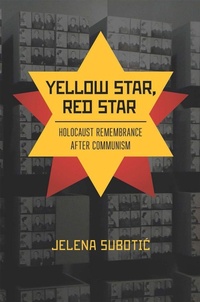
Yellow Star, Red Star
Holocaust Remembrance After Communism
Published on 15. December 2019
Book
Hardback
264 pages
978-1-5017-4240-8 (ISBN)
Description
Yellow Star, Red Star asks why Holocaust memory continues to be so deeply troubled-ignored, appropriated, and obfuscated-throughout Eastern Europe, even though it was in those lands that most of the extermination campaign occurred. As part of accession to the European Union, Jelena Subotic shows, East European states were required to adopt, participate in, and contribute to the established Western narrative of the Holocaust. This requirement created anxiety and resentment in post-communist states: Holocaust memory replaced communist terror as the dominant narrative in Eastern Europe, focusing instead on predominantly Jewish suffering in World War II. Influencing the European Union's own memory politics and legislation in the process, post-communist states have attempted to reconcile these two memories by pursuing new strategies of Holocaust remembrance. The memory, symbols, and imagery of the Holocaust have been appropriated to represent crimes of communism.
Yellow Star, Red Star presents in-depth accounts of Holocaust remembrance practices in Serbia, Croatia, and Lithuania, and extends the discussion to other East European states. The book demonstrates how countries of the region used Holocaust remembrance as a political strategy to resolve their contemporary "ontological insecurities"-insecurities about their identities, about their international status, and about their relationships with other international actors. As Subotic concludes, Holocaust memory in Eastern Europe has never been about the Holocaust or about the desire to remember the past, whether during communism or in its aftermath. Rather, it has been about managing national identities in a precarious and uncertain world.
Yellow Star, Red Star presents in-depth accounts of Holocaust remembrance practices in Serbia, Croatia, and Lithuania, and extends the discussion to other East European states. The book demonstrates how countries of the region used Holocaust remembrance as a political strategy to resolve their contemporary "ontological insecurities"-insecurities about their identities, about their international status, and about their relationships with other international actors. As Subotic concludes, Holocaust memory in Eastern Europe has never been about the Holocaust or about the desire to remember the past, whether during communism or in its aftermath. Rather, it has been about managing national identities in a precarious and uncertain world.
Reviews / Votes
Yellow Star, Red Star approaches Holocaust studies from a post-Communist perspective and is an important contribution to the historical canon.(Foreword) Jelena Subotic has written a fine, compelling and angry book. In Yellow Star, Red Star, she argues that Holocaust history in post-Communist countries has been ignored, subverted, adapted, adopted and misused and, in the two Balkan countries, used as a prop for creating post-Yugoslav national identities.
(Financial Times) The complicated politics of memory and commemoration regarding the Holocaust in post-communist Eastern Europe is the subject of Suboti's thoughtful analysis... Disturbing in its implications, this well-written and reasoned work is required reading for those studying history and memory.
(Choice) Yellow Star, Red Star is an excellent, in-depth analysis of current political processes afflicting postcommunist Holocaust memory. It should be required reading for anyone studying Eastern Europe, Holocaust memory, and the current rise of ethno-nationalism.
(H-Net:Humanities and Social Sciences) Yellow Star, Red Star is a scientifically well-grounded work recommended as a seminal volume, a must read for those with an interest in Serbian, Croatian, and Lithuanian history.
(Intersections: East European Journal of Society and Politics) Mrazek's social and anthropological history, together with Subotic's analysis of the historical and current factors of Holocaust remembrance has significantly expanded the field of literature. From the lives of people incarcerated in camps to the lives of people trapped by mythohistories and competitive victimhood, Mrazek and Subotic allow readers to walk in the footsteps and footfalls of history.
(REVIEWS IN HISTORY) Jelena Subotic's book has earned all the accolades it has so far received. It is an excellent foundation for a serious discussion and understanding of the moment we live in.
(Tragovi) Compellingly argued and written with genuine literary flair, Jelena Subotic's study is also a call to action, urging us to look more critically at the ways in which memory can be manipulated to suit political needs.
(Stray Satellite) Cronin's biography vividly depicts the colourful career, penetrating intellect and literary talent which made him one of the most interesting, if not influential, Russian conservative thinkers of the nineteenth century.
(Slavonic and East European Review) Jelena Subotic's second book is a compelling and prescient warning on the dangers inherent in contemporary political re-framing of Holocaust memory. Yellow Star, Red Star is bold and necessary.
(Journal of Contemporary History Book)
More details
Language
English
Place of publication
Ithaca
United States
Product notice
Paper over boards
Illustrations
8 b&w halftones, 3 maps - 3 Maps - 8 Halftones, black and white
Dimensions
Height: 233 mm
Width: 158 mm
Thickness: 25 mm
Weight
492 gr
ISBN-13
978-1-5017-4240-8 (9781501742408)
Copyright in bibliographic data and cover images is held by Nielsen Book Services Limited or by the publishers or by their respective licensors: all rights reserved.
Schweitzer Classification
Other editions
Additional editions
E-Book
12/2019
Cornell University Press
€14.49
Available for download
Person
Jelena Subotic is Professor of Political Science at Georgia State University in Atlanta. She is the author of Hijacked Justice and numerous scholarly articles.
Content
The Big Gray Truck
1. The Politics of Holocaust Remembrance after Communism
2. At the Belgrade Fairgrounds
3. Croatia's Islands of Memory
4. The Long Shadows of Vilna
The Stakes of Holocaust Remembrance in the Twenty-First Century
1. The Politics of Holocaust Remembrance after Communism
2. At the Belgrade Fairgrounds
3. Croatia's Islands of Memory
4. The Long Shadows of Vilna
The Stakes of Holocaust Remembrance in the Twenty-First Century