

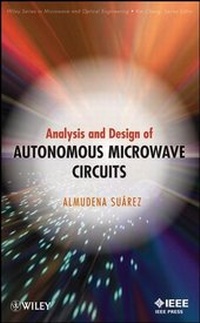
Analysis and Design of Autonomous Microwave Circuits
Published on 27. January 2009
Book
Hardback
704 pages
978-0-470-05074-3 (ISBN)
Description
Analysis and Design of Autonomous Microwave Circuits provides microwave designers and oscillator designers with a sound understanding of the free-running oscillation mechanism, the start-up from the noise level, and the establishment of the steady-state oscillation. It deals with the operation principles and main characteristics of free-running and injection-locked oscillators, coupled oscillators, and parametric frequency dividers. It covers techniques for the efficient simulation of the most common autonomous regimes as well as those used to eliminate common types of undesired behavior, such as spurious oscillations, hysteresis, and chaos.
More details
Product info
gebunden
Series
Edition
1. Auflage
Language
English
Place of publication
United States
Publishing group
John Wiley & Sons Inc
Target group
Professional and scholarly
College/higher education
Product notice
sewn/stitched
Cloth over boards
Dimensions
Height: 240 mm
Width: 161 mm
Thickness: 43 mm
Weight
1246 gr
ISBN-13
978-0-470-05074-3 (9780470050743)
Schweitzer Classification
Other editions
Additional editions
Enrique Alba | Christian Blum | Pedro Asasi
Optimization Techniques for Solving Complex Problems
E-Book
02/2009
Wiley
€147.99
Available for download
Almudena Suarez
Analysis and Design of Autonomous Microwave Circuits
E-Book
02/2009
Wiley-IEEE Press
€177.99
Available for download
Person
Almudena Suárez, PhD, is a Full Professor at the University of Cantabria, Spain, and a member of its Communications Engineering Department since 1993. She coauthored the book Stability Analysis of Nonlinear Microwave Circuits and contributed two articles to the Encyclopedia of RF and Microwave Engineering (Wiley). Professor Suárez has published dozens of papers in international journals and has been the leading researcher in several R&D projects. Her areas of interest include the nonlinear design of microwave circuits and, especially, stability and phase-noise analysis. She is a Distinguished Microwave Lecturer of IEEE.
Content
Preface.
1. Oscillator Dynamics.
1.1. Introduction.
1.2. Operational Principle of Free-Running Oscillators.
1.3. Impedance-Admittance Analysis of an Oscillator.
1.4. Frequency-Domain Formulation of an Oscillator Circuit.
1.5. Oscillator Dynamics.
1.6. Phase Noise.
2. Phase Noise.
2.1. Introduction.
2.2. Random Variable and random Processes.
2.3. Noise Sources in Electronic Circuits.
2.4. Derivation of the Oscillator Noise Spectrum Using Time-Domain Analysis.
2.5. Frequency-Domain Analysis of a Noisy Oscillator.
3. Bifurcation Analysis.
3.1. Introduction.
3.2. Representation of Solutions.
3.3. Bifurcations.
4. Injected Oscillators and Frequency Dividers.
4.1. Introduction.
4.2. Injection-Locked Oscillators.
4.3. Frequency Dividers.
4.4. Subharmonically and Ultrasubharmonically Injection-Locked Oscillators.
4.5. Self-Oscillating Mixers.
5. Nonlinear Circuit Simulation.
5.1. Introduction.
5.2. Time-Domain Integration.
5.3. Fast Time-Domain Techniques.
5.4. Harmonic Balance.
5.5. Harmonic Balance Analysis of Autonomous and Synchronized Circuit.
5.6. Envelope Transient.
5.7. Conversion Matrix Approach.
6. Stability Analysis Using Harmonic Balance.
6.1. Introduction.
6.2. Local Stability Analysis.
6.3. Stability Analysis of Free-Running Oscillators.
6.4. Solution Curves Versus a Circuit Parameter.
6.5.Global Stability Analysis.
6.6. Bifurcation Synthesis and Control.
7. Noise Analysis Using Harmonic Balance.
7.1. Introduction.
7.2. Noise in Semiconductor Devices.
7.3. Decoupled Analysis of Phase and Amplitude Perturbations in a Harmonic Balance System.
7.4. Coupled Phase and Amplitude Noise Calculation.
7.5. Carrier Modulation Approach.
7.6. Conversion Matrix Approach.
7.7. Noise in Synchronized Oscillators.
8. Harmonic Balance Techniques for Oscillator Design.
8.1. Introduction.
8.2. Oscillator Synthesis.
8.3. Design of Voltage-Controlled Oscillators.
8.4. Maximization of Oscillator Efficiency.
8.5. Control of Oscillator Transients.
8.6. Phase Noise Reduction.
9. Stabilization Techniques for Phase Noise Reduction.
9.1. Introduction.
9.2. Self-Injection Topology.
9.3. Use of High-Q Resonators.
9.4. Stabilization Loop.
9.5. Transistor-Based Oscillators.
10. Coupled-Oscillator Systems.
10.1. Introduction.
10.2. Oscillator Systems with Global Coupling.
10.3. Coupled-Oscillator Systems for Beam Steering.
11. Simulation Techniques for Frequency-Divider Design.
11.1. Introduction.
11.2. Types of frequency dividers.
11.3. Design of Transistor-Based Regenerative Frequency Dividers.
11.4. Design of Harmonic Injection Dividers.
11.5. Extension of the Techniques to Subharmonic Injection Oscillators.
12. Circuit Stabilization.
12.1. Introduction.
12.2. Unstable Class AB Amplifier Using Power Combiners.
12.3. Unstable Class E/F Amplifier.
12.4. Unstable Class E Amplifier.
12.5. Stabilization of Oscillator Circuits.
12.6. Stabilization of Multifunction MMIC Chips.
Index.