

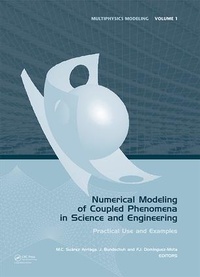
Numerical Modeling of Coupled Phenomena in Science and Engineering
Practical Use and Examples
1st Edition
Published on 1. December 2008
Book
Hardback
494 pages
978-0-415-47628-7 (ISBN)
Description
Mathematics is a universal language. Differential equations, mathematical modeling, numerical methods and computation form the underlying infrastructure of engineering and the sciences. In this context mathematical modeling is a very powerful tool for studying engineering problems, natural systems and human society. This interdisciplinary book contains a comprehensive overview, including practical examples, of the progress achieved to date in the modeling of coupled phenomena, computational mathematics and mechanics, heat transfer, fluid-structure interactions, biomechanics, and the flow of mass and energy in porous media. Numerical subjects such as grid generation, optimization, finite elements, finite differences, spectral methods, boundary elements, finite volumes and meshless methods are also discussed in detail using real examples.
The book provides a thorough presentation of the existing numerical techniques with specific applications to concrete, practical topics. The models and solutions presented here describe various systems: mechanical, biological, geophysical, technical, ecological, etc. The book is organized in thirty six chapters, each written by distinguished experts in their respective fields. The topics presented cover the current state of knowledge in numerical engineering practice including recent and ongoing developments and the presentation of new ideas for future research on applied computational engineering mathematics.
The book will be of interest to scientists working in engineering (structural, civil, mechanical), geology, geophysics, aquifer research, petroleum engineering, applied mathematics, and physics, as well as students in any of these areas.
The book provides a thorough presentation of the existing numerical techniques with specific applications to concrete, practical topics. The models and solutions presented here describe various systems: mechanical, biological, geophysical, technical, ecological, etc. The book is organized in thirty six chapters, each written by distinguished experts in their respective fields. The topics presented cover the current state of knowledge in numerical engineering practice including recent and ongoing developments and the presentation of new ideas for future research on applied computational engineering mathematics.
The book will be of interest to scientists working in engineering (structural, civil, mechanical), geology, geophysics, aquifer research, petroleum engineering, applied mathematics, and physics, as well as students in any of these areas.
More details
Series
Language
English
Place of publication
London
United Kingdom
Publishing group
Taylor & Francis Ltd
Target group
College/higher education
Postgraduate and Professional
Illustrations
25 s/w Tabellen, 60 s/w Zeichnungen
25 Tables, black and white; 60 Line drawings, black and white
Dimensions
Height: 246 mm
Width: 174 mm
Weight
1174 gr
ISBN-13
978-0-415-47628-7 (9780415476287)
Copyright in bibliographic data and cover images is held by Nielsen Book Services Limited or by the publishers or by their respective licensors: all rights reserved.
Schweitzer Classification
Other editions
Additional editions
Mario Cesar Suarez Arriaga | Jochen Bundschuh | Francisco Javier Dominguez-Mota
Numerical Modeling of Coupled Phenomena in Science and Engineering
Practical Use and Examples
E-Book
12/2008
1st Edition
CRC Press
€324.99
Available for download
Mario Cesar Suarez Arriaga | Jochen Bundschuh | Francisco Javier Dominguez-Mota
Numerical Modeling of Coupled Phenomena in Science and Engineering
Practical Use and Examples
E-Book
12/2008
Taylor & Francis
€324.99
Available for download
Persons
Mario Cesar Suarez Arriaga, Jochen Bundschuh, Francisco Javier Dominguez-Mota
Content
PREFACE - General Introduction to Coupled Phenomena. Karsten Pruess
PART 1. COMPUTATIONAL MATHEMATICS, MODELING AND NUMERICAL METHODS
PART 2. COUPLED PROBLEMS IN FLUID-STRUCTURE INTERACTIONS AND IN HEAT TRANSFER
PART 3. COMPUTATIONAL MECHANICS OF FLUIDS AND SOLIDS, MULTIPHYSICS, BIOMECHANICS
PART 4. FLOW OF MASS AND ENERGY IN POROUS MEDIA
PART 5. BOUNDARY ELEMENTS, SPECTRAL AND MESHLESS METHODS. NUMERICAL OPTIMIZATION.
PART 1. COMPUTATIONAL MATHEMATICS, MODELING AND NUMERICAL METHODS
PART 2. COUPLED PROBLEMS IN FLUID-STRUCTURE INTERACTIONS AND IN HEAT TRANSFER
PART 3. COMPUTATIONAL MECHANICS OF FLUIDS AND SOLIDS, MULTIPHYSICS, BIOMECHANICS
PART 4. FLOW OF MASS AND ENERGY IN POROUS MEDIA
PART 5. BOUNDARY ELEMENTS, SPECTRAL AND MESHLESS METHODS. NUMERICAL OPTIMIZATION.