

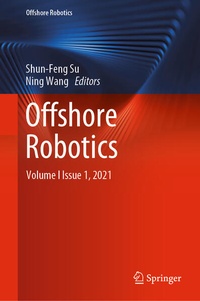
Offshore Robotics
Volume I Issue 1, 2021
Published on 19. October 2021
Book
Hardback
V, 109 pages
978-981-16-2077-5 (ISBN)
Description
This journal-like book series includes edited volumes to rapidly report and spread the latest technological results, new scientific discovery and valuable applied researches in the fields concerning offshore robotics as well as promote international academic exchange. We aim to make it one of the premier comprehensive academic publications of world offshore vehicle and robotics community.
The audience of the series will include the scholars, researchers, engineers and students who are interested in fields of autonomous marine vehicles and robotics, including autonomous surface vehicles, autonomous underwater vehicles, remote operation vehicles, marine bionics, marine vehicle modeling, guidance, navigation, control and cooperation and so on.
The audience of the series will include the scholars, researchers, engineers and students who are interested in fields of autonomous marine vehicles and robotics, including autonomous surface vehicles, autonomous underwater vehicles, remote operation vehicles, marine bionics, marine vehicle modeling, guidance, navigation, control and cooperation and so on.
More details
Series
Edition
2022 ed.
Language
English
Place of publication
Singapore
Singapore
Target group
Professional and scholarly
Illustrations
4 s/w Abbildungen, 35 farbige Abbildungen
V, 109 p. 39 illus., 35 illus. in color.
Dimensions
Height: 241 mm
Width: 160 mm
Thickness: 13 mm
Weight
348 gr
ISBN-13
978-981-16-2077-5 (9789811620775)
DOI
10.1007/978-981-16-2078-2
Schweitzer Classification
Other editions
Additional editions
Book
10/2022
Springer
€181.89
Shipment within 3-4 weeks
E-Book
10/2021
1st Edition
Springer
€171.19
Available for download
Persons
Shun-Feng Su received the B.S. degree in electrical engineering from National Taiwan University, Taiwan, R.O.C., in 1983, and the M.S. and Ph.D. degrees in electrical engineering from Purdue University, West Lafayette, Indiana, in 1989 and 1991, respectively. He is now a Chair Professor in the Department of Electrical Engineering, National Taiwan University of Science and Technology, Taipei, Taiwan. He is an IEEE Fellow and also a CACS Fellow. He has published more than 160 refereed journals and conference papers in the areas of robotics, intelligent control, fuzzy systems, neural networks, and non-derivative optimization. His current research interests include neural networks, fuzzy modeling, machine learning, virtual reality simulation, intelligent transportation systems.
Ning Wang received his B. Eng. degree in Marine Engineering and the Ph.D. degree in control theory and engineering from the Dalian Maritime University, Dalian, China in 2004 and 2009, respectively. From September 2008 to September 2009, he was financially supported by China Scholarship Council to work as a joint-training PhD student at the Nanyang Technological University (NTU), Singapore. In view of his significant research at NTU, he received the Excellent Government-funded Scholars and Students Award in 2009. From August 2014 to August 2015, he worked as a Visiting Scholar at the University of Texas at San Antonio. His research interests include self-learning modeling and control, unmanned (marine) vehicles, machine learning and autonomous systems. He has authored 3 books, and more than 100 SCI-indexed journal papers. He currently serves as members of IEEE TC on Industrial Informatics, the American Society of Mechanical Engineers (ASME), the Society of Naval Architects and Marine Engineers (SNAME), the Chinese Association of Automation (CAA), and the China's Society of Naval Architecture and Marine Engineering (CSNAME).
He is an editorialboard member of several academic journals, such as Neurocomputing, International Journal of Fuzzy Systems, Transactions of the Institute of Measurement and Control, Journal of Electrical Engineering and Technology, and Electronics.
Ning Wang received his B. Eng. degree in Marine Engineering and the Ph.D. degree in control theory and engineering from the Dalian Maritime University, Dalian, China in 2004 and 2009, respectively. From September 2008 to September 2009, he was financially supported by China Scholarship Council to work as a joint-training PhD student at the Nanyang Technological University (NTU), Singapore. In view of his significant research at NTU, he received the Excellent Government-funded Scholars and Students Award in 2009. From August 2014 to August 2015, he worked as a Visiting Scholar at the University of Texas at San Antonio. His research interests include self-learning modeling and control, unmanned (marine) vehicles, machine learning and autonomous systems. He has authored 3 books, and more than 100 SCI-indexed journal papers. He currently serves as members of IEEE TC on Industrial Informatics, the American Society of Mechanical Engineers (ASME), the Society of Naval Architects and Marine Engineers (SNAME), the Chinese Association of Automation (CAA), and the China's Society of Naval Architecture and Marine Engineering (CSNAME).
He is an editorialboard member of several academic journals, such as Neurocomputing, International Journal of Fuzzy Systems, Transactions of the Institute of Measurement and Control, Journal of Electrical Engineering and Technology, and Electronics.
Content
Marine robotics scientific and technological discussion.- Autonomous marine vehicle design, test and launch.- Autonomous marine vehicle modeling, identification and simulation.- Marine guidance, navigation and control.- Marine robot visual servo, intelligence and autonomy.- Situation awareness, collision avoidance and decision making.- Multiple marine vehicles swarm intelligence, cooperation and optimization.- Autonomous power management system.- Safety in offshore robotics.- Information systems in offshore robotics.- AI in marine robotics.- Education in offshore robotics.