

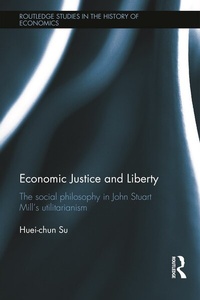
Economic Justice and Liberty
The Social Philosophy in John Stuart Mill's Utilitarianism
1st Edition
Published on 2. July 2013
Book
Hardback
220 pages
978-0-415-69275-5 (ISBN)
Description
This new book reopens the debate on theories of justice between utilitarian theorists and scholars from other camps. John Rawls' 1971 publication of A Theory of Justice put forward a devastating challenge to the long-established dominance of utilitarianism within political and moral philosophy, and until now no satisfactory and comprehensive utilitarian reply has yet been put forward.
By expounding John Stuart Mill's system of knowledge and by reconstructing his utilitarianism, Huei-chun Su offers a fresh and comprehensive analysis of Mill's moral philosophy and sheds new light on the reconciliation of Mill's idea of justice with both his utilitarianism and his theory of liberty. More than a study of Mill, this book uses a systematic framework to draw a comparison between Mill's theory of justice and those of John Rawls, Amartya Sen, and Friedrich von Hayek. It hence establishes common ground between different schools of thought in the fields of economics and philosophy, and enables more effective dialogue.
This book will be indispensable both to those interested in Mill's moral philosophy and to those seeking a solid theoretical basis for analyzing the idea of justice, as well as to anyone with an interest with the history of economics, economic philosophy and the history of economic thought more generally.
By expounding John Stuart Mill's system of knowledge and by reconstructing his utilitarianism, Huei-chun Su offers a fresh and comprehensive analysis of Mill's moral philosophy and sheds new light on the reconciliation of Mill's idea of justice with both his utilitarianism and his theory of liberty. More than a study of Mill, this book uses a systematic framework to draw a comparison between Mill's theory of justice and those of John Rawls, Amartya Sen, and Friedrich von Hayek. It hence establishes common ground between different schools of thought in the fields of economics and philosophy, and enables more effective dialogue.
This book will be indispensable both to those interested in Mill's moral philosophy and to those seeking a solid theoretical basis for analyzing the idea of justice, as well as to anyone with an interest with the history of economics, economic philosophy and the history of economic thought more generally.
Reviews / Votes
"For those who are inclined to discount John Stuart Mill as an erratic and eclectic thinker, Economic justice and liberty should be required reading. The book belongs to a steadily growing class of scholarly works which interpret Mill with sympathy and a solid cognizanc of his writings, and which confirm J. O. Urmson's judgement that if one studies his work diligently, 'an essentially consistent thesis can be discovered which is very superior to that usually attributed to Mill and immune to the common run of criticisms' (Urmson 1953, 33). The author of this highly readable book, Huei-chun Su, goes even further than Urmson."- Michael Schefczuk, Leuphana University LueneburgMore details
Series
Language
English
Place of publication
London
United Kingdom
Publishing group
Taylor & Francis Ltd
Target group
College/higher education
Illustrations
1 s/w Abbildung, 1 s/w Zeichnung
1 Line drawings, black and white; 1 Illustrations, black and white
Dimensions
Height: 234 mm
Width: 156 mm
Weight
600 gr
ISBN-13
978-0-415-69275-5 (9780415692755)
Copyright in bibliographic data and cover images is held by Nielsen Book Services Limited or by the publishers or by their respective licensors: all rights reserved.
Schweitzer Classification
Other editions
Additional editions
Book
11/2016
1st Edition
Routledge
€89.43
Shipment within 10-20 days
E-Book
07/2013
1st Edition
Routledge
€77.99
Available for download
E-Book
07/2013
Routledge
€77.99
Available for download
Person
Huei-Chun Su is an Honorary Research Associate at the Bentham Project, University College London, UK.
Content
Introduction Part I: Scientific Foundationi of Mill's Philosophy 1. Epistemological and Psychological Foundations of Mill's Utilitarian Moral Philosophy Part II: Utilitarianism as Moral Philosophy and Theory of Justice 2. Mill's Utilitarianism as a System of Moral Philosophy 3. Mill's Utilitarianism as a Theory of Morality 4. Reconstructing Mill's Theory of Justice 5. Economic Justice, Liberty and Utilitarianism Part III: Dialogues - Justice and Liberty in Focus 6. Rawls versus Mill 7. Sen versus Mill 8. Hayek versus Mill Part IV: Conclusions 9. Prospect: The Continuing Relevance of Mill's Utilitarianism Theory