

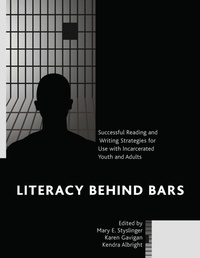
Literacy behind Bars
Successful Reading and Writing Strategies for Use with Incarcerated Youth and Adults
Published on 18. January 2017
Book
Paperback/Softback
108 pages
978-1-4422-6925-5 (ISBN)
Description
Literacy behind Bars: Successful Reading and Writing Strategies for Use with Incarcerated Youth and Adults is a practical resource for teachers, librarians, administrators, and community stakeholders who work with incarcerated youth and adults. The book includes examples of authentic literacy practices that have been successfully used with those incarcerated around the nation. These include:
creating graphic novels,book clubs,writing about gang life,reading buddies,urban literaturedeveloping a writing workshopestablishing a school library
creating graphic novels,book clubs,writing about gang life,reading buddies,urban literaturedeveloping a writing workshopestablishing a school library
Reviews / Votes
Written by professionals with experience working with incarcerated people, this resource is for educators and librarians who engage youth and adults 'behind the fence' in the English language arts.... The foreword and preface present a well-documented overview that connects poor literacy skills to incarceration. The editors introduce their text with a strong rationale that explains the literary deficits and unique needs of the incarcerated.... Well-written, insightful, timely, applicable across place and audience, this book is a fantastic resource for librarians and teachers working with incarcerated populations. These lessons are easily adaptable to an urban, general education setting and may improve the literacy skills of those at risk. * VOYA * Well-written and academic in nature, this will most likely be needed in libraries supporting the educational needs of incarcerated teens and adults either to reaffirm what they are already achieving or to convince those in power to try something new. * School Library Connection * Literacy Behind Bars is an integral text for professionals on both sides of the barbed wire fence. As an veteran secondary English of 25 years with experience in juvenile justice education and research, I stand in both excitement and awe to review this resource for multiple reasons. First, it is a valuable resource for educators demystifying literacy instruction for arguably the most vulnerable population in education. Second, the authors and contributors are well versed in education within confined settings and/or literacy curriculum development and instruction. And last, themes of reverence, hospitality, empathy, and acknowledgment of youth as unique individuals with both human and cultural capital to share with the world permeate each chapter. . . . this text presents specific, research and theory based lessons that will, through the development of reading, writing, creative and communication skills, empower students, giving voice to the voiceless and helping youth understand their own potential contributions to the greater conversations of the world. * Journal of Applied Juvenile Justice Services * Mixing personal experiences and stories from incarcerated inmates while built on a strong foundation of research, this volume provides valuable information and insights to teachers and librarians working in correctional facilities. Many of the essays describe literacy programs which bridge the core contradiction - a correctional facility is about rules and restrictions, while literacy is about freedom and choices - and could thus serve as relevant models for others working with people living behind bars in the age of mass incarceration. -- Patrick Jones, author Teen Incarceration: From Cell Bars to Ankle Bracelets (Twenty-First Century Books, 2016) Literacy behind Bars is grounded in solid research, offers exciting new strategies, and is enlivened by firsthand accounts of teaching experience. -- Stephanie Guerra, Adjunct Professor, Seattle University and Founder & Director, Creative Writing Program, King County Juvenile Detention CenterMore details
Language
English
Place of publication
United States
Publishing group
Bloomsbury Publishing Plc
Dimensions
Height: 280 mm
Width: 216 mm
Thickness: 6 mm
Weight
295 gr
ISBN-13
978-1-4422-6925-5 (9781442269255)
Copyright in bibliographic data and cover images is held by Nielsen Book Services Limited or by the publishers or by their respective licensors: all rights reserved.
Schweitzer Classification
Other editions
Additional editions
Mary E. Styslinger | Karen Gavigan | Kendra Albright
Literacy behind Bars
Successful Reading and Writing Strategies for Use with Incarcerated Youth and Adults
E-Book
01/2017
1st Edition
Rowman & Littlefield Publishers
€56.49
Available for download
Mary E. Styslinger | Karen Gavigan | Kendra Albright
Literacy behind Bars
Successful Reading and Writing Strategies for Use with Incarcerated Youth and Adults
E-Book
01/2017
1st Edition
Rowman & Littlefield Publishers
€56.49
Available for download
Persons
Mary E. Styslinger is an associate professor of English and literacy education at the University of South Carolina where she directs the Midlands Writing Project. Her research interests include interweaving literacy into the English curriculum and serving marginalized and at-risk youth; she has published articles in English Journal, Voices from the Middle, Language Arts, Journal of Adolescent and Adult Literacy, and Kappan.
Karen Gavigan is an associate professor in the School of Library and Information Science at the University of South Carolina. She and Mindy Tomasevich are co-authors of Connecting Comics to Curriculum: Strategies for Grades 6-12 (Libraries Unlimited), and Karen and Kendra Albright are co-editors of the graphic novel, AIDS in the End Zone.
Kendra Albright is Professor and Director of the School of Library and Information Science at Kent State University and Editor of Libri, International Journal of Libraries and Information Studies. Dr. Albright's interdisciplinary research addresses issues of information ethics and social justice for minority and disenfranchised populations.
Karen Gavigan is an associate professor in the School of Library and Information Science at the University of South Carolina. She and Mindy Tomasevich are co-authors of Connecting Comics to Curriculum: Strategies for Grades 6-12 (Libraries Unlimited), and Karen and Kendra Albright are co-editors of the graphic novel, AIDS in the End Zone.
Kendra Albright is Professor and Director of the School of Library and Information Science at Kent State University and Editor of Libri, International Journal of Libraries and Information Studies. Dr. Albright's interdisciplinary research addresses issues of information ethics and social justice for minority and disenfranchised populations.
Content
Foreword
Acknowledgements
List of Figures
List of Tables
Preface
Part I. Supporting Writers
1.Word by Word: Teaching Poetic Economy Behind Bars
Deborah Appleman
2.Teaching to the Heart: Fostering Empathy through Writing Workshop
Timothy R. Bunch
3.Composing Public Service Announcements: Using Digital Mentor Texts to
Support Student Writers in a Juvenile Detention Facility
Kristine E. Pytash
4. Writing About the Secrets of Gang Life
Kendra S. Albright
Part II. Encouraging Readers
5. Call-and-Responsive Reading: Street Literature as Agency for Incarcerated Readers
Vanessa Irvin
6. Books Behind the Fence
Susan McNair
7. Creating a Community of Writers Using Graphic Novels
Karen W. Gavigan
8. The Places We Can Go: Book Clubs for Social Justice
Jennifer L. Doyle, Elizabeth M. Bemiss, Mary E. Styslinger
Part III. Inspiring Partnerships
9. Theme for English B: Teaching and Learning with Incarcerated Youth
Peter Williamson, Megan Mercurio, Constance Walker
10. Reading Buddies: A School-University Partnership
Mary E. Styslinger, Timothy R. Bunch
11. Building Bridges Across the Disciplines: Professional Development Behind the
Fence
Victoria A. Oglan, Janie R. Goodman
About the Editors and Contributors
Index
Acknowledgements
List of Figures
List of Tables
Preface
Part I. Supporting Writers
1.Word by Word: Teaching Poetic Economy Behind Bars
Deborah Appleman
2.Teaching to the Heart: Fostering Empathy through Writing Workshop
Timothy R. Bunch
3.Composing Public Service Announcements: Using Digital Mentor Texts to
Support Student Writers in a Juvenile Detention Facility
Kristine E. Pytash
4. Writing About the Secrets of Gang Life
Kendra S. Albright
Part II. Encouraging Readers
5. Call-and-Responsive Reading: Street Literature as Agency for Incarcerated Readers
Vanessa Irvin
6. Books Behind the Fence
Susan McNair
7. Creating a Community of Writers Using Graphic Novels
Karen W. Gavigan
8. The Places We Can Go: Book Clubs for Social Justice
Jennifer L. Doyle, Elizabeth M. Bemiss, Mary E. Styslinger
Part III. Inspiring Partnerships
9. Theme for English B: Teaching and Learning with Incarcerated Youth
Peter Williamson, Megan Mercurio, Constance Walker
10. Reading Buddies: A School-University Partnership
Mary E. Styslinger, Timothy R. Bunch
11. Building Bridges Across the Disciplines: Professional Development Behind the
Fence
Victoria A. Oglan, Janie R. Goodman
About the Editors and Contributors
Index