

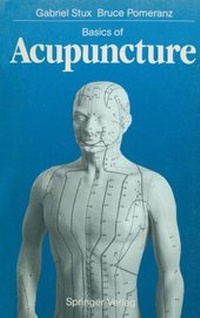
Basics of Acupuncture
Published on 18. August 1988
Book
Paperback/Softback
XI, 272 pages
978-3-540-19336-4 (ISBN)
Description
Following an introduction to the philosophical and
theoretical background oftraditional Chinese medicine, the
diagnostic system of acupuncture is presented. The Chinese
system of channels and functional organs and the
significance of the points are described. The 14 main
channels with the most important acupuncture points for
daily practice are presented with didactic emphasis on
morphology and clinical applicability. The methods of
needing and moxibustion are described in detail with their
clinical applications. The most important acupuncture points
are given for the different diagnoses.
theoretical background oftraditional Chinese medicine, the
diagnostic system of acupuncture is presented. The Chinese
system of channels and functional organs and the
significance of the points are described. The 14 main
channels with the most important acupuncture points for
daily practice are presented with didactic emphasis on
morphology and clinical applicability. The methods of
needing and moxibustion are described in detail with their
clinical applications. The most important acupuncture points
are given for the different diagnoses.
More details
Edition
Softcover reprint of the original 1st ed. 1988
Language
English
Place of publication
Heidelberg
Germany
Publishing group
Springer Berlin
Target group
College/higher education
Professional and scholarly
Dimensions
Height: 20.3 cm
Width: 12.7 cm
Weight
335 gr
ISBN-13
978-3-540-19336-4 (9783540193364)
DOI
10.1007/978-3-642-97115-0
Schweitzer Classification
Other editions
New editions
Gabriel Stux | Bruce Pomeranz
Basics of Acupuncture
Book
01/1991
2nd Edition
Springer
€85.55
Article exhausted; check for reprint
Persons
Content
1 Introduction.- 2 Scientific Basis of Acupuncture.- 2.1 Acupuncture Analgesia (Basic Research).- 2.1.1 Neural Mechanisms of Acupuncture Analgesia.- 2.1.2 Evidence for Endorphins and Acupuncture Analgesia.- 2.1.3 Evidence for Midbrain Monoamines and Acupuncture Analgesia.- 2.1.4 Evidence for Pituitary Hypothalamic System and Acupuncture Analgesia.- 2.1.5 Conclusions.- 2.2 Acupuncture Analgesia for Chronic Pain.- 2.3 Drug Addiction.- 2.4 Asthma, Nerve Regeneration, and Cardiovascular Effects of Acupuncture.- 2.5 Acupuncture Points (Do They Really Exist?).- 2.5.1 Does Needling at True Points Work Better Than Needling at Sham Points?.- 2.5.2 Are There Unique Anatomical Structures at Acupuncture Points?.- 2.5.3 Do Acupuncture Points Have Unique Physiological Features?.- 2.5.4 What Nerves Are Activated by Acupuncture?.- 3 Background and Theory of Traditional Chinese Medicine.- 3.1 Tao, Yin, and Yang.- 3.2 The Vital Energy: Qi.- 3.3 The System of Five Phases.- 3.4 Diagnosis in Traditional Chinese Medicine.- 4 Channels, Organs, and Points.- 4.1 System of Channels and Organs.- 4.2 Point Categories.- 4.2.1 Shu Points or Transport Points.- 4.2.2 Mu or Alarm Points.- 4.2.3 Influential Points, Hui Xue.- 4.2.4 Xi-Cleft Points.- 4.2.5 Five Shu Points.- 4.2.6 Tonification Point.- 4.2.7 Sedative Point.- 4.2.8 Jing Well Point.- 4.2.9 Ying Point.- 4.2.10 Yuan Source Point.- 4.2.11 Jing Point.- 4.2.12 He Sea Point.- 4.2.13 Luo Connecting Point.- 4.2.14 Confluent Points.- 4.3 Methods of Point Location.- 4.4 Description of Channels and Points.- 4.4.1 Lung Channel.- 4.4.2 Large Intestine Channel.- 4.4.3 Stomach Channel.- 4.4.4 Spleen Channel.- 4.4.5 Heart Channel.- 4.4.6 Small Intestine Channel.- 4.4.7 Urinary Bladder Channel.- 4.4.8 Kidney Channel.- 4.4.9 Pericardium Channel.- 4.4.10 Sanjiao Channel.- 4.4.11 Gallbladder Channel.- 4.4.12 Liver Channel.- 4.4.13 Du Mai.- 4.4.14 Ren Mai.- 4.4.15 Extra Points.- 5 Technique of Acupuncture.- 5.1 Acupuncture Needles.- 5.2 De Qi Sensation.- 5.3 Tonifying and Sedating Methods of Stimulation.- 5.4 Sterilization of the Needles.- 5.5 Complications of Acupuncture Treatment.- 5.6 Moxibustion.- 5.7 Acupressure.- 5.8 Laser Acupuncture.- 6 Acupuncture Treatment.- 6.1 Principles of Acupuncture and Rules of Point Selection.- 6.2 Locomotor Disorders.- 6.2.1 Cervical Spondylitis, Torticollis, Rheumatoid Arthritis.- 6.2.2 Intercostal Neuralgia, Trauma of the Thorax, Ankylosing Spondylitis, Zoster Neuralgia.- 6.2.3 Sciatica, Lumbar Pain.- 6.2.4 Periarthritis Humeroscapularis, Frozen Shoulder.- 6.2.5 Epicondylitis, Tennis Elbow.- 6.2.6 Coxarthrosis, Coxarthritis.- 6.2.7 Gonarthrosis, Pain in the Knee Joint.- 6.2.8 Rheumatoid Arthritis.- 6.3 Respiratory Disorders.- 6.3.1 Common Cold.- 6.3.2 Maxillary Sinusitis.- 6.3.3 Frontal Sinusitis.- 6.3.4 Chronic Bronchitis.- 6.3.5 Bronchial Asthma.- 6.4 Cardiovascular Disorders.- 6.4.1 Coronary Heart Disease with Angina Pectoris.- 6.4.2 Cardiac Neurosis.- 6.4.3 Exhaustion Conditions in Heart Disease.- 6.4.4 Hypertension.- 6.4.5 Hypotension.- 6.4.6 Disturbances of Peripheral Blood Supply.- 6.5 Gastroenterological Disorders.- 6.5.1 Gastritis, Gastroenteritis.- 6.5.2 Gastric and Duodenal Ulcers.- 6.5.3 Diarrhea.- 6.5.4 Irritable Bowel Disease.- 6.5.5 Constipation.- 6.5.6 Cholangitis, Cholecystitis, Biliary Dyskinesia, Biliary Colic.- 6.6 Mental Disturbances and Illnesses.- 6.6.1 Depression.- 6.6.2 Exhaustion Conditions.- 6.6.3 Agitation.- 6.6.4 Sleep Disturbances.- 6.6.5 Drug Addiction.- 6.6.6 Alcohol Addiction.- 6.6.7 Nicotine Addiction.- 6.6.8 Overweight, Weight Loss.- 6.7 Neurological Disorders.- 6.7.1 Headache and Migraine.- 6.7.2 Trigeminal Neuralgia.- 6.7.3 Hemiparesis.- 6.7.4 Facial Paresis.- 6.7.5 Epilepsy.- 6.8 Gynecological Disorders.- 6.8.1 Dysmenorrhea.- 6.8.2 Pain Caused by Gynecological Tumors.- 6.8.3 Analgesia During Childbirth.- 6.9 Urological Disorders.- 6.9.1 Pyelonephritis, Urinary Infections, Chronic Glomerulonephritis.- 6.9.2 Prostatitis, Psychogenic Urological Symptoms.- 6.9.3 Enuresis.- 6.10 Skin Disorders.- 6.10.1 Acne Vulgaris.- 6.10.2 Leg Ulcers, Deficient Wound Healing.- 6.10.3 Eczema, Neurodermatitis.- 6.10.4 Psoriasis.- 6.10.5 Herpes Simplex.- 6.11 Disorders of the Sense Organs.- 6.11.1 Deafness.- 6.11.2 Tinnitus.- 6.11.3 Ménière's Syndrome, Dizziness, Motion Sickness, Labyrinthitis.- 6.11.4 Chronic Conjunctivitis.- 6.11.5 Visual Deficiency.- 6.12 Acute Disorders and Emergencies.- 6.12.1 Fainting, Collapse.- 6.12.2 Epileptic Fits, Grand Mal.- 6.12.3 Acutely Painful Conditions.- 7 Electroacupuncture and Transcutaneous Electrical Nerve Stimulation.- 7.1 Electroacupuncture.- 7.2 Transcutaneous Electrical Nerve Stimulation, TENS.- 7.3 Acupuncture-like TENS Differs from Conventional TENS.- 7.4 Habituation to Monotonous Stimuli.- Appendixes A-D.- References (for chapter 2).