

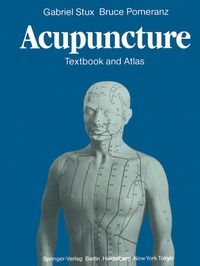
Acupuncture
Textbook and Atlas
Published on 18. November 2011
Book
Paperback/Softback
XII, 342 pages
978-3-642-71744-4 (ISBN)
Description
Following an introduction to the philosophical and theoreti- cal background of traditional Chinese medicine, the dia- gnostic system is presented: the Chinese system of channels and functional organs, the significance of pointsand point categories, methods of needling and moxibustion. There is a chapter on treatment based on western diagnosis.
More details
Edition
Softcover reprint of the original 1st ed. 1987
Language
English
Place of publication
Berlin
Germany
Publishing group
Springer Berlin
Target group
Professional and scholarly
Research
Illustrations
XII, 342 p.
Dimensions
Height: 280 mm
Width: 210 mm
Thickness: 20 mm
Weight
881 gr
ISBN-13
978-3-642-71744-4 (9783642717444)
DOI
10.1007/978-3-642-71742-0
Schweitzer Classification
Other editions
Additional editions
E-Book
12/2012
Springer
€82.38
Available for download

Book
05/1987
Springer
€85.55
Article exhausted; check different version
Persons
Content
1 Scientific Basis of Acupuncture.- 1.1 Acupuncture Analgesia (Basis Research).- 1.2 Acupuncture Analgesia for Chronic Pain.- 1.3 Drug Addiction.- 1.4 Asthma, Nerve Regeneration and Cardiovascular Effects of Acupuncture.- 1.5 Acupuncture Points (Do They Really Exist?).- 2 History of Acupuncture.- 3 Background and Theory of Traditional Chinese Medicine.- 3.1 Tao, Yin and Yang.- 3.2 The Cosmic Vital Energy: Qi.- 3.3 Jing, the Life Essence.- 3.4 Shen, or Psychic Energy.- 3.5 Disturbances of Qi.- 3.6 The System of Five Phases.- 3.7 External Climatic Factors.- 3.8 Internal Emotional Factors.- 4 Diagnosis in Traditional Chinese Medicine.- 4.1 Eight Diagnostic Criteria, Ba gang.- 4.2 Interior and Exterior Li, Biao.- 4.3 Excess and Deficiency Shi, Xu.- 4.4 Heat and Cold Re, Han.- 4.5 Yin and Yang.- 4.6 Four Examinations Si zh?n.- 4.7 Visual Observation Wàng zh?n.- 4.8 Listening and Smelling Wén zh?n.- 4.9 Questioning Wèn zh?n.- 4.10 Physical Examination Qie zh?n.- 5 Chinese System of Channels,Organs and Points.- 5.1 Channels and Organs.- 5.2 Presentation of the Point Categories.- 5.3. Methods of Point Location.- 6 Systematic Description of Channels and Points.- 6.1 Lung Channel.- 6.2 Large Intestine Channel.- 6.3 Stomach Channel.- 6.4 Spleen Channel.- 6.5 HeartChannel.- 6.6 Small Intestine Channel.- 6.7 Urinary Bladder Channel.- 6.8 Kidney Channel.- 6.9 Pericardium Channel.- 6.10 Sanjiao Channel.- 6.11 Gallbladder Channel.- 6.12 LiverChannel.- 6.13 Du Mai.- 6.14 Ren Mai.- 6.15 Chong Mai.- 6.16 Dai Mai.- 6.17 Yangqiao.- 6.18 Yinqiao.- 6.19 Yangwei.- 6.20 Yinwei.- 6.21 Extra Points.- 7 Regions with Important Acupuncture Points.- 7.1 Face.- 7.2 NeckArea.- 7.3 Dorsal Side of the Trunk.- 7.4 Abdominal Area.- 7.5 Shoulder Area.- 7.6 Points Around the Knee Joint.- 8 Technique of Acupuncture.- 8.1 Acupuncture Needles.- 8.2 Technique of Insertion and Stimulation of the Needles.- 8.3 De Qi Sensation.- 8.4 Tonifying and Sedating Methods of Stimulation.- 8.5 Electroacupuncture, Electrostimulation.- 8.6 Sterilization of the Needles.- 8.7 Complications of Acupuncture Treatment.- 9 Moxibustion.- 9.1 Indications and Methods.- 9.2 Direct Moxibustion.- 9.3 Indirect Moxibustion with Ginger Slice Isolation.- 9.4 Moxibustion with "Moxa Cigars".- 9.5 Moxibustion by Heating Acupuncture Needles.- 9.6 Infrared Moxibustion.- 10 Laser Acupuncture.- 11 Acupressure.- 12 Ear Acupuncture.- 12.1 Technique of Ear Acupuncture.- 12.2. Representation of the Body on the Auricle.- 12.3 Numbering of Ear Points.- 12.4 Rules for Selection of Ear Points.- 13 Scalp Acupuncture.- 13.1 Fourteen Lines for Treatment.- 13.2 Method of Needling.- 14 Hand Acupuncture.- 14.1 Points of the Dorsum of the Hand.- 14.2 Points on the Palm.- 15 Acupuncture Treatment.- 15.1 Principles of Acupuncture and Major Rules of Point Selection.- 15.2 Locomotor Disorders.- 15.3 Respiratory Disorders.- 15.4 Cardiovascular Disorders.- 15.5 Gastroenterological Disorders.- 15.6 Mental Disturbances and Illnesses.- 15.7 Neurologic Disorders.- 15.8 Gynecological Disorders.- 15.9 Urological Disorders.- 15.10 SkinDisorders.- 15.11 Disorders of the Sense Organs.- 15.12 Acute Disorders and Emergencies.- Appendixes A-H.- A. World Health Organization List of Indications for Acupuncture.- B. Nomenclature and Abbreviations for Channels and Points.- C. Glossary of Chinese Terms.- D. Translation of Chinese Ideograms and Point Names.- E. Alphabetic List of Chinese Point Names.- F. Index of Indications for Acupuncture.- H. System of the Five Phases.- Literature.