

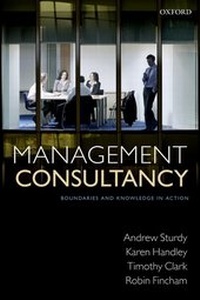
Management Consultancy
Boundaries and Knowledge in Action
1st Edition
Published on 10. June 2010
Book
Paperback/Softback
224 pages
978-0-19-959375-0 (ISBN)
Description
Management consultants are typically seen as key mediators in the flow of management ideas. And yet little is known about exactly what happens when they work together with clients, behind closed doors in consulting projects. Do they really innovate or simply legitimate existing knowledge? This book presents research from a three year long 'fly-on-the-wall study' of consulting projects and challenges our taken for granted view of consultancy.
It draws on and integrates theories of knowledge and social boundaries to reveal a picture of complex and shifting insider-outsider relationships. Here, the outsider or expert status of consultants in relation to their clients cannot be assumed in their day-to-day project interactions. Different actors, roles, and types of knowledge are involved in an interactive and dynamic process where various boundaries are constructed, reinforced, negotiated and transformed. The chapters selectively explore these dynamics, revealing the importance of boundary complexity, the role of humour and challenge in often tense relationships, and the importance of shared knowledge domains such as sector knowledge.
This in-depth analysis of inter-organizational project teams also covers a wide range of consultancy contexts, drawing on cases studies which include:
* a US-based strategy firm and a multinational client,
* the public and private sectors,
* a sole practitioner consultant,
* IT implementation in financial services.
The book is important for all those with an interest in management consultancy, project working and management knowledge as well as in innovation/change, inter-organisational relations, boundaries and professional services. The authors include some of the leading research experts on management consultancy as well as a former management consultant and current expert in management learning.
It draws on and integrates theories of knowledge and social boundaries to reveal a picture of complex and shifting insider-outsider relationships. Here, the outsider or expert status of consultants in relation to their clients cannot be assumed in their day-to-day project interactions. Different actors, roles, and types of knowledge are involved in an interactive and dynamic process where various boundaries are constructed, reinforced, negotiated and transformed. The chapters selectively explore these dynamics, revealing the importance of boundary complexity, the role of humour and challenge in often tense relationships, and the importance of shared knowledge domains such as sector knowledge.
This in-depth analysis of inter-organizational project teams also covers a wide range of consultancy contexts, drawing on cases studies which include:
* a US-based strategy firm and a multinational client,
* the public and private sectors,
* a sole practitioner consultant,
* IT implementation in financial services.
The book is important for all those with an interest in management consultancy, project working and management knowledge as well as in innovation/change, inter-organisational relations, boundaries and professional services. The authors include some of the leading research experts on management consultancy as well as a former management consultant and current expert in management learning.
Reviews / Votes
This book adds a great deal to the study of consulting. It makes consistent and strong arguments, backed up by a solid empirical base, for a process-based approach to consulting work and to boundaries and knowledge flow within it. * Management Learning* An important contribution to the practice and research of consulting. There are rich descriptions, a framework that organizes the findings including surfacing interesting inconsistencies and gaps, and intriguing suggestion about future enquiries. * Chris Argyris, the James Conant Professor of Education and Organizational Behavior Emeritus at Harvard University *
More details
Language
English
Place of publication
Oxford
United Kingdom
Target group
Professional and scholarly
Dimensions
Height: 234 mm
Width: 157 mm
Thickness: 13 mm
Weight
356 gr
ISBN-13
978-0-19-959375-0 (9780199593750)
Copyright in bibliographic data and cover images is held by Nielsen Book Services Limited or by the publishers or by their respective licensors: all rights reserved.
Schweitzer Classification
Other editions
Additional editions
Andrew Sturdy | Karen Handley | Timothy Clark
Management Consultancy
Boundaries and Knowledge in Action
E-Book
06/2010
OUP eBook
€41.99
Available for download
Andrew Sturdy | Karen Handley | Timothy Clark
Management Consultancy
Boundaries and Knowledge in Action
Book
03/2009
Oxford University Press
€129.50
Shipment within 15-20 days
Persons
Andrew Sturdy is Professor of Organizational Behaviour and Head of Department, at the Department of Management, University of Bristol, UK. Previously he was Professor of Organizational Behaviour at Warwick Business School, University of Warwick. His work on management consultancy spans over a decade and is widely cited in academic and popular media. In addition to his research work with diverse client and consulting organisations, he advises various government agencies on the use of management consultancy. He is currently leading a research project on internal consultancy, funded by the UK Economic and Social Research Council (ESRC).
Timothy Clark is Professor of Organizational Behaviour at Durham Business School, Durham University. Over the past fifteen years he has conducted a series of research projects into different aspects of consultancy work and, more recently, focused on the role of management gurus. These have resulted in a series of influential publications, including Managing Consultants (1995, Open University Press) and Critical Consulting: New Perspectives on the Management Advice Industry (2002, Blackwell, with R. Fincham). He is a General Editor of Journal of Management Studies, and co-editor of the forthcoming Oxford Handbook of Management Consulting.
Robin Fincham is Professor of Organizational Behaviour at Stirling University UK. His work spans areas of management consulting, management knowledge and expert labour, and previously he has researched into information technologies.
Karen Handley is Senior Lecturer in HRM and Organizational Behaviour at Oxford Brookes University Business School. Before entering academia, she worked in the financial services industry and as a management consultant at PricewaterhouseCoopers. Karen's research interests include management learning, consultancy, and project-based organisations. She is also involved in pedagogic research and is currently Assistant Director of a research project, Engaging Students with Assessment Feedback, funded by the Higher Education Academy.
Timothy Clark is Professor of Organizational Behaviour at Durham Business School, Durham University. Over the past fifteen years he has conducted a series of research projects into different aspects of consultancy work and, more recently, focused on the role of management gurus. These have resulted in a series of influential publications, including Managing Consultants (1995, Open University Press) and Critical Consulting: New Perspectives on the Management Advice Industry (2002, Blackwell, with R. Fincham). He is a General Editor of Journal of Management Studies, and co-editor of the forthcoming Oxford Handbook of Management Consulting.
Robin Fincham is Professor of Organizational Behaviour at Stirling University UK. His work spans areas of management consulting, management knowledge and expert labour, and previously he has researched into information technologies.
Karen Handley is Senior Lecturer in HRM and Organizational Behaviour at Oxford Brookes University Business School. Before entering academia, she worked in the financial services industry and as a management consultant at PricewaterhouseCoopers. Karen's research interests include management learning, consultancy, and project-based organisations. She is also involved in pedagogic research and is currently Assistant Director of a research project, Engaging Students with Assessment Feedback, funded by the Higher Education Academy.
Author
Professor of Organizational Behaviour and Head of Department at the Department of Management, University of Bristol
Senior Lecturer in HRM and Organisational Behaviour, Oxford Brookes University Business School
Professor of Organizational Behaviour, Durham Business School, University of Durham
Professor of Organizational Behaviour, Department of Management and Organization, University of Stirling
Content
1. Consultancy, Knowledge, and Boundaries ; 2. Boundaries and Knowledge Flow ; 3. The Case Studies ; 4. Re-thinking Potentials for Knowledge Flow ; 5. Outside Expertise and 'Sector Knowledge' ; 6. Challenge - Testing Boundaries ; 7. Humour and Boundary Tensions ; 8. Conclusion - Beyond Boundaries and Projects