

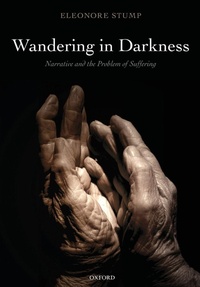
Wandering in Darkness
Narrative and the Problem of Suffering
1st Edition
Published on 13. September 2012
Book
Paperback/Softback
688 pages
978-0-19-965930-2 (ISBN)
Description
Only the most naive or tendentious among us would deny the extent and intensity of suffering in the world. Can one hold, consistently with the common view of suffering in the world, that there is an omniscient, omnipotent, perfectly good God? This book argues that one can.
Wandering in Darkness first presents the moral psychology and value theory within which one typical traditional theodicy, namely, that of Thomas Aquinas, is embedded. It explicates Aquinas's account of the good for human beings, including the nature of love and union among persons. Eleonore Stump also makes use of developments in neurobiology and developmental psychology to illuminate the nature of such union.
Stump then turns to an examination of narratives. In a methodological section focused on epistemological issues, the book uses recent research involving autism spectrum disorder to argue that some philosophical problems are best considered in the context of narratives. Using the methodology argued for, the book gives detailed, innovative exegeses of the stories of Job, Samson, Abraham and Isaac, and Mary of Bethany.
In the context of these stories and against the backdrop of Aquinas's other views, Stump presents Aquinas's own theodicy, and shows that Aquinas's theodicy gives a powerful explanation for God's allowing suffering. She concludes by arguing that this explanation constitutes a consistent and cogent defense for the problem of suffering.
Wandering in Darkness first presents the moral psychology and value theory within which one typical traditional theodicy, namely, that of Thomas Aquinas, is embedded. It explicates Aquinas's account of the good for human beings, including the nature of love and union among persons. Eleonore Stump also makes use of developments in neurobiology and developmental psychology to illuminate the nature of such union.
Stump then turns to an examination of narratives. In a methodological section focused on epistemological issues, the book uses recent research involving autism spectrum disorder to argue that some philosophical problems are best considered in the context of narratives. Using the methodology argued for, the book gives detailed, innovative exegeses of the stories of Job, Samson, Abraham and Isaac, and Mary of Bethany.
In the context of these stories and against the backdrop of Aquinas's other views, Stump presents Aquinas's own theodicy, and shows that Aquinas's theodicy gives a powerful explanation for God's allowing suffering. She concludes by arguing that this explanation constitutes a consistent and cogent defense for the problem of suffering.
Reviews / Votes
Review from previous edition immensely ambitious [and] stunningly successful, repeatedly finding new levels of meaning. * Times Literary Supplement * Eleonore Stump's magisterial treatment of the problem of evil ... is bold, meticulously argued, and highly nuanced. In terms of scope and power, Stump's book clearly ranks among the best book length treatments of the problem of evil. * European Journal for the Philosophy of Religion * Eleonore Stump's major new book on the problem of suffering is perhaps the most important contribution to the field in decades ... reading this book is a thought-provoking spiritual journey which raises all kinds of fresh yet down-to-earth and urgent questions. Ultimately, it may have the potential to transform how we think about and do theology. * Theology * original, insightful, and brilliant. * Religious Studies Review * A truly magnificent achievement, the book is rich with compelling narratives from inside and outside the Judeo-Christian Scriptures. * Analysis * a must-read for philosophers of religion and a very beneficial read for other philosophers and for other scholars of religion. It is without question a highly nuanced and philosophically deep book. * Notre Dame Philosophical Reviews * Eleonore Stump's Wandering in Darkness poses a learned, astutely crafted argument for the compatability of human suffering and God's existence, and in doing so it provides a number of innovations that will be of real interest to analytic philosophers of religion in particular and more generally to anyone curious about the so-called 'problem of evil' * Daniel Colucciello Barber, Journal of Religious Studies *More details
Language
English
Place of publication
Oxford
United Kingdom
Target group
College/higher education
Professional and scholarly
Scholars and advanced students of philosophy and religion
Dimensions
Height: 244 mm
Width: 170 mm
Thickness: 37 mm
Weight
1170 gr
ISBN-13
978-0-19-965930-2 (9780199659302)
Copyright in bibliographic data and cover images is held by Nielsen Book Services Limited or by the publishers or by their respective licensors: all rights reserved.
Schweitzer Classification
Other editions
Additional editions
Book
09/2010
Oxford University Press
€183.00
Shipment within 15-20 days
Eleonore Stump
Wandering in Darkness: Narrative and the Problem of Suffering
Narrative and the Problem of Suffering
E-Book
09/2010
1st Edition
OUP Oxford
€11.89
Available for download
Person
Eleonore Stump is The Robert J. Henle, SJ, Professor of Philosophy at Saint Louis University, where she has taught since 1992. She received a Ph.D. in medieval studies and medieval philosophy from Cornell University in 1975.
Content
PART I: THE NATURE OF THE PROJECT; PART II: THE WORLD AT LARGE: LOVE AND LONELINESS; PART III: THE WORLD OF THE STORIES: SUFFERING IN PARTICULAR; PART IV: OTHER-WORLDLY THEODICY: WHAT WE CARE ABOUT IN A DEFENSE