

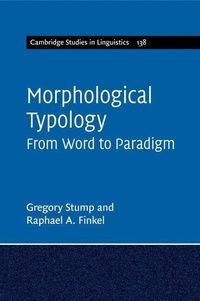
Morphological Typology
From Word to Paradigm
Published on 23. June 2016
Book
Paperback/Softback
428 pages
978-1-316-60477-9 (ISBN)
Description
In this radically new approach to morphological typology, the authors set out new and explicit methods for the typological classification of languages. Drawing on evidence from a diverse range of languages including Chinantec, Dakota, French, Fur, Icelandic, Ngiti and Sanskrit, the authors propose innovative ways of measuring inflectional complexity. Designed to engage graduate students and academic researchers, the book presents opportunities for further investigation. The authors' data sets and the computational tool that they constructed for their analysis are available online, allowing readers to employ them in their own research. Readers can access the online computational tool through www.cambridge.org/stump_finkel.
Reviews / Votes
'A highly interesting new approach to morphological typology based on a formalized measure of the complexity of inflectional systems. An essential contribution to theoretical morphology and to research on linguistic complexity.' Matti Miestamo, Stockholm University 'In this illuminating and timely investigation of inflectional systems, Stump and Finkel combine theoretical rigour with practical implementation, to provide a range of measures of complexity and an original typology.' Greville G. Corbett, University of Surrey 'Periodically a book is published which offers such an original perspective that it seems we have never really understood what we thought we knew: this is likely that kind of book for many readers. The cross-linguistic study of complex morphological systems is establishing the crucial status of words and paradigms in providing insights about natural language organization. With characteristically careful rigor and clarity, Stump and Finkel introduce a new way of analyzing and typologizing inflectional systems. While developing their model would have been enough, the book takes on an even greater dimension as they explicitly explore ways of synthesizing their perspective with recent competing models. Stump and Finkel cause us to pause and consider a new role for morphology in modern linguistic theory. And I suspect that the field will improve, when we do.' Farrell Ackerman, University of California, San DiegoMore details
Series
Language
English
Place of publication
Cambridge
United Kingdom
Target group
Professional and scholarly
Product notice
Paperback (trade)
Illustrations
232 Tables, black and white; 13 Halftones, black and white; 5 Line drawings, black and white
Dimensions
Height: 229 mm
Width: 152 mm
Thickness: 23 mm
Weight
616 gr
ISBN-13
978-1-316-60477-9 (9781316604779)
Copyright in bibliographic data and cover images is held by Nielsen Book Services Limited or by the publishers or by their respective licensors: all rights reserved.
Schweitzer Classification
Other editions
Additional editions
Book
07/2013
Cambridge University Press
€99.90
Shipment within 15-20 days
Persons
Gregory Stump is Professor of Linguistics in the Department of English at the University of Kentucky. Raphael A. Finkel is Professor of Computer Science in the Department of Computer Science at the University of Kentucky.
Content
1. Principal parts; 2. Plats; 3. A typology of principal-part systems; 4. Inflection-class transparency; 5. Grammatically enhanced plats; 6. Impostors and heteroclites; 7. Stems as principal parts; 8. The marginal detraction hypothesis; 9. Inflection classes, implicative relations and morphological theory; 10. Entropy, predictability and predictiveness; 11. The complexity of inflection-class systems; 12. Sensitivity to plat presentation; 13. The Principal-Parts Analyzer.