

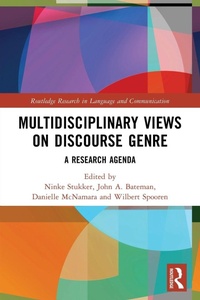
Multidisciplinary Views on Discourse Genre
A Research Agenda
1st Edition
Published on 30. January 2026
Book
Paperback/Softback
234 pages
978-1-032-37162-7 (ISBN)
Description
This collection sets out an innovative research agenda for advancing a multidisciplinary approach to genre, bringing together researchers from a variety of disciplines to enhance our existing understanding of the challenges and opportunities for current and future genre research.
The volume brings together perspectives from across disciplinary borders, including such fields as discourse studies, cognitive studies, computational discourse analysis, and education, to advance genre research into new directions, as it has historically been studied from a mono-disciplinary perspective. The book highlights how fruitful a multidisciplinary approach can be in accounting for the dynamic complexity of the discourse genres that underpin daily life, exploring six broad themes: defining genre; stability and variation; genre and cognition; computational methods; language and literacy development; and genre education. Taken together, the volume makes the case for the value of such an approach in better accounting for the conceptual and empirical complexities of genre and, in turn, serving as a springboard for innovations in genre research.
This book will be of interest to students and scholars in linguistics, discourse studies, discourse psychology, media studies, language and literacy development, and education.
The volume brings together perspectives from across disciplinary borders, including such fields as discourse studies, cognitive studies, computational discourse analysis, and education, to advance genre research into new directions, as it has historically been studied from a mono-disciplinary perspective. The book highlights how fruitful a multidisciplinary approach can be in accounting for the dynamic complexity of the discourse genres that underpin daily life, exploring six broad themes: defining genre; stability and variation; genre and cognition; computational methods; language and literacy development; and genre education. Taken together, the volume makes the case for the value of such an approach in better accounting for the conceptual and empirical complexities of genre and, in turn, serving as a springboard for innovations in genre research.
This book will be of interest to students and scholars in linguistics, discourse studies, discourse psychology, media studies, language and literacy development, and education.
More details
Language
English
Place of publication
Oxford
United Kingdom
Target group
Postgraduate
Illustrations
3 s/w Photographien bzw. Rasterbilder, 17 s/w Zeichnungen, 7 s/w Tabellen, 20 s/w Abbildungen
Dimensions
Height: 229 mm
Width: 152 mm
Thickness: 13 mm
Weight
346 gr
ISBN-13
978-1-032-37162-7 (9781032371627)
Schweitzer Classification
Other editions
Additional editions
Ninke Stukker | John A. Bateman | Danielle McNamara
Multidisciplinary Views on Discourse Genre
A Research Agenda
E-Book
09/2024
1st Edition
Routledge
€60.49
Available for download
Ninke Stukker | John A. Bateman | Danielle McNamara
Multidisciplinary Views on Discourse Genre
A Research Agenda
E-Book
09/2024
1st Edition
Routledge
€60.49
Available for download
Ninke Stukker | John A. Bateman | Danielle McNamara
Multidisciplinary Views on Discourse Genre
A Research Agenda
Book
09/2024
1st Edition
Routledge
€186.10
Shipment within 10-20 days
Persons
Ninke Stukker is Assistant Professor at the Center for Language and Cognition, University of Groningen, the Netherlands.
John A. Bateman is a Full Professor of Applied Linguistics in the English and Linguistics Departments at the University of Bremen, Germany.
Danielle McNamara is Professor of Psychology and Director of the Science of Learning and Educational Technology at Arizona State University, USA.
Wilbert Spooren is Professor of Discourse Studies of Dutch at the Centre for Language Studies, Radboud University, the Netherlands.
John A. Bateman is a Full Professor of Applied Linguistics in the English and Linguistics Departments at the University of Bremen, Germany.
Danielle McNamara is Professor of Psychology and Director of the Science of Learning and Educational Technology at Arizona State University, USA.
Wilbert Spooren is Professor of Discourse Studies of Dutch at the Centre for Language Studies, Radboud University, the Netherlands.
Content
List of Contributors
Acknowledgements
Chapter 1. Introduction
Ninke Stukker, John A. Bateman, Danielle McNamara and Wilbert Spooren
Chapter 2. What is "genre"? Theoretical dimensions for the analysis of genre
John A. Bateman
Chapter 3. Genre beyond boundaries: Towards a definition
John A. Bateman, Vivien Heller, Ilaria Moschini and Maria Grazia Sindoni
Chapter 4. Stability and variation in genre
Barbara De Cock and Wilbert Spooren
Chapter 5. Cognitive perspectives on the role of genre in reading comprehension
Kathryn S. McCarthy, Marco van de Ven, Jacqueline Evers-Vermeul, Eliane Segers and Paul van den Broek
Chapter 6. Computational methods for the analysis of fiction genres
Andreas van Cranenburgh, Laura Allen, Serge Sharoff and Karina van Dalen-Oskam
Chapter 7. Bridging the gap between genre theory and genre education
Ninke Stukker, Tracy Arner, Jacqueline Evers-Vermeul, Vivien Heller, Melanie J. Hof and Moniek Vis
Chapter 8. Looking forward: A research agenda for a multidimensional understanding of genres in discourse
Ninke Stukker, John A. Bateman, Danielle McNamara and Wilbert Spooren
Index
Acknowledgements
Chapter 1. Introduction
Ninke Stukker, John A. Bateman, Danielle McNamara and Wilbert Spooren
Chapter 2. What is "genre"? Theoretical dimensions for the analysis of genre
John A. Bateman
Chapter 3. Genre beyond boundaries: Towards a definition
John A. Bateman, Vivien Heller, Ilaria Moschini and Maria Grazia Sindoni
Chapter 4. Stability and variation in genre
Barbara De Cock and Wilbert Spooren
Chapter 5. Cognitive perspectives on the role of genre in reading comprehension
Kathryn S. McCarthy, Marco van de Ven, Jacqueline Evers-Vermeul, Eliane Segers and Paul van den Broek
Chapter 6. Computational methods for the analysis of fiction genres
Andreas van Cranenburgh, Laura Allen, Serge Sharoff and Karina van Dalen-Oskam
Chapter 7. Bridging the gap between genre theory and genre education
Ninke Stukker, Tracy Arner, Jacqueline Evers-Vermeul, Vivien Heller, Melanie J. Hof and Moniek Vis
Chapter 8. Looking forward: A research agenda for a multidimensional understanding of genres in discourse
Ninke Stukker, John A. Bateman, Danielle McNamara and Wilbert Spooren
Index