

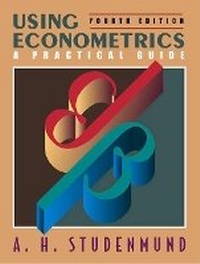
Using Econometrics
A Practical Guide: International Edition
4th Edition
Published on 2. August 2000
Book
Paperback/Softback
656 pages
978-0-321-18899-1 (ISBN)
Description
This revolutionary text covers single-equation linear regression analysis in an easy-to-understand format that emphasizes real-world examples and exercises. This intuitive approach focuses on learning how to use econometrics, not on matrix algebra or calculus proofs. Clear, accessible writing and numerous exercises provide students with a solid understanding of applied econometrics. This new approach is accessible to beginning econometrics students as well as experienced practitioners.
More details
Edition
4th edition
Language
English
Place of publication
United States
Publishing group
Pearson Education (US)
Target group
Professional and scholarly
Dimensions
Height: 234 mm
Width: 191 mm
Thickness: 25 mm
Weight
988 gr
ISBN-13
978-0-321-18899-1 (9780321188991)
Copyright in bibliographic data and cover images is held by Nielsen Book Services Limited or by the publishers or by their respective licensors: all rights reserved.
Schweitzer Classification
Other editions
New editions
Book
06/2005
5th Edition
Pearson
€68.19
Article exhausted; check for reprint
Previous edition

Book
02/1997
3rd Edition
Pearson
€41.00
Article exhausted; check for reprint
Content
I. THE BASIC REGRESSION MODEL.
1. An Overview of Regression Analysis.
2. Ordinary Least Squares.
3. Learning to Use Regression Analysis.
4. The Classical Model.
5. Hypothesis Testing.
II. VIOLATIONS OF THE CLASSICAL ASSUMPTIONS.
6. Specification: Choosing the Independent Variables.
7. Specification: Choosing a Functional Form.
8. Multicollinearity.
9. Serial Correlation.
10. Heteroskedasticity.
11. A Regression User's Handbook.
III. EXTENSIONS OF THE BASIC REGRESSION MODEL.
12. Time-Series Models.
13. Dummy Dependent Variable Techniques.
14. Simultaneous Equations.
15. Forecasting.
16. Statistical Principles.
1. An Overview of Regression Analysis.
2. Ordinary Least Squares.
3. Learning to Use Regression Analysis.
4. The Classical Model.
5. Hypothesis Testing.
II. VIOLATIONS OF THE CLASSICAL ASSUMPTIONS.
6. Specification: Choosing the Independent Variables.
7. Specification: Choosing a Functional Form.
8. Multicollinearity.
9. Serial Correlation.
10. Heteroskedasticity.
11. A Regression User's Handbook.
III. EXTENSIONS OF THE BASIC REGRESSION MODEL.
12. Time-Series Models.
13. Dummy Dependent Variable Techniques.
14. Simultaneous Equations.
15. Forecasting.
16. Statistical Principles.