

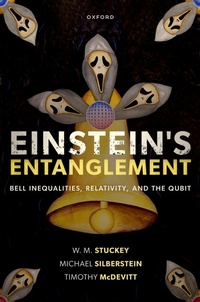
Einstein's Entanglement
Bell Inequalities, Relativity, and the Qubit
Published on 27. August 2024
Book
Hardback
320 pages
978-0-19-891967-4 (ISBN)
Description
Einstein introduced quantum entanglement in 1935 and referred to it as "spooky actions at a distance" because it seemed to conflict with his theory of special relativity. Today, some refer to it as "the greatest mystery in physics" and the 2022 Nobel Prize in Physics was even awarded for experimental confirmation of the "spookiness." While the mystery is experimentally well-established, its solution remains elusive because it is commonly believed that quantum entanglement entails that quantum mechanics is incomplete, that the world works according to "spooky actions at a distance," that causes from the future create effects in the present, that there is "superdeterministic" causal control of experimental procedures, that people can correctly disagree on the outcome of one and the same experiment, and that a single experimental measurement can produce all possible outcomes.
In this book, a rigorous solution to the mystery of quantum entanglement is provided that entails none of those things. The key to this seemingly impossible feat is - to use Einstein's own language - a "principle" explanation that foregoes the need for any "constructive" explanation of quantum entanglement, such as those listed above. Ironically, the proposed principle explanation is Einstein's own relativity principle as grounded in quantum information theory. So contrary to popular belief, quantum mechanics and special relativity are far from inconsistent, as both are a consequence of the exact same relativity principle.
In this book, a rigorous solution to the mystery of quantum entanglement is provided that entails none of those things. The key to this seemingly impossible feat is - to use Einstein's own language - a "principle" explanation that foregoes the need for any "constructive" explanation of quantum entanglement, such as those listed above. Ironically, the proposed principle explanation is Einstein's own relativity principle as grounded in quantum information theory. So contrary to popular belief, quantum mechanics and special relativity are far from inconsistent, as both are a consequence of the exact same relativity principle.
Reviews / Votes
Presents a compelling and interesting novel approach to making sense of quantum mechanics. * Emily Adlam, Chapman University, Orange, California * Mark Stuckey and his co-authors perform a rigorous reconstruction of quantum theory, drawing inspiration from the elegant axiomatic foundations of special relativity in Einstein's Entanglement. At the centre of the authors transformative principle is an information-theoretic interpretation of the quantum state that unravels many counterintuitive aspects of quantum theory in an appealing and natural way. * Caslav Brukner, Science Director of the Institute for Quantum Optics and Quantum Information (IQOQI), Vienna * Einstein's Entanglement is an engaging introduction to all-at-once physics, offering a simple and compelling new axiomatization of quantum mechanics, which demonstrates the power of the all-at-once approach while also revealing intriguing connections with special relativity. * Emily Adlam, Schmid College of Science and Technology, Philosophy and Physics, Chapman University * Stuckey et al. have been doing "all-at-once" physics since before it was cool. Their use of a simple principle, treating past and future in the same manner, looks like a great starting point for making sense of quantum entanglement. * Ken Wharton, Professor of Physics & Astronomy, San Jose State University * Written at a relatively elementary level, this insightful and engaging treatment of quantum entanglement shows how an information-theoretic approach inspired by Einsteinas methodology in the special theory of relativity can demystify what Schroedinger called the characteristic trait of quantum mechanics, making the departure from classical thinking more natural and comprehensible. * Jeffrey Bub, Distinguished University Professor in the Department of Philosophy and the Joint Center for Quantum Information and Computer Science, University of Maryland *More details
Language
English
Place of publication
Oxford
United Kingdom
Target group
College/higher education
Product notice
sewn/stitched
Cloth over boards
Illustrations
83 line illustrations and 2 halftones
Dimensions
Height: 237 mm
Width: 158 mm
Thickness: 25 mm
Weight
688 gr
ISBN-13
978-0-19-891967-4 (9780198919674)
Copyright in bibliographic data and cover images is held by Nielsen Book Services Limited or by the publishers or by their respective licensors: all rights reserved.
Schweitzer Classification
Other editions
Additional editions
W. M. Stuckey | Michael Silberstein | Timothy McDevitt
Einstein's Entanglement
Bell Inequalities, Relativity, and the Qubit
E-Book
10/2024
OUP eBook
€54.99
Available for download
Persons
W. M. Stuckey earned a Ph.D. in physics with a thesis in general relativistic cosmology under Louis Witten at the University of Cincinnati in 1987 and is now a Professor of Physics at Elizabethtown College. In his 36 years there he has taught numerous courses in physics to include quantum mechanics, special relativity, general relativity, and foundations of modern physics. In addition to his work in foundations of quantum mechanics, he has published journal articles on cosmology, dark matter, dark energy, and general relativity.
Michael Silberstein is Professor of Philosophy at Elizabethtown College, Director of the Cognitive Science Program, and a Core Neuroscience Faculty member. His primary research interests are foundations of physics, foundations of cognitive science, and the science of consciousness. He is also interested in how these branches of philosophy and science bear on more general questions of reduction, emergence, and explanation. His two most recent book with OUP are Beyond the Dynamical Universe (2018) and, Emergence in Context (2022), with Robert Bishop and Mark Pexton.
Timothy J. McDevitt earned a PhD in Applied Mathematics from the University of Virginia in 1996 studying the deformations of elastic shells. He has worked in academia for 24 years, but he also spent time in the employment of the US government, and he was a Congressional Fellow in 2021-2022 for the American Association for the Advancement of Science representing the American Statistical Association. Tim especially enjoys interdisciplinary research and he has published articles in cryptology, engineering, math, medicine, philosophy, and physics.
Michael Silberstein is Professor of Philosophy at Elizabethtown College, Director of the Cognitive Science Program, and a Core Neuroscience Faculty member. His primary research interests are foundations of physics, foundations of cognitive science, and the science of consciousness. He is also interested in how these branches of philosophy and science bear on more general questions of reduction, emergence, and explanation. His two most recent book with OUP are Beyond the Dynamical Universe (2018) and, Emergence in Context (2022), with Robert Bishop and Mark Pexton.
Timothy J. McDevitt earned a PhD in Applied Mathematics from the University of Virginia in 1996 studying the deformations of elastic shells. He has worked in academia for 24 years, but he also spent time in the employment of the US government, and he was a Congressional Fellow in 2021-2022 for the American Association for the Advancement of Science representing the American Statistical Association. Tim especially enjoys interdisciplinary research and he has published articles in cryptology, engineering, math, medicine, philosophy, and physics.
Author
Professor of PhysicsProfessor of Physics, Dept of Physics, Elizabethtown College, Pennsylvania
Professor of PhilosophyProfessor of Philosophy, Dept of Philosophy, Elizabethtown College, Pennsylvania
Professor of MathematicsProfessor of Mathematics, Dept of Mathematics, Elizabethtown College, Pennsylvania
Content
Preface
0: Albert's Mysterious Quantum Gloves Experiment
1: Introduction: Nobody Understands Quantum Mechanics
2: The Mystery: Mermin's Device
3: Constructive Responses to Bell's Theorem
4: A Precedent: Special Relativity
5: Einstein's Principle or Reichenbach's?
6: A Principle Response from Quantum Information Theorists
7: Mystery Solved: Oh, the Irony
8: Superquantum Probabilities: Why No PR-Box?
9: 9 What's Really Going On?
9A: Interpreting Quantum Mechanics in a Realist Fashion
9B: Gravity Matters
9C: The Delayed Choice Experiment
9D: Schrodinger's Cat and Wigner's Friend
0: Albert's Mysterious Quantum Gloves Experiment
1: Introduction: Nobody Understands Quantum Mechanics
2: The Mystery: Mermin's Device
3: Constructive Responses to Bell's Theorem
4: A Precedent: Special Relativity
5: Einstein's Principle or Reichenbach's?
6: A Principle Response from Quantum Information Theorists
7: Mystery Solved: Oh, the Irony
8: Superquantum Probabilities: Why No PR-Box?
9: 9 What's Really Going On?
9A: Interpreting Quantum Mechanics in a Realist Fashion
9B: Gravity Matters
9C: The Delayed Choice Experiment
9D: Schrodinger's Cat and Wigner's Friend