

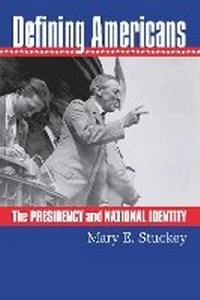
Defining Americans
The Presidency and National Identity
Published on 17. March 2023
Book
Paperback/Softback
424 pages
978-0-7006-3520-7 (ISBN)
Description
Winner: Bruce E. Gronbeck Political Communication AwardWinner: APSA Presidents and Executive Politics Legacy Award
Andrew Jackson spoke to Americans in ways that reflected the concerns of a young nation. Grover Cleveland helped citizens redefine themselves after the havoc of the Civil War era. FDR confronted widespread hardship with hope and determination, while Eisenhower spoke to our fears of the Communist menace. Throughout our history, presidents by their very utterances have shaped our sense of who we are as Americans.
As Mary Stuckey observes, presidents embrace, articulate, and reinvigorate our sense of national identity. They define who Americans are-often by declaring who they aren't. In this book, she shows how presidential speech has served to broaden the American political community over the past two centuries while at the same time excluding others.
Ranging broadly from Andrew Jackson to Bill Clinton and George W. Bush, Stuckey demonstrates how presidents accomplish the dual enactment of inclusion and exclusion through their rhetorical and political choices. Our early leaders were preoccupied with balancing the growing nation; later presidents were concerned with the nature and definitions of citizenship. By examining the political speeches of presidents exemplifying distinctly different circumstances, she presents a series of snapshots which, when taken together, reveal both the continuity and the changes in our national self-understanding.
Ambitious and sweeping, Stuckey's work documents the tactics that have naturalized and legitimated inclusion and exclusion, tracing the progress of groups such as women and African Americans from political invisibility to partial visibility and eventual inclusion. She also shows how the terms of inclusion have varied with changing political winds, helping us understand how depictions of the powerless by the powerful reflect and influence the status of various groups.
Stuckey's analysis shows how presidents use language rooted in their times and circumstances to frame and influence contemporary definitions of citizenship. A provocative book that documents the changes in our understanding of who is and who isn't one of "us," Defining Americans reveals that all presidents draw upon the same set of national ideals, values, and events-but not all use those ideas in precisely the same ways.
Andrew Jackson spoke to Americans in ways that reflected the concerns of a young nation. Grover Cleveland helped citizens redefine themselves after the havoc of the Civil War era. FDR confronted widespread hardship with hope and determination, while Eisenhower spoke to our fears of the Communist menace. Throughout our history, presidents by their very utterances have shaped our sense of who we are as Americans.
As Mary Stuckey observes, presidents embrace, articulate, and reinvigorate our sense of national identity. They define who Americans are-often by declaring who they aren't. In this book, she shows how presidential speech has served to broaden the American political community over the past two centuries while at the same time excluding others.
Ranging broadly from Andrew Jackson to Bill Clinton and George W. Bush, Stuckey demonstrates how presidents accomplish the dual enactment of inclusion and exclusion through their rhetorical and political choices. Our early leaders were preoccupied with balancing the growing nation; later presidents were concerned with the nature and definitions of citizenship. By examining the political speeches of presidents exemplifying distinctly different circumstances, she presents a series of snapshots which, when taken together, reveal both the continuity and the changes in our national self-understanding.
Ambitious and sweeping, Stuckey's work documents the tactics that have naturalized and legitimated inclusion and exclusion, tracing the progress of groups such as women and African Americans from political invisibility to partial visibility and eventual inclusion. She also shows how the terms of inclusion have varied with changing political winds, helping us understand how depictions of the powerless by the powerful reflect and influence the status of various groups.
Stuckey's analysis shows how presidents use language rooted in their times and circumstances to frame and influence contemporary definitions of citizenship. A provocative book that documents the changes in our understanding of who is and who isn't one of "us," Defining Americans reveals that all presidents draw upon the same set of national ideals, values, and events-but not all use those ideas in precisely the same ways.
Reviews / Votes
"Presidents claim to speak for 'we the people.' Stuckey's bold and insightful book deconstructs the rhetoric through which presidents have excluded and even vilified some Americans even as they have included and acclaimed others. Through fascinating case studies of some of our best and worst presidents, Stuckey compels us to confront the powerful part that all have played in defining who we are."-Bruce Miroff, author of Icons of Democracy: American Leaders as Heroes, Aristocrats, Dissenters, and Democrats"Students of history, politics, and rhetoric will profit from this insightful study of the nexus between language and culture."-David Zarefsky, author of Lincoln, Douglas, and Slavery: In the Crucible of Public Debate
More details
Language
English
Place of publication
Kansas
United States
Target group
Professional and scholarly
Dimensions
Height: 229 mm
Width: 152 mm
Thickness: 22 mm
Weight
272 gr
ISBN-13
978-0-7006-3520-7 (9780700635207)
Copyright in bibliographic data and cover images is held by Nielsen Book Services Limited or by the publishers or by their respective licensors: all rights reserved.
Schweitzer Classification
Other editions
Additional editions
E-Book
02/2024
University Press of Kansas
€36.99
Available for download
Content
Acknowledgments
Introduction: Presidential Rhetoric and National Identity
1. Land, Citizenship, and National Identity in Jackson's America
2. Temperance, Character, and Race in the Antebellum United States
3. The Business of Government during the Democratic Interregnum of Grover Cleveland, 1885-1889
4. Establishing a Transcendent International Order under Woodrow Wilson, 1913-1921
5. Balancing the Nation: Brokering FDR's Economic Union, 1932-1940
6. Citizenship Contained: Domesticating God, Family, and Country during the Eisenhower Years
7. Managing Diversity in a Fragmented Polity: The Post-Cold War World George H.W. Bush
Conclusion: Choosing Our National Identity
Notes
Index
Introduction: Presidential Rhetoric and National Identity
1. Land, Citizenship, and National Identity in Jackson's America
2. Temperance, Character, and Race in the Antebellum United States
3. The Business of Government during the Democratic Interregnum of Grover Cleveland, 1885-1889
4. Establishing a Transcendent International Order under Woodrow Wilson, 1913-1921
5. Balancing the Nation: Brokering FDR's Economic Union, 1932-1940
6. Citizenship Contained: Domesticating God, Family, and Country during the Eisenhower Years
7. Managing Diversity in a Fragmented Polity: The Post-Cold War World George H.W. Bush
Conclusion: Choosing Our National Identity
Notes
Index