

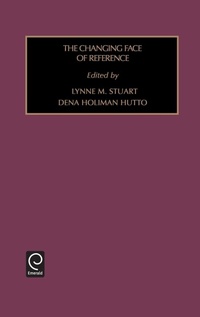
Changing Face of Reference
Will be published approx. on 11. March 1997
Book
Hardback
260 pages
978-0-7623-0217-8 (ISBN)
Description
This volume covers the changing expectations for both the librarian and for the service user. How has the world changed, how have students changed and how can the reference library cope? The changing user is viewed in terms of particular cultural needs and also the "Generation X" factor. Topics covered are; remote access; instructional multimedia; software; courseware; networked resources; and designing custom computer applications.
More details
Series
Language
English
Place of publication
United States
Publishing group
Emerald Publishing Limited
Target group
College/higher education
Professional and scholarly
Dimensions
Height: 240 mm
Width: 161 mm
Thickness: 19 mm
Weight
558 gr
ISBN-13
978-0-7623-0217-8 (9780762302178)
Copyright in bibliographic data and cover images is held by Nielsen Book Services Limited or by the publishers or by their respective licensors: all rights reserved.
Schweitzer Classification
Content
Introduction: the changing face of reference, Lynne M. Stuart and Dena Hutto. Part 1 Changing approaches to reference service: the changing face of reference - a history of the future, Inga H. Barnello; the reference service encounter - what patrons and librarians can expect, Gary B. Thompson; combining disparate units, building effective teams, integrating federal documents - a case study at Illinois State University, Barbara B. Alexander et al. Part 2 Reference service for changing user populations: the role of reference services in a multicultural university library, Maria de Jesus Ayala-Schueneman and Roberta Pitts; accessing library materials about Mexican Americans, Robert L. Mowery; special students, special needs, special reference, Mollie D. Lawson; the changing face of the college student - the impact of generation X on reference and instructional services, Catherine A. Lee. Part 3 Reference service beyond library walls: understanding remote access and its importance for reference services, Pamela Snelson; support services for virtual library users, Sally Kalin; holding library office hours in academic departments - reaching out to faculty, Lucia Snowhill; telephone reference - division of labour via online network, Kathryn Robinson and Sally Fry. Part 4 The impact of changing technologies on reference service: Internet use patterns and the scholarly research process, Vivienne Monty and P. Warren-WEnk; references services in higher education - instructional multimedia, software, courseware and networked resources, Carol Ann Wright; designing custom computer applications for reference, Stephen Sottong; developing electronic library services at the University of Northern Colorado, Lisa Blankenship and Jane Smith.