

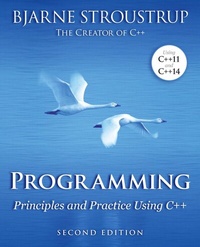
Programming: Principles and Practice Using C++
Principles and Practice Using C++
2nd Edition
Published on 5. June 2014
Book
Paperback/Softback
1312 pages
978-0-321-99278-9 (ISBN)
Description
An Introduction to Programming by the Inventor of C++
Preparation for Programming in the Real World
The book assumes that you aim eventually to write non-trivial programs, whether for work in software development or in some other technical field.
Focus on Fundamental Concepts and Techniques
The book explains fundamental concepts and techniques in greater depth than traditional introductions. This approach will give you a solid foundation for writing useful, correct, maintainable, and efficient code.
Programming with Today's C++ (C++11 and C++14)
The book is an introduction to programming in general, including object-oriented programming and generic programming. It is also a solid introduction to the C++ programming language, one of the most widely used languages for real-world software. The book presents modern C++ programming techniques from the start, introducing the C++ standard library and C++11 and C++14 features to simplify programming tasks.
For BeginnersAnd Anyone Who Wants to Learn Something New
The book is primarily designed for people who have never programmed before, and it has been tested with many thousands of first-year university students. It has also been extensively used for self-study. Also, practitioners and advanced students have gained new insight and guidance by seeing how a master approaches the elements of his art.
Provides a Broad View
The first half of the book covers a wide range of essential concepts, design and programming techniques, language features, and libraries. Those will enable you to write programs involving input, output, computation, and simple graphics. The second half explores more specialized topics (such as text processing, testing, and the C programming language) and provides abundant reference material. Source code and support supplements are available from the author's website.
Preparation for Programming in the Real World
The book assumes that you aim eventually to write non-trivial programs, whether for work in software development or in some other technical field.
Focus on Fundamental Concepts and Techniques
The book explains fundamental concepts and techniques in greater depth than traditional introductions. This approach will give you a solid foundation for writing useful, correct, maintainable, and efficient code.
Programming with Today's C++ (C++11 and C++14)
The book is an introduction to programming in general, including object-oriented programming and generic programming. It is also a solid introduction to the C++ programming language, one of the most widely used languages for real-world software. The book presents modern C++ programming techniques from the start, introducing the C++ standard library and C++11 and C++14 features to simplify programming tasks.
For BeginnersAnd Anyone Who Wants to Learn Something New
The book is primarily designed for people who have never programmed before, and it has been tested with many thousands of first-year university students. It has also been extensively used for self-study. Also, practitioners and advanced students have gained new insight and guidance by seeing how a master approaches the elements of his art.
Provides a Broad View
The first half of the book covers a wide range of essential concepts, design and programming techniques, language features, and libraries. Those will enable you to write programs involving input, output, computation, and simple graphics. The second half explores more specialized topics (such as text processing, testing, and the C programming language) and provides abundant reference material. Source code and support supplements are available from the author's website.
More details
Other editions
New editions
Book
09/2024
3rd Edition
Addison Wesley
€74.50
Shipment within 15-20 days
Additional editions
E-Book
06/2014
2nd Edition
Addison Wesley
€69.99
Available for download
E-Book
05/2014
2nd Edition
Addison Wesley
from
€44.40
Available for download
Previous edition
Book
12/2008
Addison Wesley
€59.41
Article exhausted; check for reprint
Person
Bjarne Stroustrup is the designer and original implementer of C++, as well as the author of The C++ Programming Language, Fourth Edition (Addison-Wesley, 2013), and A Tour of C++ (Addison-Wesley, 2014) and many popular and academic publications. Dr. Stroustrup is a managing director at Morgan Stanley in New York City, as well as a visiting professor at Columbia University and a Research distinguished professor at Texas A&M University. He is a member of the U.S. National Academy of Engineering, an IEEE Fellow, and an ACM fellow. His research interests include distributed systems, design, programming techniques, software development tools, and programming languages. He is actively involved in the ISO standardization of C++.
Content
- Chapter 0: Notes to the Reader
- Chapter 1: Computers, People, and Programming
- Chapter 2: Hello, World!
- Chapter 3: Objects, Types, and Values
- Chapter 4: Computation
- Chapter 5: Errors
- Chapter 6: Writing a Program
- Chapter 7: Completing a Program
- Chapter 8: Technicalities: Functions, etc.
- Chapter 9: Technicalities: Classes, etc
- Chapter 10: Input and Output Streams
- Chapter 11: Customizing Input and Output
- Chapter 12: A Display Model
- Chapter 13: Graphics Classes
- Chapter 14: Graphics Class Design
- Chapter 15: Graphing Functions and Data
- Chapter 16: Graphical User Interfaces
- Chapter 17: Vector and Free Store
- Chapter 18: Vectors and Arrays
- Chapter 19: Vector, Templates, and Exceptions
- Chapter 20: Containers and Iterators
- Chapter 21: Algorithms and Maps
- Chapter 22: Ideals and History
- Chapter 23: Text Manipulation
- Chapter 24: Numerics
- Chapter 25: Embedded Systems Programming
- Chapter 26: Testing
- Chapter 27: The C Programming Language