

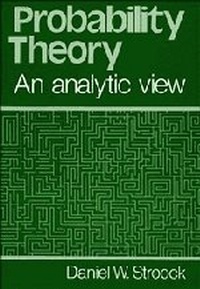
Probability Theory, an Analytic View
Published on 28. January 1994
Book
Hardback
528 pages
978-0-521-43123-1 (ISBN)
Description
This revised edition is suitable for a first-year graduate course on probability theory. It is intended for students with a good grasp of introductory, undergraduate probability and a reasonably sophisticated introduction to modern analysis who now want to learn what these two topics have to say about each other. By modern standards the topics treated here are classical and the techniques used far-ranging. No attempt has been made to present the subject as a monolithic structure resting on a few basic principles. The first part of the book deals with independent random variables, Central Limit phenomena, the general theory of weak convergence and several of its applications, as well as elements of both the Gaussian and Markovian theory of measures on function space. The introduction of conditional expectation values is postponed until the second part of the book where it is applied to the study of martingales. This section also explores the connection between martingales and various aspects of classical analysis and the connections between Wiener's measure and classical potential theory.
More details
Language
English
Place of publication
Cambridge
United Kingdom
Target group
Professional and scholarly
Dimensions
Height: 257 mm
Width: 184 mm
Thickness: 35 mm
Weight
1080 gr
ISBN-13
978-0-521-43123-1 (9780521431231)
Copyright in bibliographic data and cover images is held by Nielsen Book Services Limited or by the publishers or by their respective licensors: all rights reserved.
Schweitzer Classification
Other editions
New editions
Book
12/2010
2nd Edition
Cambridge University Press
€134.86
Article exhausted; check for reprint
Daniel W. Stroock
Probability Theory, an Analytic View
Book
01/2000
Cambridge University Press
€52.08
Article exhausted; check for reprint
Person
Content
1. Sums of Independent random variables; 2. The central limit theorem; 3. Convergence of measures, Infinite divisibility, and processes with independent increments; 4. A celebration of Wiener's measure; 5. Conditioning and Martingales; 6. Some applications of Martingale theory; 7. Continuous Martingales and elementary diffiusion theory; 8. A little classical potential theory.