

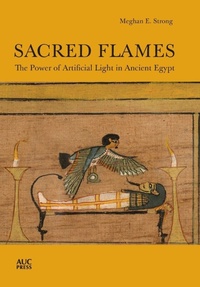
Sacred Flames
The Power of Artificial Light in Ancient Egypt
Published on 27. April 2021
Book
Hardback
272 pages
978-1-64903-000-9 (ISBN)
Description
A fascinating examination of the role of lighting in ancient Egyptian culture
Artificial lighting is one of the earliest tools used by humans. By the time we began to paint cave walls, we were producing lamps consisting of an illuminant, a fat or oil, and a wick, such as a strip of fabric or a piece of reed or wood.
Drawing on archaeological, textual, and iconographic sources, Meghan Strong examines the symbolic part that artificial lighting played in religious, economic, and social spheres in ancient Egyptian culture. From the earliest identifiable examples of lighting devices to the infiltration of Hellenistic lamps in the seventh century BC, Sacred Flames explores the sensory experience of illumination in ancient Egypt, the shadows, sheen, color, and movement that resulted when lighting interacted with different spaces and surfaces. The soft, flickering light from lamps or hand-held lighting devices not only facilitated the navigation of darkened environments, such as allowing workers to see in underground chambers in the Valley of the Kings, or served as temple offerings, but also impacted upon the viewer's perception of a space and the objects within it.
Sacred Flames illustrates the active role that lighting played in Egyptian society, providing a richer understanding of the symbolic and social value of artificial light and the role of lighting in ritual space and performance in ancient Egyptian culture, while serving as a case study of the broader impact of artificial light in the ancient world.
Artificial lighting is one of the earliest tools used by humans. By the time we began to paint cave walls, we were producing lamps consisting of an illuminant, a fat or oil, and a wick, such as a strip of fabric or a piece of reed or wood.
Drawing on archaeological, textual, and iconographic sources, Meghan Strong examines the symbolic part that artificial lighting played in religious, economic, and social spheres in ancient Egyptian culture. From the earliest identifiable examples of lighting devices to the infiltration of Hellenistic lamps in the seventh century BC, Sacred Flames explores the sensory experience of illumination in ancient Egypt, the shadows, sheen, color, and movement that resulted when lighting interacted with different spaces and surfaces. The soft, flickering light from lamps or hand-held lighting devices not only facilitated the navigation of darkened environments, such as allowing workers to see in underground chambers in the Valley of the Kings, or served as temple offerings, but also impacted upon the viewer's perception of a space and the objects within it.
Sacred Flames illustrates the active role that lighting played in Egyptian society, providing a richer understanding of the symbolic and social value of artificial light and the role of lighting in ritual space and performance in ancient Egyptian culture, while serving as a case study of the broader impact of artificial light in the ancient world.
Reviews / Votes
"Through the analysis and contextualization of numerous types of lighting devices, Meghan Strong offers a multi-faceted, innovative method for decoding ancient Egypt that has not been previously explored in depth. Out of metaphorical darkness emerges compelling new research that brightens our knowledge of ancient Egyptian culture-of commoners and kings, the living and the dead, the sacred and the profane. Sacred Flames makes a substantial contribution to Egyptology, lychnology, the archaeology of the night, the anthropology of luminosity, and studies of ideology and inequality."- Nan Gonlin, Bellevue College, Washington"Meghan Strong's innovative research into artificial light in ancient Egypt blends representational, textual, and experimental evidence. She explores the way in which flames extended the daytime, provided protection in the night world, and enhanced and stimulated color intensity. From oils to wicks, from dark structures to the landscape, this book truly throws light on an aspect of Egypt that has not been previously studied in such an exciting and holistic way." - Penny Wilson, Durham University
"Original, compellingly argued, and beautifully written, Meghan Strong reminds us that for most of human history, people have lived without electric lights. With this important book, she fills a historiographic lacuna in studies of ancient Egyptian uses of light, both natural and artificial. Her perspectives range from the concrete and practical (including personal experimentation), to the 'Egyptian lightscape,' the sensorium, time, cost, social status, ritual, and decorum, among others. This fresh and transdisciplinary work will be relevant for years to come."-Elizabeth Bolman, Case Western Reserve University
"A very welcome study. Highly recommended!"-Kent Weeks
More details
Language
English
Place of publication
United States
Product notice
With printed dust jacket
Illustrations
51 b&w
Dimensions
Height: 233 mm
Width: 159 mm
Thickness: 24 mm
Weight
564 gr
ISBN-13
978-1-64903-000-9 (9781649030009)
Copyright in bibliographic data and cover images is held by Nielsen Book Services Limited or by the publishers or by their respective licensors: all rights reserved.
Schweitzer Classification
Other editions
Additional editions
E-Book
04/2021
Princeton University Press
€57.99
Available for download
Person
Meghan E. Strong is an archaeologist and art historian whose research incorporates sensory archaeology, ritual performance, material cultures studies, and lychnology (the study of ancient lighting devices). She is co-director of the Nuri Archaeological Expedition in Sudan and splits her academic time between the Cleveland Museum of Natural History and Case Western Reserve University.
Content
List of Figures
Acknowledgments
List of Abbreviations
Introduction
Chapter One. The Archaeology of Light
Chapter Two. Artificial Lighting in Context
Chapter Three. The Language of Light
Chapter Four. Offering Light
Chapter Five. The Power of Light
Chapter Six. Accessing the Ancient Egyptian Lightscape
Appendix One. Lighting Devices
Appendix Two. Theban Tombs with Light-offering Scenes
Notes
Bibliography
Index
Acknowledgments
List of Abbreviations
Introduction
Chapter One. The Archaeology of Light
Chapter Two. Artificial Lighting in Context
Chapter Three. The Language of Light
Chapter Four. Offering Light
Chapter Five. The Power of Light
Chapter Six. Accessing the Ancient Egyptian Lightscape
Appendix One. Lighting Devices
Appendix Two. Theban Tombs with Light-offering Scenes
Notes
Bibliography
Index