

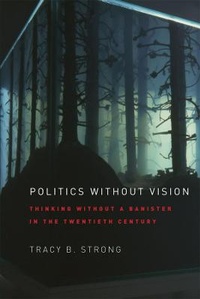
Politics without Vision
Thinking without a Banister in the Twentieth Century
Published on 20. April 2012
Book
Hardback
424 pages
978-0-226-77746-7 (ISBN)
Description
From Plato through the nineteenth century, the West could draw on comprehensive political visions to guide government and society. Now, for the first time in more than two thousand years, Tracy B. Strong contends, we have lost our foundational supports. In the words of Hannah Arendt, the state of political thought in the twentieth and twenty-first centuries has left us effectively "thinking without a banister." "Politics without Vision" takes up the work of seven influential thinkers, each of whom attempted to construct a political solution to this problem: Nietzsche, Weber, Freud, Lenin, Schmitt, Heidegger, and Arendt. None of these theorists were liberals nor, excepting possibly Arendt, were they democrats-and some might even be said to have served as handmaidens to totalitarianism. And all to a greater or lesser extent shared the common conviction that the institutions and practices of liberalism are inadequate to the demands and stresses of the present time. In examining their thought, Strong acknowledges the political evil that some of their ideas served to foster but argues that these were not necessarily the only paths their explorations could have taken.
By uncovering the turning points in their thought - and the paths not taken - Strong strives to develop a political theory that can avoid, and perhaps help explain, the mistakes of the past while furthering the democratic impulse. Confronting the widespread belief that political thought is on the decline, Strong puts forth a brilliant and provocative counterargument that in fact it has endured - without the benefit of outside support. A compelling rendering of contemporary political theory, "Politics without Vision" is sure to provoke discussion among scholars in many fields.
By uncovering the turning points in their thought - and the paths not taken - Strong strives to develop a political theory that can avoid, and perhaps help explain, the mistakes of the past while furthering the democratic impulse. Confronting the widespread belief that political thought is on the decline, Strong puts forth a brilliant and provocative counterargument that in fact it has endured - without the benefit of outside support. A compelling rendering of contemporary political theory, "Politics without Vision" is sure to provoke discussion among scholars in many fields.
Reviews / Votes
"An outstanding study of twentieth-century political thought, conceptually challenging but accessibly written. Tracy B. Strong's unmistakable voice is at once lyrical and sober, and Politics without Vision is erudite and illuminating at every turn." -Patchen Markell, University of Chicago "This is an important book that has needed to be written, that Tracy B. Strong is perhaps uniquely positioned to write, and that some of us have been waiting for him to write for a long time. He does so expertly and knowledgeably with an astonishing grasp of a rich variety of texts." -Joshua Foa Dienstag, University of California, Los Angeles"More details
Language
English
Place of publication
Chicago
United States
Publishing group
The University of Chicago Press
Target group
Professional and scholarly
Dimensions
Height: 24 mm
Width: 16 mm
Thickness: 3 mm
Weight
709 gr
ISBN-13
978-0-226-77746-7 (9780226777467)
Copyright in bibliographic data and cover images is held by Nielsen Book Services Limited or by the publishers or by their respective licensors: all rights reserved.
Schweitzer Classification
Other editions
Additional editions
E-Book
03/2020
University of Chicago Press
€18.18
Available for download
Person
Tracy B. Strong is distinguished professor in the Department of Political Science at the University of California, San Diego. He is a former editor of Political Theory and the author or editor of many books, including Friedrich Nietzsche and the Politics of Transfiguration, Jean-Jacques Rousseau and the Politics of the Ordinary, and The One and the Many: Ethical Pluralism in Contemporary Perspectives.