

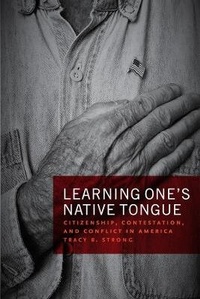
Learning One's Native Tongue
Citizenship, Contestation, and Conflict in America
Published on 5. September 2019
Book
Paperback/Softback
312 pages
978-0-226-62322-1 (ISBN)
Description
Citizenship is much more than the right to vote. It is a collection of political capacities constantly up for debate. From Socrates to contemporary American politics, the question of what it means to be an authentic citizen is an inherently political one.
With Learning One's Native Tongue, Tracy B. Strong explores the development of the concept of American citizenship and what it means to belong to this country,
starting with the Puritans in the seventeenth century and continuing to the present day. He examines the conflicts over the meaning of citizenship means in the writings and speeches of prominent thinkers and leaders ranging from John Winthrop and Roger Williams to Thomas Jefferson, Nathaniel Hawthorne, Abraham Lincoln, Frederick Douglass, and Franklin Roosevelt, among many others who have participated in these important cultural and political debates. The criteria that define what being a citizen entails change over time and in response to historical developments, and they are thus also often the source of controversy and conflict, as with voting rights for women and African Americans. Strong looks closely at these conflicts and the ensuing changes in the conception of citizenship, paying attention to what difference each change makes and what each particular conception entails socially and politically.
With Learning One's Native Tongue, Tracy B. Strong explores the development of the concept of American citizenship and what it means to belong to this country,
starting with the Puritans in the seventeenth century and continuing to the present day. He examines the conflicts over the meaning of citizenship means in the writings and speeches of prominent thinkers and leaders ranging from John Winthrop and Roger Williams to Thomas Jefferson, Nathaniel Hawthorne, Abraham Lincoln, Frederick Douglass, and Franklin Roosevelt, among many others who have participated in these important cultural and political debates. The criteria that define what being a citizen entails change over time and in response to historical developments, and they are thus also often the source of controversy and conflict, as with voting rights for women and African Americans. Strong looks closely at these conflicts and the ensuing changes in the conception of citizenship, paying attention to what difference each change makes and what each particular conception entails socially and politically.
More details
Language
English
Place of publication
Chicago
United States
Publishing group
The University of Chicago Press
Product notice
Paperback (trade)
Unsewn / adhesive bound
Dimensions
Height: 226 mm
Width: 152 mm
Thickness: 20 mm
Weight
481 gr
ISBN-13
978-0-226-62322-1 (9780226623221)
Copyright in bibliographic data and cover images is held by Nielsen Book Services Limited or by the publishers or by their respective licensors: all rights reserved.
Schweitzer Classification
Other editions
Additional editions
Strong Tracy B. Strong
Learning One's Native Tongue
Citizenship, Contestation, and Conflict in America
E-Book
11/2019
1st Edition
University of Chicago Press
from
€27.60
Available for download
Person
Tracy B. Strong is professor of political theory and philosophy at the University of Southampton, UK, and distinguished professor, emeritus, in the Department of Political Science at the University of California, San Diego. He is a former editor of Political Theory and the author or editor of many books, including, most recently, Politics without Vision.