

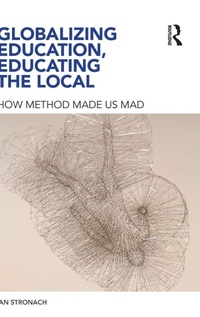
Globalizing Education, Educating the Local
How Method Made us Mad
1st Edition
Published on 4. December 2009
Book
Hardback
230 pages
978-0-415-43111-8 (ISBN)
Description
This book offers a critical and deconstructive account of global discourses on education, arguing that these overblown 'hypernarratives' are neither economically, technically nor philosophically defensible. Nor even sane. Their 'mythic economic instrumentalism' mimic rather than meet the economic needs of global capitalism in ways that the Crash of 2008 brings into vivid disarray. They reduce national education to the same 'hollowed out' state as national capitalisms, subject to global pseudo-accountancy and fads. The book calls for a philosophical and methodological revolution, arguing for more transformative narratives that remodel qualitative inquiry, particularly in addressing a more performative rather than representative ideal.
The first part of the book aims to critique, deconstruct and satirise contemporary assumptions about educational achievement and outputs, the nature of contemporary educational discourses, and the nature of the professionalism that sustain them. The second part offers innovative postmodernist ways of reconstructing a theory and methodology that aims at 'educating the local' rather than succumbing to the fantasies of the universal.
This is a very timely book in that the economic crisis re-exposes the mythic nature of education-economic linkages, putting discourses prefaced on such 'connections' into parallel crisis. Our global educational discourses have also crashed, and new futures need urgently to be found. Such a 'turnaround' is both proposed and argued for. The book will appeal to a wide range of readers who are committed to educational and cultural change, and who are interested in a new politics of education. It will have an immediate relevance and appeal in the UK, USA, Australia and New Zealand in particular.
The first part of the book aims to critique, deconstruct and satirise contemporary assumptions about educational achievement and outputs, the nature of contemporary educational discourses, and the nature of the professionalism that sustain them. The second part offers innovative postmodernist ways of reconstructing a theory and methodology that aims at 'educating the local' rather than succumbing to the fantasies of the universal.
This is a very timely book in that the economic crisis re-exposes the mythic nature of education-economic linkages, putting discourses prefaced on such 'connections' into parallel crisis. Our global educational discourses have also crashed, and new futures need urgently to be found. Such a 'turnaround' is both proposed and argued for. The book will appeal to a wide range of readers who are committed to educational and cultural change, and who are interested in a new politics of education. It will have an immediate relevance and appeal in the UK, USA, Australia and New Zealand in particular.
More details
Language
English
Place of publication
London
United Kingdom
Publishing group
Taylor & Francis Ltd
Target group
College/higher education
Illustrations
9 s/w Photographien bzw. Rasterbilder, 2 s/w Zeichnungen, 2 s/w Tabellen
2 Tables, black and white; 2 Line drawings, black and white; 9 Halftones, black and white
Dimensions
Height: 240 mm
Width: 161 mm
Thickness: 18 mm
Weight
529 gr
ISBN-13
978-0-415-43111-8 (9780415431118)
Copyright in bibliographic data and cover images is held by Nielsen Book Services Limited or by the publishers or by their respective licensors: all rights reserved.
Schweitzer Classification
Other editions
Additional editions
Book
05/2011
1st Edition
Routledge
€69.30
Shipment within 15-20 days
E-Book
12/2009
Routledge
€63.49
Available for download
E-Book
12/2009
Routledge
€63.49
Available for download
Person
Ian Stronach is Professor of Education at the Faculty of Education, Community and Leisure at Liverpool John Moores University, UK.
Content
1. Introduction to the Global Knowledge Economy in Education 2. Economic instrumentalism in the global economy 3. Disordered dynamics of educational discourses 4. Constructing pathological categories in education 5. Professional identities in the postmodern 6. Philosophies of difference, and the opening of a new political agenda 7. Education evaluation reconsidered 8. The educational evaluation of Summerhill school: progressivism versus the audit culture 9. Action research reconsidered 10. Ways of going on: some futures for qualitative research