


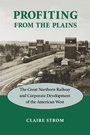
Profiting from the Plains
The Great Northern Railway and Corporate Development of the American West
Published on 1. September 2003
Book
Hardback
240 pages
978-0-295-98348-6 (ISBN)
Description
"Profiting from the Plains" looks at two inextricably linked historical movements in the United States: the westward expansion of the great Northern Railway and the agricultural development of the northern plains. Claire Strom explores the persistent, idiosyncratic attempts by the Great Northern to boost agricultural production along its rail routes from St. Paul to Seattle between 1878 and 1917. Lacking a federal land grant, the Great Northern could not make money through land sales like other railways. It had to rely on haulage to make a profit, and the greatest potential for increasing haulage lay in farming. The energetic and charismatic owner of the Great Northern Railway, James J. Hill, spearheaded most of the initiatives undertaken by his corporation to boost agricultural production. He tried, often unsuccessfully, to persuade farmers of the profitability of his methods, which were largely based on his personal farming experience. When Hill's initial efforts to increase haulage failed, he shifted his focus to working with outside agencies and institutions, often providing them with the funding to pursue projects he hoped would profit his railroad.
At the time, state and federal agencies were also promoting agricultural development through irrigation, conservation, and dryland farming, but their agendas often clashed with those of the Great Northern Railway. Because Hill failed to grasp the extent to which politicians' goals differed from those of the railroad, his use of federal expertise to promote agricultural change often backfired. But despite these obstacles, the railroad magnate ironically remained among the last defenders of the small-scale farmer modelled on Jeffersonian idealism. This fascinating story of railroad politics and development ties into themes of corporate and federal sponsorship, which are increasingly recognized as fundamental to western history. As the first scholarly examination of James J. Hill's agricultural enterprises, "Profiting from the Plains" makes an important contribution to the biography of the popular and controversial Hill, as well as to western and environmental history. Claire Strom is assistant professor of history, North Dakota State University, Fargo.
At the time, state and federal agencies were also promoting agricultural development through irrigation, conservation, and dryland farming, but their agendas often clashed with those of the Great Northern Railway. Because Hill failed to grasp the extent to which politicians' goals differed from those of the railroad, his use of federal expertise to promote agricultural change often backfired. But despite these obstacles, the railroad magnate ironically remained among the last defenders of the small-scale farmer modelled on Jeffersonian idealism. This fascinating story of railroad politics and development ties into themes of corporate and federal sponsorship, which are increasingly recognized as fundamental to western history. As the first scholarly examination of James J. Hill's agricultural enterprises, "Profiting from the Plains" makes an important contribution to the biography of the popular and controversial Hill, as well as to western and environmental history. Claire Strom is assistant professor of history, North Dakota State University, Fargo.
More details
Language
English
Place of publication
Seattle
United States
Target group
Professional and scholarly
Illustrations
30 photos
Dimensions
Height: 229 mm
Width: 152 mm
Weight
499 gr
ISBN-13
978-0-295-98348-6 (9780295983486)
Copyright in bibliographic data is held by Nielsen Book Services Limited or its licensors: all rights reserved.
Schweitzer Classification
Other editions
Additional editions
Claire M. Strom
Profiting from the Plains
The Great Northern Railway and Corporate Development of the American West
E-Book
10/2011
1st Edition
University of Washington Press
€29.49
Available for download