

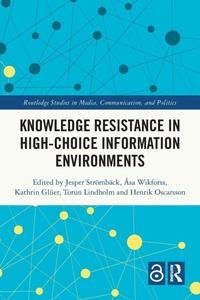
Knowledge Resistance in High-Choice Information Environments
1st Edition
Published on 29. January 2024
Book
Paperback/Softback
290 pages
978-0-367-62928-1 (ISBN)
Description
This book offers a truly interdisciplinary exploration of our patterns of engagement with politics, news, and information in current high-choice information environments. Putting forth the notion that high-choice information environments may contribute to increasing misperceptions and knowledge resistance rather than greater public knowledge, the book offers insights into the processes that influence the supply of misinformation and factors influencing how and why people expose themselves to and process information that may support or contradict their beliefs and attitudes.
A team of authors from across a range of disciplines address the phenomena of knowledge resistance and its causes and consequences at the macro- as well as the micro-level. The chapters take a philosophical look at the notion of knowledge resistance, before moving on to discuss issues such as misinformation and fake news, psychological mechanisms such as motivated reasoning in processes of selective exposure and attention, how people respond to evidence and fact-checking, the role of political partisanship, political polarization over factual beliefs, and how knowledge resistance might be counteracted.
This book will have a broad appeal to scholars and students interested in knowledge resistance, primarily within philosophy, psychology, media and communication, and political science, as well as journalists and policymakers.
The Open Access version of this book, available at www.taylorfrancis.com, has been made available under a Creative Commons Attribution-Non Commercial-No Derivatives 4.0 license.
A team of authors from across a range of disciplines address the phenomena of knowledge resistance and its causes and consequences at the macro- as well as the micro-level. The chapters take a philosophical look at the notion of knowledge resistance, before moving on to discuss issues such as misinformation and fake news, psychological mechanisms such as motivated reasoning in processes of selective exposure and attention, how people respond to evidence and fact-checking, the role of political partisanship, political polarization over factual beliefs, and how knowledge resistance might be counteracted.
This book will have a broad appeal to scholars and students interested in knowledge resistance, primarily within philosophy, psychology, media and communication, and political science, as well as journalists and policymakers.
The Open Access version of this book, available at www.taylorfrancis.com, has been made available under a Creative Commons Attribution-Non Commercial-No Derivatives 4.0 license.
More details
Series
Language
English
Place of publication
London
United Kingdom
Publishing group
Taylor & Francis Ltd
Target group
College/higher education
Postgraduate and Undergraduate
Illustrations
8 s/w Abbildungen, 8 s/w Zeichnungen, 15 s/w Tabellen
15 Tables, black and white; 8 Line drawings, black and white; 8 Illustrations, black and white
Dimensions
Height: 234 mm
Width: 156 mm
Thickness: 17 mm
Weight
471 gr
ISBN-13
978-0-367-62928-1 (9780367629281)
Copyright in bibliographic data and cover images is held by Nielsen Book Services Limited or by the publishers or by their respective licensors: all rights reserved.
Schweitzer Classification
Other editions
Additional editions
Jesper Stroembaeck | Asa Wikforss | Kathrin Glueer
Knowledge Resistance in High-Choice Information Environments
Book
05/2022
1st Edition
Routledge
€206.80
Shipment within 15-20 days
Jesper Stroembaeck | Asa Wikforss | Kathrin Glueer
Knowledge Resistance in High-Choice Information Environments
E-Book
05/2022
1st Edition
Routledge
€0.00
Available for download
Jesper Stroembaeck | Asa Wikforss | Kathrin Glueer
Knowledge Resistance in High-Choice Information Environments
E-Book
05/2022
1st Edition
Routledge
€0.00
Available for download
Persons
Jesper Stroembaeck is Professor in Journalism and Political Communication at the Department of Journalism, Media and Communication, University of Gothenburg, Sweden. His research focuses on political communication, political news journalism and public opinion formation.
Asa Wikforss is Professor of Theoretical Philosophy at Stockholm University, Sweden, and does research in the intersection of philosophy of mind, language, and epistemology.
Kathrin Glueer is Professor of Theoretical Philosophy at the Department of Philosophy, Stockholm University. Her research ranges from formal semantics to perception, and she has a longstanding interest in reasons and rationality.
Torun Lindholm is Professor in Psychology at the Department of Psychology, Stockholm University. Her research centers around cognitive and social psychological mechanisms involved in intergroup perception and judgments.
Henrik Oscarsson is Professor in Political Science and Research Director for the Swedish National Election Studies (SNES) at the Department of Political Science, University of Gothenburg. His research interests focus on public opinion and electoral behavior.
Asa Wikforss is Professor of Theoretical Philosophy at Stockholm University, Sweden, and does research in the intersection of philosophy of mind, language, and epistemology.
Kathrin Glueer is Professor of Theoretical Philosophy at the Department of Philosophy, Stockholm University. Her research ranges from formal semantics to perception, and she has a longstanding interest in reasons and rationality.
Torun Lindholm is Professor in Psychology at the Department of Psychology, Stockholm University. Her research centers around cognitive and social psychological mechanisms involved in intergroup perception and judgments.
Henrik Oscarsson is Professor in Political Science and Research Director for the Swedish National Election Studies (SNES) at the Department of Political Science, University of Gothenburg. His research interests focus on public opinion and electoral behavior.
Content
1. Introduction: Toward Understanding Knowledge Resistance in High-Choice Information Environments; 2. What is Knowledge Resistance?; 3. From Low-choice to High-choice Media Environments: Implications for Knowledge Resistance; 4. Disinformation, Misinformation, and Fake News: Understanding the Supply Side; 5. Selective Exposure and Attention to Attitude-consistent and Attitude-discrepant Information: Reviewing the Evidence; 6. Relevance-Based Knowledge Resistance in Public Conversations; 7. Responsiveness to Evidence: A Political Cognition Approach; 8. Reports of the Death of Expertise May Be Exaggerated: Limits on Knowledge Resistance in Health and Medicine; 9. Is Resistance Futile? Citizen Knowledge, Motivated Reasoning, and Fact-Checking; 10. Uninformed or Misinformed? A Review of the Conceptual-Operational gap Between (Lack of) Knowledge and (Mis)perceptions; 11. Striving for Certainty: Epistemic Motivations and (Un)biased Cognition; 12. Political Polarization Over Factual Beliefs; 13. The Democratic Gold-Standard of Fact-Based Issue Ambivalence; 14. Overcoming Knowledge Resistance: A Systematic Review of Experimental Studies