

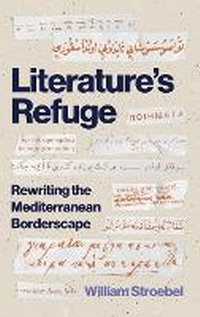
Literature's Refuge
Rewriting the Mediterranean Borderscape
Will be published approx. on 18. March 2025
Book
Hardback
320 pages
978-0-691-26604-6 (ISBN)
Description
Stories silenced or sequestered by a century of mass displacement between Europe and the Middle East-recovered and retold at last
In 1923, the Greco-Turkish Population Exchange uprooted and swapped nearly two million Christians and Muslims, "pacifying" the so-called Near East through ethnic partition and refugeehood. This imposition of borders not only uprooted peoples from their place in the world; it also displaced many of their stories from a place in world literature. In Literature's Refuge, William Stroebel recovers and weaves together work by fugitive writers, oral storytellers, readers, copyists, editors, and translators dispersed by this massive "unmixing" of populations and the broader border logic that it set in motion. Stroebel argues that two complementary forces emerged as a template for the Eastern Mediterranean's cultural landscape: the modern border, which reshuffled people through a system of filters and checkpoints; and modern philology, which similarly reshuffled their words and works. Philologists and publishers defined modern literature by picking apart, extracting, reformatting, or dispossessing refugee and diasporic texts across a racialized borderscape-a gray zone of semi-inclusion and semi-exclusion, semimobility and immobility.
Stroebel reaches into the chinks and crannies of this borderscape to reconstitute the rich textual geography between Greek Orthodoxy and Sunni Islam, between Greek-script, Arabic-script, and Latin-script literary traditions at the edges of Europe and the Middle East. Doing so, he offers a new methodological toolkit for rewriting the modern borderscapes of world literature.
In 1923, the Greco-Turkish Population Exchange uprooted and swapped nearly two million Christians and Muslims, "pacifying" the so-called Near East through ethnic partition and refugeehood. This imposition of borders not only uprooted peoples from their place in the world; it also displaced many of their stories from a place in world literature. In Literature's Refuge, William Stroebel recovers and weaves together work by fugitive writers, oral storytellers, readers, copyists, editors, and translators dispersed by this massive "unmixing" of populations and the broader border logic that it set in motion. Stroebel argues that two complementary forces emerged as a template for the Eastern Mediterranean's cultural landscape: the modern border, which reshuffled people through a system of filters and checkpoints; and modern philology, which similarly reshuffled their words and works. Philologists and publishers defined modern literature by picking apart, extracting, reformatting, or dispossessing refugee and diasporic texts across a racialized borderscape-a gray zone of semi-inclusion and semi-exclusion, semimobility and immobility.
Stroebel reaches into the chinks and crannies of this borderscape to reconstitute the rich textual geography between Greek Orthodoxy and Sunni Islam, between Greek-script, Arabic-script, and Latin-script literary traditions at the edges of Europe and the Middle East. Doing so, he offers a new methodological toolkit for rewriting the modern borderscapes of world literature.
Reviews / Votes
"Winner of the Mediterranean Studies Best Book Prize, Mediterranean Seminar" "A sensitive, impressively researched, and immaculately argued book that gives voice to texts, their authors, and their handlers. The author's knowledge of, and sensitivity to, the languages, communities, and cultures spotlighted is exceptional and admirable. Literature's Refuge is, quite simply, a brilliant achievement."---Panayiotis Xenophontos, Journal of Modern Greek Studies "With an impressive array of carefully assembled archival material, Stroebel recovers works of literature that had long remained hidden or displaced from their original contexts. . . . Literature's Refuge offers a new window into philology that promises to inspire future scholarship in comparative literature, as well as in Greek and Turkish studies."---Enver A. Akova, International Journal of Middle East StudiesMore details
Series
Language
English
Place of publication
New Jersey
United States
Target group
College/higher education
Professional and scholarly
Product notice
Trade binding
Illustrations
20 b/w illus. 12 tables.
Dimensions
Height: 235 mm
Width: 156 mm
Weight
671 gr
ISBN-13
978-0-691-26604-6 (9780691266046)
Copyright in bibliographic data and cover images is held by Nielsen Book Services Limited or by the publishers or by their respective licensors: all rights reserved.
Schweitzer Classification
Other editions
Additional editions
E-Book
02/2025
1st Edition
Princeton University Press
€39.49
Available for download
Person
William Stroebel is assistant professor of modern Greek and comparative literature at the University of Michigan.