

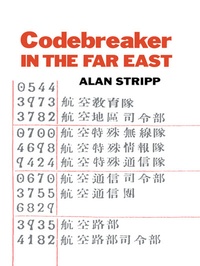
Codebreaker in the Far East
1st Edition
Published on 15. December 2012
Book
Paperback/Softback
222 pages
978-0-415-64672-7 (ISBN)
Description
This is the first book to describe British wartime success in breaking Japanese codes of dazzling variety and great complexity which contributed to the victory in Burma three months before Hiroshima. Written for the general reader, this first-hand account describes the difficulty of decoding one of the most complex languages in the world in some of the most difficult conditions. The book was published in 1989 to avoid proposed legislation which would prohibit those in the security services from publishing secret information.
More details
Series
Language
English
Place of publication
London
United Kingdom
Publishing group
Taylor & Francis Ltd
Target group
College/higher education
Dimensions
Height: 234 mm
Width: 156 mm
Weight
410 gr
ISBN-13
978-0-415-64672-7 (9780415646727)
Copyright in bibliographic data and cover images is held by Nielsen Book Services Limited or by the publishers or by their respective licensors: all rights reserved.
Schweitzer Classification
Other editions
Additional editions
Alan Stripp
Codebreaker in the Far East
E-Book
11/2012
1st Edition
Routledge
€64.49
Available for download
Alan Stripp
Codebreaker in the Far East
E-Book
11/2012
1st Edition
Routledge
€64.49
Available for download
Alan Stripp
Codebreaker in the Far East
Book
11/2004
1st Edition
Routledge
€222.84
Shipment within 10-20 days
Person
Alan Stripp in 1943 was a first-year Cambridge classics scholar with an aptitude for musical composition, chess, and crossword puzzles. These attributes led to his selection for training in breaking Japanese codes, which he did at Bletchley Park and in Delhi until the end of the war, when he switched to Persian and Afghan codes. Returning to Cambridge, he changed course to read Japanese and Chinese. His later career embraced the British Council in Portugal and Indonesia, and both lecturing and administration at Cambridge. Since retiring in 1988 he has directed Cambridge University summer schools on British secret intelligence.
Content
1. CAMBRIDGE, BEDFORD, AND YORKSHIRE ; 7. JAPANESE CODES AND CIPHERS: WHAT WERE THEY LIKE? ; 14. CLANDESTINE GROUPS AND THEIR SIGNALS