

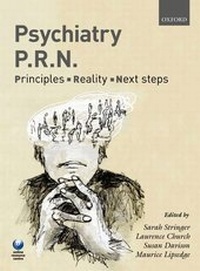
Psychiatry PRN: Principles, Reality, Next Steps
Published on 5. March 2009
Book
Paperback/Softback
256 pages
978-0-19-956198-8 (ISBN)
Description
Psychiatry PRN contains core content for psychiatry education, but gives prominence to clinical and practical skills, as well as exam preparation. PRN is a Latin medical acronym meaning Pro Re Nata (as required). These letters also inform the structure of the book into the parts: Principles, Reality and Next Steps.
Each of the main chapters opens with Principles, which cover the key characteristics of a psychiatric condition. This is the typical ground of textbooks, and this book covers all the necessary ground as concerns undergraduate learning outcomes, but is arguably more succinct than standard works on the subject. Nevertheless, illustrations and the careful use of pedagogic features (prominence given to key facts, tips and points of reflection, as well as effective use of tables) lift even
this most standard area of coverage.
The Reality section is where this book begins to really distinguish itself, with a practical articulation of clinical skills for the novice. This involves sample dialogue which might form part of the psychiatric interview, which bravely, yet skilfully reflects the reality with which patients present, and the difficulties often encountered by medical students. The content in this section includes a general approach (Tips, Tricks and Cautionary Tales), leading to a sample interview,
moving on to indicative stations for Objective Structured Clinical Examinations (OSCEs).
The Next Steps section puts psychiatry into the context of early working life as a doctor, and highlights where psychiatric considerations overlap with medical and surgical management, as exemplified by scenarios dealing with capacity to consent to treatment.
Psychiatry PRN exists to enable students to engage with psychiatry. In addition to the framework described above, the book is rich in illustrative content, be that an original impressionistic picture of a condition, or an allusion to contemporary cultural representations of mental health and illness, to which students may relate, albeit if they haven't previously encountered psychiatric disease. To catalyse this process, the book opens with Vincent Van Gogh as its first patient, and
continues in a vivid, humane fashion to prepare the student for the typical content of undergraduate psychiatry, with particular flair in terms of practical interactions with patients and associated assessment.
Online Resource Centre:
www.oxfordtextbooks.co.uk/orc/stringer
? Video clips of key psychiatric interviews e.g. mini mental state examination, history taking of depression. Clips accompanied by guidance on usage.
? Illustrative content from the book, including clinical signs drawings (with exercise), visual mnemonics of side effects and risk factors, and impressionistic drawings of psychiatric conditions.
? Self-assessment resources, including sample OSCEs and interactive cases.
Each of the main chapters opens with Principles, which cover the key characteristics of a psychiatric condition. This is the typical ground of textbooks, and this book covers all the necessary ground as concerns undergraduate learning outcomes, but is arguably more succinct than standard works on the subject. Nevertheless, illustrations and the careful use of pedagogic features (prominence given to key facts, tips and points of reflection, as well as effective use of tables) lift even
this most standard area of coverage.
The Reality section is where this book begins to really distinguish itself, with a practical articulation of clinical skills for the novice. This involves sample dialogue which might form part of the psychiatric interview, which bravely, yet skilfully reflects the reality with which patients present, and the difficulties often encountered by medical students. The content in this section includes a general approach (Tips, Tricks and Cautionary Tales), leading to a sample interview,
moving on to indicative stations for Objective Structured Clinical Examinations (OSCEs).
The Next Steps section puts psychiatry into the context of early working life as a doctor, and highlights where psychiatric considerations overlap with medical and surgical management, as exemplified by scenarios dealing with capacity to consent to treatment.
Psychiatry PRN exists to enable students to engage with psychiatry. In addition to the framework described above, the book is rich in illustrative content, be that an original impressionistic picture of a condition, or an allusion to contemporary cultural representations of mental health and illness, to which students may relate, albeit if they haven't previously encountered psychiatric disease. To catalyse this process, the book opens with Vincent Van Gogh as its first patient, and
continues in a vivid, humane fashion to prepare the student for the typical content of undergraduate psychiatry, with particular flair in terms of practical interactions with patients and associated assessment.
Online Resource Centre:
www.oxfordtextbooks.co.uk/orc/stringer
? Video clips of key psychiatric interviews e.g. mini mental state examination, history taking of depression. Clips accompanied by guidance on usage.
? Illustrative content from the book, including clinical signs drawings (with exercise), visual mnemonics of side effects and risk factors, and impressionistic drawings of psychiatric conditions.
? Self-assessment resources, including sample OSCEs and interactive cases.
Reviews / Votes
Psychiatry is one of those specialties that isn't covered in as much detail during the lectures of the first and second years of medicine. I was hence a little apprehensive about starting my psychiatry rotation in the third year. Finding a suitable textbook that breaks the specialty into easy to digest chunks is difficult and I am hence grateful to this textbook for helping me get through the rotation as well as my end of year examinations. This book is clear,focused, engaging and interesting; I particularly enjoyed going through the case studies. The self-assessment questions are a great revision tool. It is pitched perfectly for the medical student; it provides information not only to excel in the psychiatry aspect of the examination but the OSCE as well.
This book is highly recommended; thank you Psychiatry P.R.N.!
Thomas Mathen, King's College London It is easy to read, provides knowledge at a suitable level and is unique in that not only does it offer insight on a clinical level, but also looks at how a disease can affect the patient and the doctor. We only wish this book had been available when we were students. * The Psychiatrist Online * This short textbook has captured the basic essence of psychiatry within its pages. Its effective use of summary tables, boxes and illustrations are great for guidance and revision not just for students but also for more senior health professionals. I will be referring to it throughout my training in mental health. * 2010 BMA Book Awards Judges *
More details
Language
English
Place of publication
Oxford
United Kingdom
Target group
College/higher education
Illustrations
150 colour illustrations, 60 black and white illustrations.
Dimensions
Height: 265 mm
Width: 195 mm
Thickness: 12 mm
Weight
622 gr
ISBN-13
978-0-19-956198-8 (9780199561988)
Copyright in bibliographic data and cover images is held by Nielsen Book Services Limited or by the publishers or by their respective licensors: all rights reserved.
Schweitzer Classification
Persons
Dr Sarah Stringer, Higher Specialty Trainee in Psychiatry and Honorary Lecturer at King's College London Medical School
Dr Laurence Church, Consultant Psychiatrist in General Adult Psychiatry, Surrey & Borders Partnership NHS Foundation Trust
Dr Susan Davison, Consultant Psychiatrist in Psychotherapy at the Maudsley Psychotherapy Service
Dr Maurice Lipsedge, Emeritus Consultant Psychiatrist, South London and Maudsley NHS Trust, and Honorary Senior Lecturer at King's College London Medical School
Dr Laurence Church, Consultant Psychiatrist in General Adult Psychiatry, Surrey & Borders Partnership NHS Foundation Trust
Dr Susan Davison, Consultant Psychiatrist in Psychotherapy at the Maudsley Psychotherapy Service
Dr Maurice Lipsedge, Emeritus Consultant Psychiatrist, South London and Maudsley NHS Trust, and Honorary Senior Lecturer at King's College London Medical School
Content
PART 1 : OVERVIEW IN PSYCHIATRY; PART 2: CLINICAL CONDITIONS: PRINCIPLES, REALITY & NEXT STEPS