

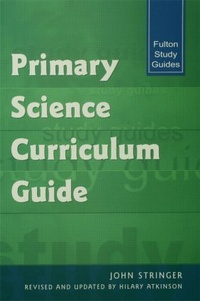
Primary Science Curriculum Guide
Edited by Hilary Atkinson
Published on 15. March 2002
Book
Paperback/Softback
96 pages
978-1-85346-882-7 (ISBN)
Description
This guide provides trainee teachers with an insight into the nature and teaching of primary science. It aims to introduce you to the ways in which children learn science, and to the science itself. Each Unit can be studied independently or used to support/prepare for school experiences. You will be directed towards additional reading, which will develop or confirm the subject knowledge you will need to achieve QTS.
the curriculum guide is up-to-date, revised to take account of Curriculum 2000 and accepted 'good practice' in primary science teaching and learning. It is also flexible - many of the Units are stand-alone. They can be undertaken in any order, at your own pace, to complement school experiences. The Units are practical and feasible: the activities suggested can be undertaken by the non-specialist; in many cases without specialized equipment or access to large numbers of pupils. The guide is comprehensive, covering all the primary science elements in Curriculum 2000 and giving background information into other aspects of primary science teaching. It is also supportive - the guide suggests further texts to support trainees' own understanding of the scientific and pedagogical concepts involved. Additional reading draws on the TTA's list of approved key texts.
The original text was piloted by students following a distance-learning PGCE course. It has been revised and updated in line with their comments and to meet Curriculum 2000 and Curriculum Guidance for the Foundation Stage. The text was initially developed as a core text for the part-time distance-learning course at Liverpool Hope and is designed for trainee teachers on distance learning and flexible routes, returning, converting or overseas teachers.
the curriculum guide is up-to-date, revised to take account of Curriculum 2000 and accepted 'good practice' in primary science teaching and learning. It is also flexible - many of the Units are stand-alone. They can be undertaken in any order, at your own pace, to complement school experiences. The Units are practical and feasible: the activities suggested can be undertaken by the non-specialist; in many cases without specialized equipment or access to large numbers of pupils. The guide is comprehensive, covering all the primary science elements in Curriculum 2000 and giving background information into other aspects of primary science teaching. It is also supportive - the guide suggests further texts to support trainees' own understanding of the scientific and pedagogical concepts involved. Additional reading draws on the TTA's list of approved key texts.
The original text was piloted by students following a distance-learning PGCE course. It has been revised and updated in line with their comments and to meet Curriculum 2000 and Curriculum Guidance for the Foundation Stage. The text was initially developed as a core text for the part-time distance-learning course at Liverpool Hope and is designed for trainee teachers on distance learning and flexible routes, returning, converting or overseas teachers.
More details
Language
English
Place of publication
London
United Kingdom
Publishing group
Taylor & Francis Ltd
Target group
Professional and scholarly
Dimensions
Height: 280 mm
Width: 210 mm
Weight
294 gr
ISBN-13
978-1-85346-882-7 (9781853468827)
Copyright in bibliographic data and cover images is held by Nielsen Book Services Limited or by the publishers or by their respective licensors: all rights reserved.
Schweitzer Classification
Other editions
Additional editions
John Stringer
Primary Science Curriculum Guide
E-Book
06/2013
David Fulton Publishers Ltd
€35.99
Available for download
John Stringer
Primary Science Curriculum Guide
E-Book
06/2013
David Fulton Publishers Ltd
€35.99
Available for download
Persons
John Stringer is a former Head and Advisory Teacher, now author, consultant and inset provider. Hilary Atkinson is Senior Lecturer at Liverpool Hope University College.
Content
What is Primary School Science? What is National Curriculum Science? How do I plan for Science? Differentiation and progression; Organising your class; Science and ICT; Choosing published resources; How to use the units in this guide; The preprimary Science curriculum; Science and language; Children's prior ideas; Science investigations; Investigating in practice; Investigations and knowledge; Assessing children's progress in Science; Teaching the content of Science; Materials and their uses; Light and sound; Earth and beyond; Forces; Humans and other animals; Plants and other living things; Electricity (and magnetism); Additional reading.