

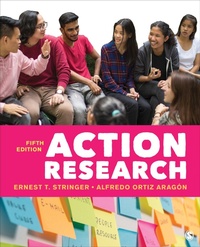
Action Research
5th Edition
Published on 25. November 2020
Book
Paperback/Softback
408 pages
978-1-5443-5594-8 (ISBN)
Description
Action Research is an invaluable guide to both novice and experienced researchers from a diversity of disciplines, backgrounds, and levels of study for understanding how action research works in real-life contexts. The Fifth Edition builds on the experiences of the authors by acknowledging the dramatic changes taking place in our everyday lives, including developments of social and digital media that have become central to modern life. Author Ernest T. Stringer and new co-author Alfredo Ortiz Aragon aim to provide a meaningful methodology arising from their extensive field experience for both students and practitioners. Presenting research that produces practical, effective, and sustainable outcomes to real-world problems, Action Research helps students see the value of their research in a broader context, beyond academia, to effecting change on a larger scale.
Additional resources can be found at the authors' website
Additional resources can be found at the authors' website
More details
Edition
5th Revised edition
Language
English
Place of publication
Thousand Oaks
United States
Target group
College/higher education
Edition type
Revised edition
Dimensions
Height: 236 mm
Width: 191 mm
Thickness: 22 mm
Weight
693 gr
ISBN-13
978-1-5443-5594-8 (9781544355948)
Copyright in bibliographic data and cover images is held by Nielsen Book Services Limited or by the publishers or by their respective licensors: all rights reserved.
Schweitzer Classification
Persons
Ernest T. Stringer
After an early career as a primary teacher and school principal, Ernie was a lecturer in education at Curtin University of Technology, in Western Australia. From the mid-1980s, based at Curtin's Centre for Aboriginal Studies, he worked collaboratively with Aboriginal staff and community people to develop a wide variety of innovative and highly successful education and community development programs and services. His work with government departments, community-based agencies, business corporations, and local governments assisted them to work more effectively with Aboriginal people. In recent years, as visiting professor at the University of New Mexico and Texas A&M University and as visiting scholar at Cornell University, he taught research methods courses and/or engaged in projects with African American and Hispanic community and neighborhood groups. As a UNICEF consultant, he recently engaged in a major project to increase parent participation in schools in East Timor. He is author of Action Research (Sage, 2007), Action Research in Education (Pearson, 2008), Action Research in Health (with Bill Genat; Pearson, 2004), and Action Research in Human Services (with Rosalie Dwyer; Pearson, 2005). Until recently, he was a member of the editorial board of the Action Research Journal and past president of the Action Learning, Action Research Association (ALARA).
Alfredo Ortiz Aragon
Alfredo is an action researcher who designs and implements change processes to address pressing social and environmental concerns in support of equitable development. In the field he seeks to help organizations and movements that support processes of social change and environmental stewardship in order to be more effective and reflective in their work. In all of his work he uses methods that appeal to diverse learning styles but that also challenge dominant ways of seeing, knowing, and acting in the world that uphold unjust social rules and structures. He encourages all of his collaborators to reflectively "put themselves into the picture" and consciously participate in the changes they seek for others. He is willing to lead but also be vulnerable and open about what he and we know, and how we all might use our leadership and vulnerability to engage in honest conversations that help us support people in need in ways that are culturally relevant and potentially transformative. He is an associate professor at the Dreeben School of Education Graduate Studies Program at the University of the Incarnate Word in San Antonio, Texas, where he teaches qualitative and action research methods and design. His PhD is from the Institute of Development Studies at the University of Sussex, in the United Kingdom.
After an early career as a primary teacher and school principal, Ernie was a lecturer in education at Curtin University of Technology, in Western Australia. From the mid-1980s, based at Curtin's Centre for Aboriginal Studies, he worked collaboratively with Aboriginal staff and community people to develop a wide variety of innovative and highly successful education and community development programs and services. His work with government departments, community-based agencies, business corporations, and local governments assisted them to work more effectively with Aboriginal people. In recent years, as visiting professor at the University of New Mexico and Texas A&M University and as visiting scholar at Cornell University, he taught research methods courses and/or engaged in projects with African American and Hispanic community and neighborhood groups. As a UNICEF consultant, he recently engaged in a major project to increase parent participation in schools in East Timor. He is author of Action Research (Sage, 2007), Action Research in Education (Pearson, 2008), Action Research in Health (with Bill Genat; Pearson, 2004), and Action Research in Human Services (with Rosalie Dwyer; Pearson, 2005). Until recently, he was a member of the editorial board of the Action Research Journal and past president of the Action Learning, Action Research Association (ALARA).
Alfredo Ortiz Aragon
Alfredo is an action researcher who designs and implements change processes to address pressing social and environmental concerns in support of equitable development. In the field he seeks to help organizations and movements that support processes of social change and environmental stewardship in order to be more effective and reflective in their work. In all of his work he uses methods that appeal to diverse learning styles but that also challenge dominant ways of seeing, knowing, and acting in the world that uphold unjust social rules and structures. He encourages all of his collaborators to reflectively "put themselves into the picture" and consciously participate in the changes they seek for others. He is willing to lead but also be vulnerable and open about what he and we know, and how we all might use our leadership and vulnerability to engage in honest conversations that help us support people in need in ways that are culturally relevant and potentially transformative. He is an associate professor at the Dreeben School of Education Graduate Studies Program at the University of the Incarnate Word in San Antonio, Texas, where he teaches qualitative and action research methods and design. His PhD is from the Institute of Development Studies at the University of Sussex, in the United Kingdom.
Content
SECTION I: An Introduction to Action Research
Chapter 1: Understanding Action Research
Chapter 2: Theoretical Foundations of Action Research
SECTION II: Action Research Practices and Processes
Chapter 3: Setting the Stage: Initiating an Action Research Process
Chapter 4: Look: Generating and Gathering Data
Chapter 5: Think: Reflecting and Analyzing
Chapter 6: Act: Implementing Practical Solutions
SECTION III: From Local to Global-Action Research for Social Change
Chapter 7: Reporting: Informing Stakeholders and Other Audiences
Chapter 8: Developmental Approaches to Social and Organizational Change
Chapter 9: Action Research and Digital Media
Appendix: Case Examples of Formal Reports
References
Index
Chapter 1: Understanding Action Research
Chapter 2: Theoretical Foundations of Action Research
SECTION II: Action Research Practices and Processes
Chapter 3: Setting the Stage: Initiating an Action Research Process
Chapter 4: Look: Generating and Gathering Data
Chapter 5: Think: Reflecting and Analyzing
Chapter 6: Act: Implementing Practical Solutions
SECTION III: From Local to Global-Action Research for Social Change
Chapter 7: Reporting: Informing Stakeholders and Other Audiences
Chapter 8: Developmental Approaches to Social and Organizational Change
Chapter 9: Action Research and Digital Media
Appendix: Case Examples of Formal Reports
References
Index