

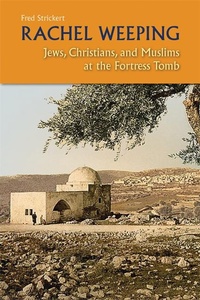
Rachel Weeping
Jews, Christians, and Muslims at the Fortress Tomb
Published on 1. July 2007
Book
Paperback/Softback
192 pages
978-0-8146-5987-8 (ISBN)
Description
Rachel's story is one of the great dramas of the Old Testament. It begins with a passionate love story 'the shepherdess meets Jacob at the well and he is moved to weep and kiss her. So great is Jacob's love for Rachel that he works seven years for her hand in marriage and then, tricked into marrying her sister Leah, he works another seven years for Rachel. After years of heartbreaking barrenness, Rachel gives birth to Joseph. While giving birth to her second son, Benjamin, Rachel dies on the way to the family's new home. She is buried there beside the road, not in the family tomb. The very nature of Rachel's burial site means she will be a dramatic figure weeping for the Israelites as they are led into captivity by the Babylonians, and again for the children massacred by Herod after Jesus ' birth.
It is this on-the-way character of Rachel that marks her story and the monument outside Bethlehem where Christian, Jewish, and Muslim worshipers remember her. The monument is tangled in questions of historical authenticity and sectarian struggle. For centuries it has been passed by, recorded in diaries, worn by earthquakes and neglect, and embellished by members from all three traditions. Finally, in the early twenty-first century, it has been surrounded by a wall, cut off from the very road that brought pilgrims by for so many years. Yet pilgrims continue to gather, and women come to pray for the blessing of childbirth. In Rachel Weeping, Fred Strickert takes the reader on a journey into the nature and significance of Rachel's story and the story of her tomb. With meticulous scholarship and a clear sense of how the monument fits into the current history of the Middle East, Strickert tells the story of Rachel, the woman on the way.
Fred Strickert is Professor of Religion at Wartburg College in Waverly, Iowa. He is the author of Bethsaida: Home of the Apostles (Liturgical Press).
It is this on-the-way character of Rachel that marks her story and the monument outside Bethlehem where Christian, Jewish, and Muslim worshipers remember her. The monument is tangled in questions of historical authenticity and sectarian struggle. For centuries it has been passed by, recorded in diaries, worn by earthquakes and neglect, and embellished by members from all three traditions. Finally, in the early twenty-first century, it has been surrounded by a wall, cut off from the very road that brought pilgrims by for so many years. Yet pilgrims continue to gather, and women come to pray for the blessing of childbirth. In Rachel Weeping, Fred Strickert takes the reader on a journey into the nature and significance of Rachel's story and the story of her tomb. With meticulous scholarship and a clear sense of how the monument fits into the current history of the Middle East, Strickert tells the story of Rachel, the woman on the way.
Fred Strickert is Professor of Religion at Wartburg College in Waverly, Iowa. He is the author of Bethsaida: Home of the Apostles (Liturgical Press).
Reviews / Votes
Readers will come away from Strickert's treatment with an appreciation of how a literary character such as Rachel ties all three faith traditions together. They will also glean a new appreciation of how, in the pathos of the current political situation, the ancient image of Rachel's weeping takes on an entirely new significance.Biblical Interpretation This is a book which intermingles beauty and pathos. . . . A book of serious biblical scholarship, but also engaged with present day realities, and a salutary reminder that the book of Genesis still has the power to affect our world for good or ill even in the twenty-first century.Journal for the Study of the New Testament [C]arefully weaves together the textual, historical, and political dimensions of the site, and it tells the story not only of Rachel but of all those who have gone looking for her in memory and in faith.Review of Biblical Literature The book includes an excellent bibliography that even references contemporary political press coverage, as well as useful indices.Interpretation Strickert's approach is both historical and contemporary. He puts the past at the service of the present in hopes of helping to create a more peace-filled future. . . . It's a small gem worth reading.Catholic Studies Fred Strickert has made a unique contribution to the ongoing discussion about the relationships among members of the three monotheistic faiths. He explains the important role Rachel has in Judaism, Christianity, and Islam, and he explores how her tomb has functioned as a pilgrimage site throughout history. This creative interfacing of person and place is simultaneously a celebration of how people have cooperated in the past and a challenge to reflect on how we might get along better in the future.John Kaltner, Department of Religious Studies, Rhodes College, Memphis, Tennessee Fred Strickert has written a masterful, one could say definitive, portrait of the life and lament of Rachel. With skill, sensitivity and thorough scholarship, he follows the story of Rachel, a woman 'on the way,' as she is depicted in the Bible and remembered in Judaism, Christianity and Islam. Buried along 'the way,' her tomb always provided a place of solace and strength for all who weep, especially women. In recent times this 'sacred space' has been walled in and made a private domain for Jews alone. But are her tears only for some and not others? Can they be privatized? Through this excellent and meticulous study, the author shows that historically the tears of Rachel were for all her children, for all of us. 'We are all hurting and desperately in need of healing' he writes. It is for all, not just the few, that Rachel weeps. Will the tomb again become the universal shrine it has always been? Concluding with Rachel's hope that the 'impossible will become possible,' the author believ With Rachel Weeping Fred Strickert joins a growing pool of scholars and journalists who illuminate the shared religious heritage of Jews, Christians and Muslims. What distinguishes this story of Rachel's tomb in biblical and modern history is Strickert's attention to extensive and diverse sources such as rabbinic, patristic, and Islamic commentaries and eye witness accounts by two millennia's pilgrims. Strickert's integration of biblical narrative, history, and archaeology lifts up Rachel's tomb as a paradigm for the political developments in our time that hinder the sharing of God's Holy Land by the people of these three related traditions.Carol Schersten LaHurd, Ph.D., Lutheran School of Theology, Chicago, Illinois, Evangelical Lutheran Church, America Global MissionMore details
Language
English
Place of publication
Collegeville, MN
United States
Product notice
Paperback (trade)
Dimensions
Height: 227 mm
Width: 155 mm
Thickness: 12 mm
Weight
304 gr
ISBN-13
978-0-8146-5987-8 (9780814659878)
Copyright in bibliographic data and cover images is held by Nielsen Book Services Limited or by the publishers or by their respective licensors: all rights reserved.
Schweitzer Classification
Person
Fred Strickert is professor emeritus of religion at Wartburg College in Waverly, Iowa, and is pastor of the Lutheran Church of the Redeemer, Jerusalem. He is the author of Rachel Weeping: Jews, Christians, and Muslims at the Fortress Tomb (Liturgical Press).
Content
Contents
List of Illustrations vi
Prologue vii
Introduction xiii
Part One: Mother Rachel
1. The Biblical Rachel 3
2. Rachel in Judaism 17
3. Rachel in Christianity 35
4. Rachel in Islam 48
Part Two: Rachel's Tomb
5. Rachel's Tomb in Biblical Texts 57
6. In the Age of Pilgrims 71
7. Islam and the Age of Crusades 84
8. The Modern Age: Contributions and Control in the Nineteenth and Twentieth Centuries 99
9. The Politicization of Rachel's Tomb 128
Epilogue 138
Appendix: Ephrath and Bethlehem 141
Bibliography 149
Index of Names, Places, and Subjects 158
Biblical Index 171
List of Illustrations vi
Prologue vii
Introduction xiii
Part One: Mother Rachel
1. The Biblical Rachel 3
2. Rachel in Judaism 17
3. Rachel in Christianity 35
4. Rachel in Islam 48
Part Two: Rachel's Tomb
5. Rachel's Tomb in Biblical Texts 57
6. In the Age of Pilgrims 71
7. Islam and the Age of Crusades 84
8. The Modern Age: Contributions and Control in the Nineteenth and Twentieth Centuries 99
9. The Politicization of Rachel's Tomb 128
Epilogue 138
Appendix: Ephrath and Bethlehem 141
Bibliography 149
Index of Names, Places, and Subjects 158
Biblical Index 171