

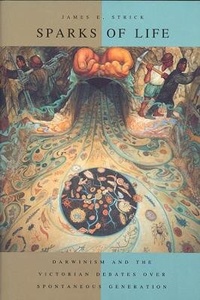
Sparks of Life
Darwinism and the Victorian Debates over Spontaneous Generation
Published on 15. October 2002
Book
Paperback/Softback
304 pages
978-0-674-00999-8 (ISBN)
Description
How, asks James E. Strick, could spontaneous generation--the idea that living things can suddenly arise from nonliving materials--come to take root for a time (even a brief one) in so thoroughly unsuitable a field as British natural theology? No less an authority than Aristotle claimed that cases of spontaneous generation were to be observed in nature, and the idea held sway for centuries. Beginning around the time of the Scientific Revolution, however, the doctrine was increasingly challenged; attempts to prove or disprove it led to important breakthroughs in experimental design and laboratory techniques, most notably sterilization methods, that became the cornerstones of modern microbiology and sped the ascendancy of the germ theory of disease.
The Victorian debates, Strick shows, were entwined with the public controversy over Darwin's theory of evolution. While other histories of the debates between 1860 and 1880 have focused largely on the experiments of John Tyndall, Henry Charlton Bastian, and others, Sparks of Life emphasizes previously understudied changes in the theories that underlay the debates. Strick argues that the disputes cannot be understood without full knowledge of the factional infighting among Darwinians themselves, as they struggled to create a socially and scientifically viable form of "Darwinian" science. He shows that even the terms of the debate, such as "biogenesis," usually but incorrectly attributed to Huxley, were intensely contested.
The Victorian debates, Strick shows, were entwined with the public controversy over Darwin's theory of evolution. While other histories of the debates between 1860 and 1880 have focused largely on the experiments of John Tyndall, Henry Charlton Bastian, and others, Sparks of Life emphasizes previously understudied changes in the theories that underlay the debates. Strick argues that the disputes cannot be understood without full knowledge of the factional infighting among Darwinians themselves, as they struggled to create a socially and scientifically viable form of "Darwinian" science. He shows that even the terms of the debate, such as "biogenesis," usually but incorrectly attributed to Huxley, were intensely contested.
Reviews / Votes
In accessible language and an engaging narrative style, Strick navigates through the Victorian power politics of both observational and experimental science (Darwin's immediate 19th-century legacy) and the old (and inevitable) rifts between men of science and arrogant medical practitioners. He illuminates especially the European backdrop and the relations of the debates over spontaneous generation to the 'big questions.' -- Lynn Margulis * Science * Sparks of Life provides a fascinating, scholarly account of the 19th century spontaneous generation controversy that raged in England which focuses on the work of Henry Charlton Bastian... Strick's highly readable account of English microbiology during the late Victorian period is superb and unlikely to be bettered-a must for everyone interested in the development of both microbiology and biology in general. -- Milton Wainwright * Microbiology Today * Between 1860 and 1880, the scientific community vigorously debated the doctrine of spontaneous generation...and it held sway for generations before being challenged in the era of Darwin's theory of evolution. Strick investigates the evidence brought to bear on this controversy, including improvements in microscope technology, laboratory techniques, and experimental method, all of which helped author germ theory. Strick also treats conceptual changes and public controversy that lay beneath the research and scientific advances of Darwin's era. * Science News * [Strick] explores the debate in Victorian Britain (1860-80) over the view that life was formed from nonliving matter (spontaneous generation or abiogenesis), against the background of controversy generated by Charles Darwin's theory of evolution and development of the germ theory of disease... The author strives to connect...diverse issues, making the work...attractive to those well versed in the scientific and historical details. -- J.S. Schwartz * Choice * With impressive scholarship, Strick examines the major books, articles, lectures, and letters on, as well as experiments and institutions involved with, the origin of life controversies in scientific philosophy. He rigorously analyzes the complex Victorian (1860-80) debates surrounding the idea of spontaneous generation... He also emphasizes the social aspects and personal interests that influenced those arguments offered by both naturalists and physicians. The result of prodigious research, Sparks of Life is highly recommended. -- H. James Birx * Library Journal * A very important contribution to the literature of the spontaneous generation debates, one that ties together many parts of the story that have never been dealt with in one place. More important, Strick has placed his narrative in the context not only of recent scholarship on Pasteur, Tyndall, Huxley, and the X-Club, but he also provides a contextualist analysis that shows far more clearly exactly how and why the debates took the course they did. A very fine piece of work. -- Garland E. Allen, Washington University By focusing on Darwin's London and Pasteur's Paris, explaining the issues and historical approaches to both, Strick knits together the academic topics of Darwinian evolution, the Pasteurization of France, and germ theories of disease-by means of a deep study of specific Darwinian medical men in England and their recourse to spontaneous generation. We thereby sense that the book is pleasingly overarching, while at the same time focused. -- Adrian Desmond, author of <i>Huxley: From Devil's Disciple to Evolution's High Priest</i>More details
Language
English
Place of publication
Cambridge, Mass
United States
Target group
Professional and scholarly
Illustrations
2 halftones, 2 line illustrations
Dimensions
Height: 235 mm
Width: 156 mm
Thickness: 19 mm
Weight
435 gr
ISBN-13
978-0-674-00999-8 (9780674009998)
Copyright in bibliographic data and cover images is held by Nielsen Book Services Limited or by the publishers or by their respective licensors: all rights reserved.
Schweitzer Classification
Person
James E. Strick is Professor in the Department of Earth and Environment and Chair of the Program in Science, Technology, and Society at Franklin and Marshall College.
Content
Introduction Early History Needham versus Spallanzani Worms, Molecules, and Evolution Note on Terminology Why Another Study of the Spontaneous Generation Debates? 1 Spontaneous Generation and Early Victorian Science The Standard Story of the British Debates Bastian and Burdon Sanderson Criticisms of Bastian by Lankester and Roberts The Germ Theory of Disease The Role of Heat-Resistant Spores Major Victorian Scientists through the 1860s 2 "Molecular"Theories and the Conversion of Owen and Bennett Brownian Movement and Histological Molecules Owen's Role in Developing Ideas on Spontaneous Generation John Hughes Bennett and "Histological Molecules" Owen's Change and the Darwinians Bennett's Conversion to Spontaneous Generation Further Response to Owen's Conversion 3 Bastian as Rising Star Bastian's Background Bastian Enters the Spontaneous Generation Debate Wallace and Darwin Discuss Bastian Further Support for Bastian 4 Initial Confrontation with the X Club: 1870-1873 Huxley's Tightrope Act Huxley's Attitude toward Young Men of Talent Huxley Turns against Bastian Brownian Movement and Other Rhetorical Devices The Younger Darwinians Bastian, Huxley, and the Royal Society E. Ray Lankester and Bastian 5 Colloids, PleomorphicTheories, and Cell Theories: A State of Flux Thomas Graham and Colloids Conservation of Energy and Correlation of Forces Cell Theory and the Demise of Histological Molecules Brownian Movement Revisited Life Cycles in Infusorial Monads Pleomorphist Theories of Bacteria 6 Germ Theories and the British Medical Community The Cattle Plague of 1865-66 and Germ Theories Tyndall, the Germ Theory, and the Medical Community Support in the Medical Community for Bastian The Pathological Society Debate of April 1875 The Physiological Society 7 Purity and Contamination: Tyndall's Campaign as the Final Blow Tyndall's A Priori Commitments Embarking on the Quest and Recruiting Support The Exact Sciences versus the Biomedical Sciences The X Club and the Royal Society Spores: Tough Allies to Kill Convincing Pasteur: Urine Proves a Weak Ally Conclusions Epilogue, 1880 through 1915 Glossary Timeline Cast of Characters Notes Sources Index