

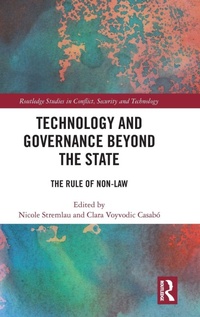
Technology and Governance Beyond the State
The Rule of Non-Law
1st Edition
Published on 30. September 2024
Book
Hardback
208 pages
978-1-032-69299-9 (ISBN)
Description
This book explores how information and communications technologies are adapted, governed, and reinterpreted in areas where the state has limited reach.
The governance and regulation of new technologies, from social media to AI, has never seemed more urgent. Efforts to harness the potential benefits, to encourage innovation and novel applications, yet restrain the known and unknown harmful aspects of these technologies, have posed unprecedented challenges. This book brings together an eclectic collection of cases from around the world - from the favelas in Brazil to the border regions of Ethiopia and Somalia and to markets in Thailand - to tease out the broader arguments and logics about how diverse enabling environments for technology and innovation may evolve and the wide range of public authorities that may be involved in providing governance and security for such innovation, beyond the state. The term 'the rule of non-law' refers to the breadth and array of rules, norms, and systems that enable novel technological assemblages and uses. By looking at technologies and the rule of non-law in areas that are often seen as marginal or at the peripheries (from a profit and business perspective), this book reflects new insights back to more Western-dominated mainstream debates about law, technology, and innovation.
This book will be of great interest to students of Socio-Legal Studies, Science and Technology Studies, Critical Security Studies, and International Relations.
The governance and regulation of new technologies, from social media to AI, has never seemed more urgent. Efforts to harness the potential benefits, to encourage innovation and novel applications, yet restrain the known and unknown harmful aspects of these technologies, have posed unprecedented challenges. This book brings together an eclectic collection of cases from around the world - from the favelas in Brazil to the border regions of Ethiopia and Somalia and to markets in Thailand - to tease out the broader arguments and logics about how diverse enabling environments for technology and innovation may evolve and the wide range of public authorities that may be involved in providing governance and security for such innovation, beyond the state. The term 'the rule of non-law' refers to the breadth and array of rules, norms, and systems that enable novel technological assemblages and uses. By looking at technologies and the rule of non-law in areas that are often seen as marginal or at the peripheries (from a profit and business perspective), this book reflects new insights back to more Western-dominated mainstream debates about law, technology, and innovation.
This book will be of great interest to students of Socio-Legal Studies, Science and Technology Studies, Critical Security Studies, and International Relations.
More details
Series
Language
English
Place of publication
London
United Kingdom
Publishing group
Taylor & Francis Ltd
Target group
College/higher education
Professional and scholarly
Postgraduate, Professional Reference, and Undergraduate Advanced
Dimensions
Height: 240 mm
Width: 161 mm
Thickness: 16 mm
Weight
496 gr
ISBN-13
978-1-032-69299-9 (9781032692999)
Copyright in bibliographic data and cover images is held by Nielsen Book Services Limited or by the publishers or by their respective licensors: all rights reserved.
Schweitzer Classification
Other editions
Additional editions
Technology and Governance Beyond the State
The Rule of Non-Law
Book
11/2024
1st Edition
Taylor & Francis Group
€63.50
Article exhausted; check different version
Nicole Stremlau | Clara Voyvodic Casabo
Technology and Governance Beyond the State
The Rule of Non-Law
E-Book
09/2024
1st Edition
Routledge
€60.49
Available for download
Nicole Stremlau | Clara Voyvodic Casabo
Technology and Governance Beyond the State
The Rule of Non-Law
E-Book
09/2024
1st Edition
Routledge
€60.49
Available for download
Persons
Nicole Stremlau is the Head of the Programme in Comparative Media Law and Policy at the University of Oxford's Centre for Socio-Legal Studies and Research Professor in the School of Communications at the University of Johannesburg.
Clara Voyvodic Casabo is a Lecturer in Peace Studies and International Development in the Department of Peace and International Development, University of Bradford.
Clara Voyvodic Casabo is a Lecturer in Peace Studies and International Development in the Department of Peace and International Development, University of Bradford.
Content
List of Contributors
Acknowledgements
Chapter 1 Non-State Law and Technology: Theory and Themes
Section I: Tradition and Modernity
Chapter 2 Digitalising Traditions: Custom, Land, Biodiversity and Resource Management in Vanuatu
Chapter 3 Tradition, Tussle, and Technology: the Khap Panchayat's Guide to Regulating Mobile Phones in India
Chapter 4 'Crowdfarming' in South Africa: Using Platform Technology to Connect Tradition and Modernity
Section II: Borderlands
Chapter 5 The Regulation of Cross-border Trading of Mobile Phones in the Ethio-Somaliland Corridor
Chapter 6 Ambivalent State Governance and Counter-governance: Migrants on the Move in the France-UK Techno-borderscape
Chapter 7 Moderating Digital Communities in Hybrid Governance Contexts: The Case of Refugees' Digital Inclusion and Communication in Nairobi
Chapter 8 The Legal Geographies of Thailand's Technology Markets
Part III: Challenges to the State
Chapter 9 Performative State building in the Digital World: ISIS and Monetary Economics
Chapter 10 The Role of the Mobile Network Operators in Conflicting Governance Systems: A Case Study of the Mobile Telecommunications Industry in Afghanistan
Chapter 11 Informality and the Internet: Alternative Versions of Technological Governance in Brazil
Part IV: Digital Spaces
Chapter 12 Decentralized Governance Opportunities in the Energy Sector: Examples from Blockchain-based Initiatives
Chapter 13 Manufacturing Legitimacy: Content Moderation and the Absence of the State
Chapter 14 Conclusions and Reflections on the Future of Technology and Regulation in Areas of Limited Statehood
Index
Acknowledgements
Chapter 1 Non-State Law and Technology: Theory and Themes
Section I: Tradition and Modernity
Chapter 2 Digitalising Traditions: Custom, Land, Biodiversity and Resource Management in Vanuatu
Chapter 3 Tradition, Tussle, and Technology: the Khap Panchayat's Guide to Regulating Mobile Phones in India
Chapter 4 'Crowdfarming' in South Africa: Using Platform Technology to Connect Tradition and Modernity
Section II: Borderlands
Chapter 5 The Regulation of Cross-border Trading of Mobile Phones in the Ethio-Somaliland Corridor
Chapter 6 Ambivalent State Governance and Counter-governance: Migrants on the Move in the France-UK Techno-borderscape
Chapter 7 Moderating Digital Communities in Hybrid Governance Contexts: The Case of Refugees' Digital Inclusion and Communication in Nairobi
Chapter 8 The Legal Geographies of Thailand's Technology Markets
Part III: Challenges to the State
Chapter 9 Performative State building in the Digital World: ISIS and Monetary Economics
Chapter 10 The Role of the Mobile Network Operators in Conflicting Governance Systems: A Case Study of the Mobile Telecommunications Industry in Afghanistan
Chapter 11 Informality and the Internet: Alternative Versions of Technological Governance in Brazil
Part IV: Digital Spaces
Chapter 12 Decentralized Governance Opportunities in the Energy Sector: Examples from Blockchain-based Initiatives
Chapter 13 Manufacturing Legitimacy: Content Moderation and the Absence of the State
Chapter 14 Conclusions and Reflections on the Future of Technology and Regulation in Areas of Limited Statehood
Index