


When Research Goes Off the Rails
Why It Happens and What You Can Do About It
1st Edition
Will be published approx. on 11. November 2009
Book
Paperback/Softback
398 pages
978-1-60623-410-5 (ISBN)
Description
Few behavioral or health science studies proceed seamlessly. This refreshingly candid guide presents firsthand vignettes of obstacles on the bumpy road of research and offers feasible, easy-to-implement solutions. Contributors from a range of disciplines describe real-world problems at each stage of a quantitative or qualitative research projectaEUR"from gaining review board approval to collecting and analyzing dataaEUR"and discuss how these problems were resolved. A detailed summary chart helps readers quickly find material on specific issues, methods, and settings. Written with clarity and wit, the vignettes provide exemplars of critical thinking that researchers can apply when developing the operational plan of a study or when facing practical difficulties in a particular research phase.
Winner--American Journal of Nursing Book of the Year Award
Winner--American Journal of Nursing Book of the Year Award
Reviews / Votes
This unique, thorough guide offers inspiring testimony about how to persevere in the face of unexpected setbacks when designing or implementing a study. Contributors describe the untold story of research--the real-world intrusions that almost never make it into the publication of record. Topics include the ethical review process, recruitment contingencies with formal and informal gatekeepers, missteps in data collection and analysis, roadblocks and detours when implementing the study, and conflicts and personality factors associated with collaboration and intervention. The cautionary yet inspiring vignettes will resonate with experienced researchers and will appeal to graduate students just learning the ropes. This text will enliven a standard research methods course with a wonderful collection of stories from the front lines.--Gregory J. Meyer, PhD, Department of Psychology, University of ToledoMost books for social and behavioral science researchers assume that faithfully following certain protocols will produce useful results. In contrast, this book shows that the unexpected almost always strikes. There is as much to learn from these real-world situations of research gone awry as from textbook examples of 'perfect' designs that lead to straightforward results. The underlying message of all of the chapters is that serious mishaps are best avoided by focusing on prevention. Drawing on diverse studies using different designs in multiple disciplines, the book illustrates broadly applicable approaches to navigating the vicissitudes of research and evaluation practice.--Henry M. Levin, PhD, William Heard Kilpatrick Professor of Economics and Education, Teachers College, Columbia University; David Jacks Professor of Education and Economics (Emeritus), Stanford University
Nobody told us this stuff! This is the information that is missing in graduate courses and professional texts on research methods, experimental design, and statistics. From distinguished interdisciplinary editors and contributors, this book fills an extremely important niche. It should be required reading for all graduate students considering a career in the health and social sciences. It will be extremely valuable to experienced researchers, knowledge brokers, and policy makers in the health and social service fields.--Charles E. Cunningham, PhD, Department of Psychiatry and Behavioural Neurosciences and Jack Laidlaw Chair in Patient-Centred Health Care, McMaster University, Canada
In typical 'Streineresque' style, this book is easy to read, grounded in reality, and solution oriented. The contributors use accessible language, which makes reading the book feel like you are having an informal dialogue with colleagues. Social science researchers experiencing challenges at various stages of project implementation, graduate students who want to avoid and learn from mistakes made by others, and reviewers of grant proposals or manuscripts who are in a position to help others keep their research on track should seriously consider making this book a 'must read.'--Lucyna M. Lach, MSW, PhD, School of Social Work, McGill University, Canada
This book is a useful reference that could help you anticipate potential problems when planning your thesis or dissertation study.--Amanda L. Garrett, graduate student, Department of Educational Psychology, University of Nebraska-Lincoln
-An eye-opening text that pushes the reader to think about solutions to real world problems that occur in the field as one performs research....An essential read for new researchers and will be thought-provoking for those in the field....As a graduate student new to the field, I found this book useful for exploring the realities of research....The text reads more like a novel than a traditional scholarly text, which is a welcome addition to the reading list of most doctoral students. This text would be excellent material to pair with a traditional textbook for a research design course....Regardless of your position, social researchers will find the honest discussion of research problems and solutions to be an enlightening and interesting read.--Canadian Journal of Program Evaluation, 5/28/2013
More details
Language
English
Place of publication
New York
United States
Target group
College/higher education
Professional Practice & Development
Product notice
Paperback (trade)
Unsewn / adhesive bound
Dimensions
Height: 215 mm
Width: 125 mm
Thickness: 26 mm
Weight
567 gr
ISBN-13
978-1-60623-410-5 (9781606234105)
Copyright in bibliographic data and cover images is held by Nielsen Book Services Limited or by the publishers or by their respective licensors: all rights reserved.
Schweitzer Classification
Other editions
Additional editions
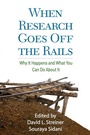
David L. Streiner | Souraya Sidani
When Research Goes Off the Rails
Why It Happens and What You Can Do About It
E-Book
03/2011
The Guilford Press
€58.99
Available for download
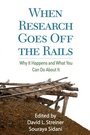
David L. Streiner | Souraya Sidani
When Research Goes Off the Rails
Why It Happens and What You Can Do About It
Book
11/2009
1st Edition
Guilford Publications
€102.93
Article exhausted; check different version
Persons
David L. Streiner is Senior Scientist at the Baycrest Centre for Geriatric Care and Professor of Psychiatry at the University of Toronto.
Souraya Sidani is Canada Research Chair, Tier One, in Health Interventions Design and Evaluation at Toronto Metropolitan University.
Souraya Sidani is Canada Research Chair, Tier One, in Health Interventions Design and Evaluation at Toronto Metropolitan University.
Content
Going Off the Rails: An Introduction, Souraya Sidani and David L. Streiner
I. Ethics Approval
1. When Mountains Move Too Slowly, Melanie A. Hwalek and Victoria L. Straub
2. The Ethics of Sex Research on the Internet, Alissa Sherry and Amy Amidon
3. When Safeguards Become Straitjackets: How Ethics Research Board Requirements Might Contribute to Ethical Dilemmas in Studies with Marginalized Populations, Mechthild Meyer, Alma Estable, Lynne MacLean, and Nancy Edwards
4. Going Off the Rails for aEURoeLove or MoneyaEUR: Implementation Issues Related to Payment of Research Participants in an Addiction-Research Project, Brian R. Rush and Dominique Morisano
II. Accessing the Participants
5. Frailty, Thy Name Is Macho, JosA (c) Quirino dos Santos
6. Power in Numbers: Research with Families in Long-Term Care, Julie M. Dergal Serafini
7. Getting the Wrong Gatekeeper, Lynne MacLean
8. Breaking into Court, Mandeep K. Dhami and Karen A. Souza
9. The RDC Archipelago, Scott Veldhuizen, John Cairney, and David L. Streiner
III. Recruitment and Retention
10. Small Colleges and Small naEUR (TM)s, Christopher Koch and Anna Tabor
11. Mitigating the Impact of External Forces, Souraya Sidani, David L. Streiner, and Chantale Marie LeClerc
12. A Trip to the School of Hard Knocks: Recruiting Participants from Health Service Agencies for Qualitative Studies of Aging, Kathleen W. Piercy
13. All Aboard!: Using Community Leaders to Keep Clinical Researchers on Track, Philippe Barrette
14. Changing Horses in Midstream: Transforming a Study to Address Recruitment Problems, Anthony S. Joyce
15. When Cost Meets Efficiency: Rethinking Ways to Sample a Rare Population, Julian Montoro-Rodriguez and Gregory C. Smith
16. The Story Is in the Numbers, Robert van Reekum
17. Strategies for Retaining Participants in Longitudinal Research with Economically Disadvantaged and Ethnically Diverse Samples, Elizabeth A. Goncy, Michelle E. Roley, and Manfred H. M. van Dulmen
18. Culturally Specific Strategies for Retention and Adherence to Physical Activity Interventions in Hispanic Women, Colleen Keller, Julie Fleury, and Adrianna Perez
IV. Study Implementation
19. When a Beautiful Intervention Meets Ugly Reality: Implementing an Intervention in the Real World, Souraya Sidani, David L. Streiner, and Chantale Marie LeClerc
20. When Saving Blood Goes Wrong, Claudio S. CinA and Catherine M. Clase
21. PDA = Pretty Darned Awful: The Trials and Tribulations of Running Trials of PDAs, Geoffrey R. Norman
22. When Sugar Is Not So Sweet: Camera Shyness and Intentional Cointervention Almost Derail a Study, FranA?oise Filion and C. Celeste Johnston
23. Placebo Problems: Power and Persecution, or Paranoia?, Robert van Reekum
V. Data Collection
24. Revisiting Traditional Survey Methodology to Recruit and Survey Lesbian, Gay, and Bisexual Older Adults, S. Melinda Spencer and Julie Hicks Patrick
25. Technology: Help or Hindrance?, Nasreen Roberts
26. Hoist on Our Own Postcard, David L. Streiner
27. On the Finer Points of Handling Googlies: Reflections on Hits, Near Misses, and Full-Blown Swings at the Air in Large, Population-Based Studies Involving School, Parents, and Children, John Cairney, John A. Hay, and Brent E. Faught
28. Pets, Pies, and Videotape: Conducting In-Home Observational Research with Late-Life Intergenerational Families, Brian D. Carpenter and Steve Balsis
29. Underfunded but Not Undone, Dianne Bryant
30. Community-Based Participatory Research: A Lesson in Humility, Dennis Watson
31. Where Did All the Bodies Go?, Harry S. Shannon
32. Measures for Improving Measures, Katherine McKnight, and Patrick E. McKnight
VI. Data Analysis
33. Drowsing Over Data: When Less Is More, Lynne MacLean, Alma Estable, Mechthild Meyer, Anita Kothari, Nancy Edwards, and Barb Riley
34. Bigger Is Not Always Better: Adventures in the World of Survey Data Analysis, Sylvia Kairouz and Louise Nadeau
35. Taking Aim at a Moving Target: When a Study Changes in the Middle, Arturo MartA--Carvajal
36. Lack of Normative Data as an Obstacle to Neuropsychological Assessment, F. Richard Ferraro and Kaylee Trottier-Wolter
37. These Data Do Not Compute, Lynne MacLean, Mechthild Meyer, Alma Estable, Anita Kothari, and Nancy Edwards
38. Avoiding Data Disasters and Other Pitfalls, Melinda F. Davis
39. When Interpretation Goes Awry: The Impact of Interim Testing, Dale Glaser
VII. Collaboration
40. What Happened to Cooperation and Collaboration?, Nasreen Roberts
41. Presto! ItaEUR (TM)s Gone: When a Study Ceases to Exist Right before Your Eyes, Katrina L. Bledsoe
42. Building Stakeholder Capacity to Enhance Effectiveness in Participatory Program Evaluation, Debazou Y. Yantio
VIII. Final Thoughts
43. Sometimes It Is the Researcher, Not the Research, That Goes aEURoeOff the RailsaEUR: The Value of Clear, Complete, and Precise Information in Scientific Reports, Joseph A. Durlak, Christine I. Celio, Molly K. Pachan, and Kriston B. Schellinger
44. A Healthy Dose of Realism, Souraya Sidani and David L. Streiner
I. Ethics Approval
1. When Mountains Move Too Slowly, Melanie A. Hwalek and Victoria L. Straub
2. The Ethics of Sex Research on the Internet, Alissa Sherry and Amy Amidon
3. When Safeguards Become Straitjackets: How Ethics Research Board Requirements Might Contribute to Ethical Dilemmas in Studies with Marginalized Populations, Mechthild Meyer, Alma Estable, Lynne MacLean, and Nancy Edwards
4. Going Off the Rails for aEURoeLove or MoneyaEUR: Implementation Issues Related to Payment of Research Participants in an Addiction-Research Project, Brian R. Rush and Dominique Morisano
II. Accessing the Participants
5. Frailty, Thy Name Is Macho, JosA (c) Quirino dos Santos
6. Power in Numbers: Research with Families in Long-Term Care, Julie M. Dergal Serafini
7. Getting the Wrong Gatekeeper, Lynne MacLean
8. Breaking into Court, Mandeep K. Dhami and Karen A. Souza
9. The RDC Archipelago, Scott Veldhuizen, John Cairney, and David L. Streiner
III. Recruitment and Retention
10. Small Colleges and Small naEUR (TM)s, Christopher Koch and Anna Tabor
11. Mitigating the Impact of External Forces, Souraya Sidani, David L. Streiner, and Chantale Marie LeClerc
12. A Trip to the School of Hard Knocks: Recruiting Participants from Health Service Agencies for Qualitative Studies of Aging, Kathleen W. Piercy
13. All Aboard!: Using Community Leaders to Keep Clinical Researchers on Track, Philippe Barrette
14. Changing Horses in Midstream: Transforming a Study to Address Recruitment Problems, Anthony S. Joyce
15. When Cost Meets Efficiency: Rethinking Ways to Sample a Rare Population, Julian Montoro-Rodriguez and Gregory C. Smith
16. The Story Is in the Numbers, Robert van Reekum
17. Strategies for Retaining Participants in Longitudinal Research with Economically Disadvantaged and Ethnically Diverse Samples, Elizabeth A. Goncy, Michelle E. Roley, and Manfred H. M. van Dulmen
18. Culturally Specific Strategies for Retention and Adherence to Physical Activity Interventions in Hispanic Women, Colleen Keller, Julie Fleury, and Adrianna Perez
IV. Study Implementation
19. When a Beautiful Intervention Meets Ugly Reality: Implementing an Intervention in the Real World, Souraya Sidani, David L. Streiner, and Chantale Marie LeClerc
20. When Saving Blood Goes Wrong, Claudio S. CinA and Catherine M. Clase
21. PDA = Pretty Darned Awful: The Trials and Tribulations of Running Trials of PDAs, Geoffrey R. Norman
22. When Sugar Is Not So Sweet: Camera Shyness and Intentional Cointervention Almost Derail a Study, FranA?oise Filion and C. Celeste Johnston
23. Placebo Problems: Power and Persecution, or Paranoia?, Robert van Reekum
V. Data Collection
24. Revisiting Traditional Survey Methodology to Recruit and Survey Lesbian, Gay, and Bisexual Older Adults, S. Melinda Spencer and Julie Hicks Patrick
25. Technology: Help or Hindrance?, Nasreen Roberts
26. Hoist on Our Own Postcard, David L. Streiner
27. On the Finer Points of Handling Googlies: Reflections on Hits, Near Misses, and Full-Blown Swings at the Air in Large, Population-Based Studies Involving School, Parents, and Children, John Cairney, John A. Hay, and Brent E. Faught
28. Pets, Pies, and Videotape: Conducting In-Home Observational Research with Late-Life Intergenerational Families, Brian D. Carpenter and Steve Balsis
29. Underfunded but Not Undone, Dianne Bryant
30. Community-Based Participatory Research: A Lesson in Humility, Dennis Watson
31. Where Did All the Bodies Go?, Harry S. Shannon
32. Measures for Improving Measures, Katherine McKnight, and Patrick E. McKnight
VI. Data Analysis
33. Drowsing Over Data: When Less Is More, Lynne MacLean, Alma Estable, Mechthild Meyer, Anita Kothari, Nancy Edwards, and Barb Riley
34. Bigger Is Not Always Better: Adventures in the World of Survey Data Analysis, Sylvia Kairouz and Louise Nadeau
35. Taking Aim at a Moving Target: When a Study Changes in the Middle, Arturo MartA--Carvajal
36. Lack of Normative Data as an Obstacle to Neuropsychological Assessment, F. Richard Ferraro and Kaylee Trottier-Wolter
37. These Data Do Not Compute, Lynne MacLean, Mechthild Meyer, Alma Estable, Anita Kothari, and Nancy Edwards
38. Avoiding Data Disasters and Other Pitfalls, Melinda F. Davis
39. When Interpretation Goes Awry: The Impact of Interim Testing, Dale Glaser
VII. Collaboration
40. What Happened to Cooperation and Collaboration?, Nasreen Roberts
41. Presto! ItaEUR (TM)s Gone: When a Study Ceases to Exist Right before Your Eyes, Katrina L. Bledsoe
42. Building Stakeholder Capacity to Enhance Effectiveness in Participatory Program Evaluation, Debazou Y. Yantio
VIII. Final Thoughts
43. Sometimes It Is the Researcher, Not the Research, That Goes aEURoeOff the RailsaEUR: The Value of Clear, Complete, and Precise Information in Scientific Reports, Joseph A. Durlak, Christine I. Celio, Molly K. Pachan, and Kriston B. Schellinger
44. A Healthy Dose of Realism, Souraya Sidani and David L. Streiner