

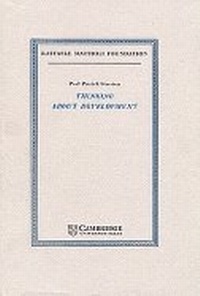
Thinking about Development
Published on 29. September 1995
Book
Hardback
425 pages
978-0-521-48276-9 (ISBN)
Description
Paul Streeten is recognised as one of the profession's most eminent authorities on economic development. In these lectures he provides a major statement on his approach to the development problem, stressing that human development, not simply income growth, should be the focus of all strategies to eradicate hunger and poverty in the world. His argument assigns an important role to reformed government - both in providing social services and in facilitating the functioning of markets - in opposition to the prevailing idea that minimal government is more often than not the optimal solution. The role of small and larger firms, institutions, central and local government is also carefully examined. Streeten outlines a normative political economy - how to mobilise reformist alliances, how to use interest group, how to harness coalition - in the pursuit of effective development.
More details
Series
Language
English
Place of publication
Cambridge
United Kingdom
Target group
Professional and scholarly
Dimensions
Height: 254 mm
Width: 175 mm
Thickness: 41 mm
Weight
1110 gr
ISBN-13
978-0-521-48276-9 (9780521482769)
Copyright in bibliographic data and cover images is held by Nielsen Book Services Limited or by the publishers or by their respective licensors: all rights reserved.
Schweitzer Classification
Other editions
New editions
Paul Patrick Streeten
Thinking about Development
Book
07/1997
Cambridge University Press
€58.60
Shipment within 15-20 days
Additional editions
Paul Patrick Streeten
Thinking about Development
Book
07/1997
Cambridge University Press
€58.60
Shipment within 15-20 days
Person
Content
Preface; Introduction; 1. The evolution of development thought; 2. Global institutions for an interdependent world; 3. The judo trick: the role of direct foreign investment in developing countries; 4. Markets and states: against minimalism and dichotomy; 5. The political economy of reform; Discussion; Bibliography.