

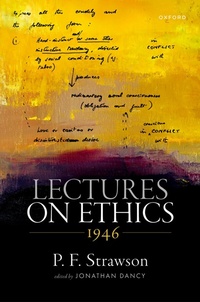
Lectures on Ethics, 1946
Published on 31. October 2024
Book
Hardback
192 pages
978-0-19-893116-4 (ISBN)
Description
This volume presents a series of lectures given by P. F. Strawson to final-year undergraduates at the University of Wales, Bangor, in the autumn term of 1946. Strawson was appointed to a lectureship at Bangor immediately after his military service in World War Two; he held this post for only one year before returning to Oxford, to a teaching position at University College. He eventually became one of the leading figures in twentieth-century philosophy. The lectures survive in manuscript form in the Bodleian Library in Oxford, and have been prepared for publication by Jonathan Dancy. Lectures on Ethics, 1946 contains the germ of Strawson's developed thought on freedom, moral attitudes, and ethical ideals, with an unusual level of attention being paid to contemporary psychological research. Other topics covered include the contrast between consequentialist and other moral theories, the analysis of moral judgements, and the nature of moral obligation.
Reviews / Votes
Strawson was exceptionally productive among analytic philosophers of his time, writing extensively about metaphysics, epistemology, philosophical logic, and philosophy of language. He published very little about ethics. These lectures reveal that he was a creative and penetrating thinker about moral philosophy as well. * Tom Nagel, Society *More details
Language
English
Place of publication
Oxford
United Kingdom
Target group
College/higher education
Product notice
sewn/stitched
Cloth over boards
Dimensions
Height: 240 mm
Width: 164 mm
Thickness: 21 mm
Weight
463 gr
ISBN-13
978-0-19-893116-4 (9780198931164)
Copyright in bibliographic data and cover images is held by Nielsen Book Services Limited or by the publishers or by their respective licensors: all rights reserved.
Schweitzer Classification
Other editions
Additional editions
P. F. Strawson | Jonathan Dancy
Lectures on Ethics, 1946
E-Book
10/2024
OUP eBook
€70.99
Available for download
P. F. Strawson | Jonathan Dancy
Lectures on Ethics, 1946
E-Book
10/2024
OUP eBook
€70.99
Available for download
Persons
P. F. Strawson (1919-2006) was a professor at Oxford from 1968 to 1987. Prior to that, he taught at University of Wales, Bangor in the academic year 1946-47. He was elected a Fellow of the British Academy in 1960, became a foreign honorary member of the American Academy of Arts of Sciences in 1971, and was an Honorary Fellow of St John's, University, and Magdalen Colleges, Oxford. Strawson was knighted in 1977 for his outstanding contribution to philosophy. His influential works include Individuals (1959), The Bounds of Sense (1966), and Freedom and Resentment (1974).
Jonathan Dancy is Professor of Philosophy Emeritus at the University of Texas at Austin.
Jonathan Dancy is Professor of Philosophy Emeritus at the University of Texas at Austin.
Content
Jonathan Dancy: Foreword
Lectures on Ethics
Elementary Ethics - Lecture Scheme
Lecture 1. The Disputes of Moral Philosophers
Lecture 2
Lecture 3
Lecture 4
Lecture 5
Lecture 6. The Dualism of Motive in Kant: Obligation
Lecture 7. The Dualism in Motive: Egoistic Desires and Disinterested Desires
Lecture 8. Moral Development: Duty, Motive and Instinct
Lecture 9. The Genesis of Obligation: Duty and Reason
Lecture 10. Duties and Goods and 'Rightness'
Lecture 11. The Epistemological Question
Lecture 12. The Analysis of Moral Judgements
Lecture 13. The Problem of Freedom
Lectures on Ethics
Elementary Ethics - Lecture Scheme
Lecture 1. The Disputes of Moral Philosophers
Lecture 2
Lecture 3
Lecture 4
Lecture 5
Lecture 6. The Dualism of Motive in Kant: Obligation
Lecture 7. The Dualism in Motive: Egoistic Desires and Disinterested Desires
Lecture 8. Moral Development: Duty, Motive and Instinct
Lecture 9. The Genesis of Obligation: Duty and Reason
Lecture 10. Duties and Goods and 'Rightness'
Lecture 11. The Epistemological Question
Lecture 12. The Analysis of Moral Judgements
Lecture 13. The Problem of Freedom