

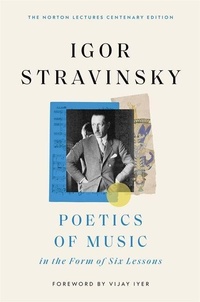
Poetics of Music in the Form of Six Lessons
Published on 16. September 2025
Book
Hardback
144 pages
978-0-674-30243-3 (ISBN)
Description
Timeless lessons on the pleasures of listening, the dilemmas of composition, and the meaning of artistic freedom from a founder of musical modernism.
In October 1939, Igor Stravinsky took the stage at Harvard not as a conductor but as a speaker. Invited to deliver the prestigious Norton Lectures, he had departed Europe just days after the outbreak of war, leaving behind not only a growing political maelstrom but also his life in France, where his wife, eldest daughter, and mother all had died in the previous year.
Poetics of Music offers a snapshot of this pivotal moment in the composer's biography and career. Delivered at the height of his neoclassical period, which blended the sculptural precision of classicism with distinctively twentieth-century cadences, Stravinsky's lectures explore both the creative potential and the constraints of tradition. Though he achieved artistic immortality as a genre-defying experimentalist who scandalized audiences in Belle Epoque Paris, the Stravinsky we find here is more circumspect, defending the dignity of formal conventions against the more anarchic currents of modernist experimentation. Tradition, he argues, is not a relic of a bygone past but a living force that animates the present. And true artistic freedom emerges not only in moments of revolutionary inspiration but also through strict deference to the formal requirements of the work.
Like his compositions, Stravinsky's lectures are ambitious and at times bombastic, punctuated by wit and polemic. Ranging widely from the phenomenology of rhythm to the fate of high culture in the Soviet Union, he invites us to reflect on what it is in music that compels us, whether we are hearing one of his polytonal works or a simple birdsong.
In October 1939, Igor Stravinsky took the stage at Harvard not as a conductor but as a speaker. Invited to deliver the prestigious Norton Lectures, he had departed Europe just days after the outbreak of war, leaving behind not only a growing political maelstrom but also his life in France, where his wife, eldest daughter, and mother all had died in the previous year.
Poetics of Music offers a snapshot of this pivotal moment in the composer's biography and career. Delivered at the height of his neoclassical period, which blended the sculptural precision of classicism with distinctively twentieth-century cadences, Stravinsky's lectures explore both the creative potential and the constraints of tradition. Though he achieved artistic immortality as a genre-defying experimentalist who scandalized audiences in Belle Epoque Paris, the Stravinsky we find here is more circumspect, defending the dignity of formal conventions against the more anarchic currents of modernist experimentation. Tradition, he argues, is not a relic of a bygone past but a living force that animates the present. And true artistic freedom emerges not only in moments of revolutionary inspiration but also through strict deference to the formal requirements of the work.
Like his compositions, Stravinsky's lectures are ambitious and at times bombastic, punctuated by wit and polemic. Ranging widely from the phenomenology of rhythm to the fate of high culture in the Soviet Union, he invites us to reflect on what it is in music that compels us, whether we are hearing one of his polytonal works or a simple birdsong.
Reviews / Votes
A quintessence of Stravinsky's reactions to the phenomenon of music. Poetics of Music offers the most coherent statement of the unchanging values behind Stravinsky's many apparent shifts of manner: his insistence, for example, that music should be a revelation of a higher order to be faithfully executed by the performer, rather than a medium of self-expression to be interpreted. Above all, the composer must submit to rules, no matter how arbitrary, for 'the more constraints one imposes, the more one frees one's self of the chains that shackle the spirit.' -- G. W. Hopkins * Musical Times * [These lectures] provide penetrating glimpses into the thought processes of Stravinsky's mind. While dealing with his chosen topics-the phenomenon of music, the composition of music, musical typology, the avatars of Russian music, and the performance of music-he reveals his reverence for tradition, order and discipline. * The American Recorder *More details
Series
Language
English
Place of publication
Cambridge, Mass
United States
Target group
College/higher education
Illustrations
1 photo
Dimensions
Height: 212 mm
Width: 139 mm
Thickness: 18 mm
Weight
288 gr
ISBN-13
978-0-674-30243-3 (9780674302433)
Copyright in bibliographic data and cover images is held by Nielsen Book Services Limited or by the publishers or by their respective licensors: all rights reserved.
Schweitzer Classification
Persons
Igor Stravinsky (1882-1971) was one of the twentieth century's most admired and influential composers, conductors, and music theorists. His ballets and symphonies, including The Firebird, Petrushka, and The Rite of Spring, cemented his central place in the evolution of musical modernism. Vijay Iyer is an award-winning composer, pianist, and music scholar. The recipient of a MacArthur Fellowship and the Doris Duke Performing Artist Award, he has been named Jazz Artist of the Year four times by the DownBeat International Critics' Poll. He is Franklin D. and Florence Rosenblatt Professor of the Arts at Harvard University, where he directs a doctoral program in Creative Practice and Critical Inquiry. George Seferis (1900-1971) was a Nobel Prize-winning Greek poet, essayist, and diplomat. One of the most influential Greek authors of his generation, he received honorary doctorates from Cambridge, Oxford, and Princeton, and was made an honorary foreign member of the American Academy of Arts and Sciences. From 1957 to 1962, he served as Greek Ambassador to the United Kingdom.