

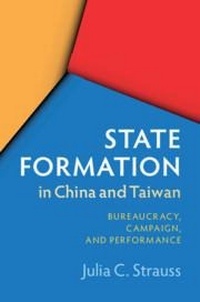
State Formation in China and Taiwan
Bureaucracy, Campaign, and Performance
Published on 7. November 2019
Book
Paperback/Softback
292 pages
978-1-108-70165-5 (ISBN)
Description
This is an ambitious comparative study of regime consolidation in the 'revolutionary' People's Republic of China and the 'conservative' Republic of China (Taiwan) in the years following the communist victory against the nationalists on the Chinese mainland in 1949. Julia C. Strauss argues that accounting for these two variants of the Chinese state solely in terms of their divergent ideology and institutions fails to recognise their similarities and their relative successes. Both, after all, emerged from a common background of Leninist party organization amid civil war and foreign invasion. However, by the mid-1950s they were on clearly different trajectories of state-building and development. Focusing on Sunan and Taiwan, Strauss considers state personnel, the use of terror and land reform to explore the evolution of these revolutionary and conservative regimes between 1949 and 1954. In so doing, she sheds important new light on twentieth-century political change in East Asia, deepening our understanding of state formation.
Reviews / Votes
'A meticulously researched and elegantly presented study of state consolidation in mainland China and Taiwan. By shrinking the mainland geographic focus to Sunan, where the social roots of the communists were relatively weak, Strauss exploits rich archival data and builds analytical leverage to illuminate commonalities and differences in strategies of the two states as outsiders after 1949.' Melanie Manion, Duke University, North Carolina 'Historians have long recognized that for all their mutual hostility and apparent ideological opposition, the two regimes on either side of the Taiwan Strait after 1949 actually had much in common. In this provocative and impressively researched work, Julia C. Strauss treats this parallelism as a kind of natural experiment in state consolidation, which she analyzes to produce more general insight into how new states pursue their agendas.' Michael Szonyi, Harvard University, Massachusetts 'Strauss (Univ. of London) has authored a fascinating comparison of two variants of the Chinese party-state in the mid-20th century.' S. C. Hart, Choice 'Overall, an excellent book, well worth the attention that it will receive from both historians of modern China and political scientists interested in state formation.' Carl Minzner, Journal of Chinese Political ScienceMore details
Language
English
Place of publication
Cambridge
United Kingdom
Target group
Professional and scholarly
Product notice
Paperback (trade)
Illustrations
Worked examples or Exercises; 11 Halftones, black and white
Dimensions
Height: 238 mm
Width: 168 mm
Thickness: 23 mm
Weight
635 gr
ISBN-13
978-1-108-70165-5 (9781108701655)
Copyright in bibliographic data and cover images is held by Nielsen Book Services Limited or by the publishers or by their respective licensors: all rights reserved.
Schweitzer Classification
Other editions
Additional editions
Book
11/2019
Cambridge University Press
€102.90
Shipment within 15-20 days
E-Book
10/2019
Cambridge University Press
€22.49
Available for download
Person
Julia C. Strauss is Professor of Chinese Politics at School of Oriental and African Studies, University of London, where she served as Editor of The China Quarterly from 2002 to 2011. Her work focuses on the twentieht-century Chinese state in China and Taiwan, the performative dimensions of politics, and China's 'Going Out' to the developing world, particularly towards Africa, and has published widely on these topics.
Content
Introduction. Modalities of state building and institution building: bureaucracies, campaigns, and performance; 1. Virtue and talent in making Chinese states: heroes and technocrats in Sunan and Taiwan, 1949-1954; 2. Comparative terror in regime consolidation: Sunan and Taiwan, 1949-1954; 3. Performing terror: lenience, legality, and the dramaturgy of the consolidating state; 4. Repertoires of land reform campaigns in Sunan and Taiwan, 1950-1954; 5. Theatres of land reform: bureaucracy, campaign, and the show, 1950-1954; Conclusion; Appendix: list of interviewees; Documentary collections, reports, and periodicals.