

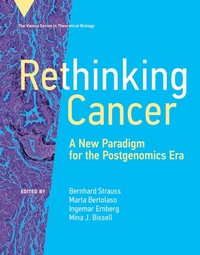
Rethinking Cancer
A New Paradigm for the Postgenomics Era
Published on 27. April 2021
Book
Hardback
376 pages
978-0-262-04521-6 (ISBN)
Description
Leading scientists argue for a new paradigm for cancer research, proposing a complex systems view of cancer supported by empirical evidence.
Current consensus in cancer research explains cancer as a disease caused by specific mutations in certain genes. After dramatic advances in genome sequencing, never before have we known so much about the individual cancer cell--and yet never before has it been so unclear what to do with this knowledge. In this volume, leading researchers argue for a new theory framework for understanding and treating cancer. The contributors propose a complex systems view of cancer, presenting conceptual building blocks for a new research paradigm supported by empirical evidence.
Current consensus in cancer research explains cancer as a disease caused by specific mutations in certain genes. After dramatic advances in genome sequencing, never before have we known so much about the individual cancer cell--and yet never before has it been so unclear what to do with this knowledge. In this volume, leading researchers argue for a new theory framework for understanding and treating cancer. The contributors propose a complex systems view of cancer, presenting conceptual building blocks for a new research paradigm supported by empirical evidence.
More details
Language
English
Place of publication
Cambridge (Massachusetts)
United States
Publishing group
MIT Press Ltd
Illustrations
34 black and white illustrations
Dimensions
Height: 237 mm
Width: 188 mm
Thickness: 35 mm
Weight
945 gr
ISBN-13
978-0-262-04521-6 (9780262045216)
Copyright in bibliographic data and cover images is held by Nielsen Book Services Limited or by the publishers or by their respective licensors: all rights reserved.
Schweitzer Classification
Other editions
Additional editions
Bernhard Strauss | Marta Bertolaso | Ingemar Ernberg
Rethinking Cancer
A New Paradigm for the Postgenomics Era
E-Book
04/2021
MIT Press
€58.99
Available for download
Persons
edited by Bernhard Strauss, Marta Bertolaso, Ingemar Ernberg, and Mina J. Bissell
Content
Series Foreword ix
Preface xi
1 Introduction and Overview 1
I REDEFINING THE PROBLEM: THE THEORY DIMENSION OF CANCER 11
2 The Search for Progress and a New Theory Framework in Cancer Research 13
3 Cancer as a System: Hard Lessons from Physics and a Way Forward 41
II THE SYSTEMS DIMENSION OF CANCER 61
4 The Logic of Cancer Treatment: Why It Is So Hard to Cure Cancer; Treatment-Induced Progression, Hyper-Progression, and the Nietzsche Effect 63
5 The Cell Attractor Concept as a Tool to Advance Our Understanding of Cancer 129
6 Adaptation of Molecular Interaction Networks in Cancer Cells 141
7 The Role of Genomic Dark Matter in Cancer: Using AI to Shine a Light on It; Why Cancer Genes Are Not the Whole Story 163
III THE TIME DIMENSION OF CANCER 185
8 Darwinism, Not Mutationalism, for New Cancer Therapies 187
9 Cancer as a Reversion to an Ancestral Phenotype 205
10 Time and Timing in Oncology: What Therapy Scheduling Can Teach Us about Cancer Biology 227
IV THE MICRO-/ENVIRONMENT DIMENSION OF CANCER 245
11 Tissue Tension Modulates Metabolism and Chromatin Organization to Promote Malignancy 247
12 Cancer Metabolism and Therapeutic Perspectives: Exploiting Acidic, Nutritional, and Oxidative Stresses 271
13 Corrupted Vascular Tumor Niches Confer Aggressiveness and Chemoresistance to Neoplastic Cells 299
14 Metastasis as a Tug of War between Cell Autonomy and Microenvironmental Control: Readdressing Unresolved Questions in Cancer Metastasis 323
15 Niche Reconstruction to Revert or Transcend the Cancer State 353
V WHAT NEXT? 391
Contributors 397
Index 399
Preface xi
1 Introduction and Overview 1
I REDEFINING THE PROBLEM: THE THEORY DIMENSION OF CANCER 11
2 The Search for Progress and a New Theory Framework in Cancer Research 13
3 Cancer as a System: Hard Lessons from Physics and a Way Forward 41
II THE SYSTEMS DIMENSION OF CANCER 61
4 The Logic of Cancer Treatment: Why It Is So Hard to Cure Cancer; Treatment-Induced Progression, Hyper-Progression, and the Nietzsche Effect 63
5 The Cell Attractor Concept as a Tool to Advance Our Understanding of Cancer 129
6 Adaptation of Molecular Interaction Networks in Cancer Cells 141
7 The Role of Genomic Dark Matter in Cancer: Using AI to Shine a Light on It; Why Cancer Genes Are Not the Whole Story 163
III THE TIME DIMENSION OF CANCER 185
8 Darwinism, Not Mutationalism, for New Cancer Therapies 187
9 Cancer as a Reversion to an Ancestral Phenotype 205
10 Time and Timing in Oncology: What Therapy Scheduling Can Teach Us about Cancer Biology 227
IV THE MICRO-/ENVIRONMENT DIMENSION OF CANCER 245
11 Tissue Tension Modulates Metabolism and Chromatin Organization to Promote Malignancy 247
12 Cancer Metabolism and Therapeutic Perspectives: Exploiting Acidic, Nutritional, and Oxidative Stresses 271
13 Corrupted Vascular Tumor Niches Confer Aggressiveness and Chemoresistance to Neoplastic Cells 299
14 Metastasis as a Tug of War between Cell Autonomy and Microenvironmental Control: Readdressing Unresolved Questions in Cancer Metastasis 323
15 Niche Reconstruction to Revert or Transcend the Cancer State 353
V WHAT NEXT? 391
Contributors 397
Index 399