

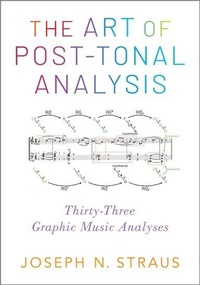
The Art of Post-Tonal Analysis
Thirty-Three Graphic Music Analyses
Published on 13. June 2022
Book
Paperback/Softback
240 pages
978-0-19-754398-6 (ISBN)
Description
The Art of Post-Tonal Analysis consists of analyses of thirty-three musical passages or entire short works in a variety of post-tonal styles. For each piece author Joseph N. Straus shows how it is put together and what sense might be made of it: how the music goes. Along the way, he shows the value of post-tonal theory in addressing these questions, and in revealing something of the fascination and beauty of this music. The works under study are taken from throughout the long twentieth century, from 1909 to the present. Within the atonal wing of modern classical music, the composers discussed here, some canonical and some not, represent a diversity of musical style, chronology, geography, gender, and race/ethnicity.
Musical examples, plus a companion website full of analytical videos, carry the burden of the analytical argument, with rarely more than a few sentences of prose at a time. In writing these analyses, Straus imagined teaching these pieces to a class of undergraduate or graduate students, seated at the piano, pointing at score, listening as they go--the book is intended as a record of these (hypothetical) classes. His approach could be loosely described as transformational, rooted in an interest in seeing how musical ideas (shapes, intervals, motives) grow, change, and effloresce. When musical ideas are obviously dissimilar and possibly in conflict, the book teases out subtle points of connection between them. Above all, the book aims to create rich networks of relatedness, allowing our musical minds and musical ears to lead each other along some of the many enjoyable pathways through this challenging and beautiful music.
Musical examples, plus a companion website full of analytical videos, carry the burden of the analytical argument, with rarely more than a few sentences of prose at a time. In writing these analyses, Straus imagined teaching these pieces to a class of undergraduate or graduate students, seated at the piano, pointing at score, listening as they go--the book is intended as a record of these (hypothetical) classes. His approach could be loosely described as transformational, rooted in an interest in seeing how musical ideas (shapes, intervals, motives) grow, change, and effloresce. When musical ideas are obviously dissimilar and possibly in conflict, the book teases out subtle points of connection between them. Above all, the book aims to create rich networks of relatedness, allowing our musical minds and musical ears to lead each other along some of the many enjoyable pathways through this challenging and beautiful music.
Reviews / Votes
Joseph Straus, who has given us the classic text Introduction to Post-Tonal Theory, now provides a refreshingly diverse introduction to post-tonal repertoire. Concise multimedia analyses offer entry-points into pieces, composers, and analytical skills. These Graphic Music Analyses will be tremendously useful for teachers and students alike. * Daphne Leong, University of Colorado Boulder * Equal parts brass tacks and fudge brownies, these analyses will challenge and delight. The repertoire is appealingly varied, the musical instincts spot-on, and the prose clear and compact. * Julian Hook, Jacobs School of Music, Indiana University * Author of Introduction to Post-Tonal Theory (2016), Joseph Straus has gifted post-tonal pedagogues with this compendium that complements many of the concepts and analyses in his popular textbook. This text is unique in its assemblage of self-contained analytical vignettes, brought to life through multimedia. This last element-multimedia integration-makes the text particularly appropriate for use in the classroom. Those who engage this text without pedagogical intentions but, rather, for the pleasure of analysis itself will find Strausas work enriching. He has placed great care into both selecting previously underappreciated works that provide opportunities for compelling interpretative arguments and reexamining familiar works through a fresh lens. There is something for everyoneafrom the novice post-tonal instructor to the experienced analyst-to enjoy. * Gerardo Lopez, Integral * Straus is... a leading authority on disability studies, and some of the features of the book and accompanying website seem designed to accommodate different learning styles...He also consistently uses analysis to support issues of interpretation, particularly of text-setting. * Christian Carey, Tempo * Joseph N. Straus's most recent book is a masterclass in the pedagogical presentation of post-tonal analysis. Straus defines his approach within the domain of post-tonal theory, primarily focusing on pitch, through a lens that "could be loosely described as transformational". * David Floyd, Notes: the Quarterly Journal of the Music Library Association 81:1 *More details
Language
English
Place of publication
New York
United States
Target group
College/higher education
Product notice
Paperback (trade)
Unsewn / adhesive bound
Illustrations
400 examples
Dimensions
Height: 246 mm
Width: 178 mm
Thickness: 15 mm
Weight
480 gr
ISBN-13
978-0-19-754398-6 (9780197543986)
Copyright in bibliographic data and cover images is held by Nielsen Book Services Limited or by the publishers or by their respective licensors: all rights reserved.
Schweitzer Classification
Other editions
Additional editions
Book
06/2022
Oxford University Press Inc
€108.94
Shipment within 15-20 days
E-Book
03/2022
OUP eBook
€22.99
Available for download
Person
Joseph N. Straus is Distinguished Professor at the Graduate Center, City University of New York, where he has taught since 1985. After receiving his Ph.D. from Yale in 1981, he taught briefly at the University of Wisconsin and, in addition to his work at CUNY, has since held visiting positions at the University of Chicago, Harvard, Yale, Princeton, and NYU. During that time, he has written numerous articles and scholarly monographs on a variety of topics in modernist music. In recent years, he has also written a series of articles and books that engage disability as a cultural practice. He was President of the Society for Music Theory in the late 1990s.
Content
Preface
Chapter 1. Arnold Schoenberg, Piano Pieces, Op. 11, No. 1 (1909) Chapter 2. Anton Webern, Movements for String Quartet, Op. 5, No. 2 (1909)
Chapter 3. Alban Berg, Four Songs, Op. 2, No. 2, "Schlafend traegt man mich" (1910)
Chapter 4. Igor Stravinsky, The Rite of Spring, Introduction to Part One (1913)
Chapter 5. Igor Stravinsky, Three Pieces for String Quartet, No. 2 (1914) Chapter 6. Arnold Schoenberg, Five Piano Pieces, Op. 23, No. 3 (1923) Chapter 7. Bela Bartok, String Quartet No. 3, Prima parte (1927) Chapter 8. Aaron Copland, Piano Variations, Theme (1930) Chapter 9. Ruth Crawford (Seeger), Diaphonic Suite No. 1, first movement (1930) Chapter 10. Ruth Crawford (Seeger), String Quartet, first movement (1931) Chapter 11. Anton Webern, Three Songs, Op. 25, No. 1, "Wie bin ich froh!" (1934)
Chapter 12. Milton Babbitt, "The Widow's Lament in Springtime" (1951) Chapter 13. Luigi Dallapiccola, Goethe Lieder, No. 2, "Die Sonne kommt!" (1953) Chapter 14. Igor Stravinsky, Three Shakespeare Songs, No. 2, "Music to hear" (1953)
Chapter 15. Louise Talma, Holy Sonnets, "La Corona" (1955) Chapter 16. Hale Smith, Three Brevities for Solo Flute, No. 2 (1969) Chapter 17. Elisabeth Lutyens, Two Bagatelles, Op. 48, No. 1 (1962) Chapter 18. Igor Stravinsky, Fanfare for a New Theatre (1964) Chapter 19. Igor Stravinsky, Requiem Canticles, "Exaudi" (1966) Chapter 20. Ursula Mamlok, Panta Rhei for Piano, Violin, and Cello, third movement (1981) Chapter 21. Elliott Carter, Riconoscenza per Gofreddo Petrassi (for solo violin) (1984)
Chapter 22. Tania Leon, Ritual (1987) Chapter 23. Tan Dun, Intercourse of Fire and Water (for solo cello) (1996) Chapter 24. Shulamit Ran, Soliloquy (for Violin, Cello, and Piano) (1997) Chapter 25. Kaija Saariaho, Papillons (for solo cello), No. 3 (2000) Chapter 26. Joan Tower, Vast Antique Cubes (2000) Chapter 27. John Adams, On the Transmigration of Souls (2002) Chapter 28. Sofia Gubaidulina, Reflections on the Theme BACH (2002) Chapter 29. Thomas Ades, The Tempest, Act III, Scene 5 (2003) Chapter 30. Thomas Ades, Four Quarters (for String Quartet), "Days" (2010)
Chapter 31. Caroline Shaw, Valencia (for String Quartet) (2012) Chapter 32. Chen Yi, Energetic Duo (for two violins) (2015) Chapter 33. Suzanne Farrin, "Unico spirto," from Dolce la morte (2016)
Post-Tonal Primer
Bibliography
Index
Chapter 1. Arnold Schoenberg, Piano Pieces, Op. 11, No. 1 (1909) Chapter 2. Anton Webern, Movements for String Quartet, Op. 5, No. 2 (1909)
Chapter 3. Alban Berg, Four Songs, Op. 2, No. 2, "Schlafend traegt man mich" (1910)
Chapter 4. Igor Stravinsky, The Rite of Spring, Introduction to Part One (1913)
Chapter 5. Igor Stravinsky, Three Pieces for String Quartet, No. 2 (1914) Chapter 6. Arnold Schoenberg, Five Piano Pieces, Op. 23, No. 3 (1923) Chapter 7. Bela Bartok, String Quartet No. 3, Prima parte (1927) Chapter 8. Aaron Copland, Piano Variations, Theme (1930) Chapter 9. Ruth Crawford (Seeger), Diaphonic Suite No. 1, first movement (1930) Chapter 10. Ruth Crawford (Seeger), String Quartet, first movement (1931) Chapter 11. Anton Webern, Three Songs, Op. 25, No. 1, "Wie bin ich froh!" (1934)
Chapter 12. Milton Babbitt, "The Widow's Lament in Springtime" (1951) Chapter 13. Luigi Dallapiccola, Goethe Lieder, No. 2, "Die Sonne kommt!" (1953) Chapter 14. Igor Stravinsky, Three Shakespeare Songs, No. 2, "Music to hear" (1953)
Chapter 15. Louise Talma, Holy Sonnets, "La Corona" (1955) Chapter 16. Hale Smith, Three Brevities for Solo Flute, No. 2 (1969) Chapter 17. Elisabeth Lutyens, Two Bagatelles, Op. 48, No. 1 (1962) Chapter 18. Igor Stravinsky, Fanfare for a New Theatre (1964) Chapter 19. Igor Stravinsky, Requiem Canticles, "Exaudi" (1966) Chapter 20. Ursula Mamlok, Panta Rhei for Piano, Violin, and Cello, third movement (1981) Chapter 21. Elliott Carter, Riconoscenza per Gofreddo Petrassi (for solo violin) (1984)
Chapter 22. Tania Leon, Ritual (1987) Chapter 23. Tan Dun, Intercourse of Fire and Water (for solo cello) (1996) Chapter 24. Shulamit Ran, Soliloquy (for Violin, Cello, and Piano) (1997) Chapter 25. Kaija Saariaho, Papillons (for solo cello), No. 3 (2000) Chapter 26. Joan Tower, Vast Antique Cubes (2000) Chapter 27. John Adams, On the Transmigration of Souls (2002) Chapter 28. Sofia Gubaidulina, Reflections on the Theme BACH (2002) Chapter 29. Thomas Ades, The Tempest, Act III, Scene 5 (2003) Chapter 30. Thomas Ades, Four Quarters (for String Quartet), "Days" (2010)
Chapter 31. Caroline Shaw, Valencia (for String Quartet) (2012) Chapter 32. Chen Yi, Energetic Duo (for two violins) (2015) Chapter 33. Suzanne Farrin, "Unico spirto," from Dolce la morte (2016)
Post-Tonal Primer
Bibliography
Index