

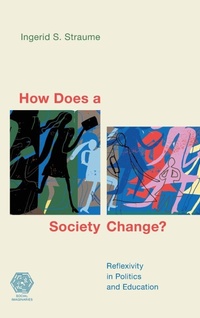
How Does a Society Change?
Reflexivity in Politics and Education
Published on 17. May 2023
Book
Hardback
158 pages
978-1-78661-152-9 (ISBN)
Description
One of the most challenging questions of today concerns how human activities threaten the conditions for our very own existence. With one crisis leading into the next, the need for socio-political change is necessary and desirable, yet so hard to imagine in practice. At the heart of the matter is a deeper crisis of the socio-political imagination.
To understand how a society produces and changes itself, Ingerid S. Straume points to historical and contemporary institutions and the imaginaries they embody, and argues that the key to social creativity is found in the reflexive potential of institutions, especially politics and education. Neoliberal rationality, on its part, has become dominant in many parts of the world, precisely by occulting the socio-political capacity for self-reflection. This occultation takes place in academic theories, policy reforms, technologies, and in individuals' self-understanding. In response to the planetary eco-crises and the weakening of democratic ideals, a new approach is needed where collectives, not individuals in isolation, become the mode for living well within existing, natural limits.
Inspired by important political thinkers such as Cornelius Castoriadis and Hannah Arendt, How Does a Society Change? develops a theoretical framework to elucidate how politics and education are two interrelated domains wherein a society may openly reflect upon itself. In short, a society that recognizes its capacity to change itself also recognizes the transformative, instituting potential of politics and education.
To understand how a society produces and changes itself, Ingerid S. Straume points to historical and contemporary institutions and the imaginaries they embody, and argues that the key to social creativity is found in the reflexive potential of institutions, especially politics and education. Neoliberal rationality, on its part, has become dominant in many parts of the world, precisely by occulting the socio-political capacity for self-reflection. This occultation takes place in academic theories, policy reforms, technologies, and in individuals' self-understanding. In response to the planetary eco-crises and the weakening of democratic ideals, a new approach is needed where collectives, not individuals in isolation, become the mode for living well within existing, natural limits.
Inspired by important political thinkers such as Cornelius Castoriadis and Hannah Arendt, How Does a Society Change? develops a theoretical framework to elucidate how politics and education are two interrelated domains wherein a society may openly reflect upon itself. In short, a society that recognizes its capacity to change itself also recognizes the transformative, instituting potential of politics and education.
Reviews / Votes
How Does a Society Change? dynamically and fruitfully contributes to acknowledging the complex role of educational matters in social imaginaries and societal change. In this compelling work, Ingerid Straume astutely points up the deeply political character of education and its inextricable connection to democracy. Straume's valuable book offers rich accounts of current crises of the social imagination and apposite, critical explorations of neoliberal detrimental effects on democratic politics, while also pertinently reconstructing the educational normativity that serves the self-reflexive renewal of social institutions. -- Marianna Papastephanou, Department of Education, University of Cyprus Erudite, wide-ranging, thoughtful, and committed: Ingerid Straume's reflections raise the level of debate about democratic politics and education and lead it towards addressing the urgencies of our time. -- Peter Wagner, Catalan Institute for Research and Advanced Studies (ICREA), University of Barcelona Ingerid Straume's book is a vigorous and original proposal to integrate the philosophy of education into political philosophy, backed up by a well-informed polemic against dominant misconceptions, both neo-liberal and pseudo-radical. Its main message is that a defence of democracy requires a thorough rethinking of approaches to education. -- Johann P. Arnason, emeritus professor of sociology, La Trobe University, AustraliaMore details
Series
Language
English
Place of publication
United Kingdom
Publishing group
Bloomsbury Publishing PLC
Target group
Professional and scholarly
Dimensions
Height: 235 mm
Width: 157 mm
Thickness: 13 mm
Weight
389 gr
ISBN-13
978-1-78661-152-9 (9781786611529)
Copyright in bibliographic data and cover images is held by Nielsen Book Services Limited or by the publishers or by their respective licensors: all rights reserved.
Schweitzer Classification
Other editions
Additional editions
E-Book
05/2023
1st Edition
Rowman & Littlefield Publishers
€82.49
Available for download
E-Book
05/2023
1st Edition
Rowman & Littlefield Publishers
€82.49
Available for download
Person
Ingerid S. Straume is professor in education at Western Norway University of Applied Sciences. Her research is mostly interdisciplinary, spanning political and educational thought related to questions such as environmental politics, climate change, and depoliticization of the public sphere. Straume has published articles, book chapters, and books in English and Norwegian.
Content
Acknowledgements
Introduction: Political-Educational Questioning
Chapter 1: The Politics of Education
Chapter 2: Educational Imaginaries: From Investment to Question
Chapter 3: Conceptions of Education and Why It Matters
Chapter 4: Political Imaginaries of Democracy and Citizenship
Chapter 5: Extraordinary Politics, Extraordinary Education, or: How Does a Society Change?
Afterword
References
Index
About the Author
Introduction: Political-Educational Questioning
Chapter 1: The Politics of Education
Chapter 2: Educational Imaginaries: From Investment to Question
Chapter 3: Conceptions of Education and Why It Matters
Chapter 4: Political Imaginaries of Democracy and Citizenship
Chapter 5: Extraordinary Politics, Extraordinary Education, or: How Does a Society Change?
Afterword
References
Index
About the Author