

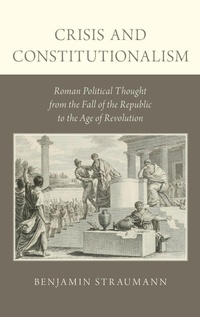
Crisis and Constitutionalism
Roman Political Thought from the Fall of the Republic to the Age of Revolution
Published on 14. April 2016
Book
Hardback
432 pages
978-0-19-995092-8 (ISBN)
Description
Crisis and Constitutionalism argues that the late Roman Republic saw, for the first time in the history of political thought, the development of a normative concept of constitutionthe concept of a set of constitutional norms designed to guarantee and achieve certain interests of the individual. Benjamin Straumann first explores how a Roman concept of constitution emerged out of the crisis and fall of the Roman Republic. The increasing use of emergency measures and extraordinary powers in the late Republic provoked Cicero and some of his contemporaries to turn a hitherto implicit, inchoate constitutionalism into explicit constitutional argument and theory. The crisis of the Republic thus brought about a powerful constitutionalism and convinced Cicero to articulate the norms and rights that would provide its substance; this typically Roman constitutional theory is described in the second part of the study. Straumann then discusses the reception of Roman constitutional thought up to the late eighteenth century and the American Founding, which gave rise to a new, constitutional republicanism. This tradition was characterized by a keen interest in the Roman Republics decline and fall, and an insistence on the limits of virtue. The crisis of the Republic was interpreted as a constitutional crisis, and the only remedy to escape the Republic's fate -- military despotism -- was thought to lie, not in republican virtue, but in Roman constitutionalism. By tracing Roman constitutional thought from antiquity to the modern era, this unique study makes a substantial contribution to our understanding of Roman political thought and its reception.
Reviews / Votes
Straumann's Crisis and Constitutionalism is an important contribution to a growing body of scholarship that is challenging conventional interpretations of Roman political thought [...] The work effectively both broadens and deepens our understanding of Roman political thought, challenging conventional interpretations and providing key insights into the final decades of the Roman republic. * Dean Hammer, Franklin & Marshall College, Polis: The Journal for Ancient Greek Political Thought * This well-written book will be of interest to political theorists, classicists, and historians. ... Summing Up: Recommended. Graduate students and faculty. * J. L. Miller, CHOICE * a critical book to consult about Roman political and legal thought. It uncovers a Roman constitutional tradition and how that tradition was received in the medieval and early modern period. * Lee Trepanier, Voegelin View * Straumann has written a brilliant book [...] In Crisis and Constitutionalism, Straumann has challenged us to think much more deeply about constitutional theory and I look forward to discussing his arguments for years to come. * Michelle T. Clark, Dartmouth College, in New England Classical Journal * Important works on ancient Roman politics and law have also contributed to this Roman turn in the history of early-modern political thought. With this new work, Straumann positions himself at the forefront of this turn, and has produced a book that will speak to historians, jurists, political theorists, and philosophers alike. His erudition is towering, his analyses sharp and insightful, and he writes with clarity and occasional wit. * Dan Edelstein, Global Intellectual History * An important and welcome work on several levels. It offers learned interpretations of important political thinkers, including Cicero, Polybius, and Jean Bodin. The work transcends in importance any given interpretation of the thinkers it considers because it also engages in a scholarly debate, endeavouring to help correct what the author regards as a significant misunderstanding in the secondary literature that draws a strict distinction between 'classical republicanism' and liberalism ... An unusually learned and rich book. * Vickie B. Sullivan, Global Intellectual History * Straumann succeeds in drawing attention to the legacy of Roman political thought, lending it an abiding importance for students of political institutions in any age. * David Potter, Law and Liberty * With an impressive and wide-ranging triple grip on the ancient sources, early modern reception, and much more recent scholarship, Benjamin Straumann has lucidly reconstructed for us the Roman debate about emergency powers -- above all concerning the dictatorship, extraordinary commands, and the question of limits to the citizen's right of appeal -- in order to show how the long tradition of political reflection on the fall of the Republic, which stretches back to Cicero himself, eventually came to animate a great deal of modern constitutionalism. * Christopher Brooke, University of Cambridge * For Straumann, the constitution was at the heart of the crisis of the late Roman Republic, and this was strongly reflected in later political theory. This novel and adventurous thesis mounts a refreshing challenge to current orthodoxies, and will provoke constructive debate among historians and political theorists alike. * Peter Garnsey, University of Cambridge * Crisis and Constitutionalism is a brilliantly original and erudite argument in favor of the distinctiveness and long-term importance of Roman constitutional thought from Cicero to the American Founders, which demonstrates just how much Western political and legal thought, on both sides of the Atlantic, has owed, and still owes, to ancient Rome. It is controversial, highly compelling, and of very real contemporary significance. * Anthony Pagden, author of The Enlightenment -- And Why it Still Matters * Crisis and Constitutionalism brings much learning and intelligence * Malcolm Schofield, American Historical Review * learned, original, ambitious and important * Alexander Yakobson, The Ancient History Bulletin *More details
Other editions
Additional editions
Benjamin Straumann
Crisis and Constitutionalism
Roman Political Thought from the Fall of the Republic to the Age of Revolution
Book
03/2018
Oxford University Press Inc
€56.31
Shipment within 15-20 days
Benjamin Straumann
Crisis and Constitutionalism
Roman Political Thought from the Fall of the Republic to the Age of Revolution
E-Book
04/2016
1st Edition
OUP eBook
€30.49
Available for download
Benjamin Straumann
Crisis and Constitutionalism
Roman Political Thought from the Fall of the Republic to the Age of Revolution
E-Book
03/2016
1st Edition
OUP eBook
€30.49
Available for download
Person
Benjamin Straumann is Alberico Gentili Senior Fellow at New York University School of Law and Lecturer at the University of Zurich. He is the author of Roman Law in the State of Nature and co-editor of the book series The History and Theory of International Law.
Content
Preface and Acknowledgements
Introduction: The Fall of the Roman Republic and the Rise of Constitutional Thought
I. Inchoate Constitutionalism in the Late Roman Republic
1. "Not Some Piece of Legislation": The Roman Concept of Constitution
2. Infinite Power? Emergencies and Extraordinary Powers in Constitutional Argument
3. "The Sole Bulwark of Liberty": Constitutional Rights at Rome
II. A Hierarchy of Laws: Roman Constitutional Thought
4. Cicero and the Legitimacy of Political Authority
5. Greek vs. Roman Constitutional Thought
III. The Limits of Virtue: The Roman Contribution to Political Thought
6. The Roman Republic as a Constitutional Order from the Principate to the Renaissance
7. Neo-Roman Interlude: Machiavelli and the Anti-Constitutional Tradition
8. Jean Bodin and the Fall of the Roman Republic
Epilogue: Constitutional Republicanism, the "Cant-Word" Virtue and the American Founding
Bibliography
General Index
Index Locorum
Introduction: The Fall of the Roman Republic and the Rise of Constitutional Thought
I. Inchoate Constitutionalism in the Late Roman Republic
1. "Not Some Piece of Legislation": The Roman Concept of Constitution
2. Infinite Power? Emergencies and Extraordinary Powers in Constitutional Argument
3. "The Sole Bulwark of Liberty": Constitutional Rights at Rome
II. A Hierarchy of Laws: Roman Constitutional Thought
4. Cicero and the Legitimacy of Political Authority
5. Greek vs. Roman Constitutional Thought
III. The Limits of Virtue: The Roman Contribution to Political Thought
6. The Roman Republic as a Constitutional Order from the Principate to the Renaissance
7. Neo-Roman Interlude: Machiavelli and the Anti-Constitutional Tradition
8. Jean Bodin and the Fall of the Roman Republic
Epilogue: Constitutional Republicanism, the "Cant-Word" Virtue and the American Founding
Bibliography
General Index
Index Locorum