

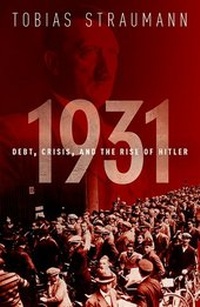
1931
Debt, Crisis, and the Rise of Hitler
Published on 26. March 2019
Book
Hardback
272 pages
978-0-19-881618-8 (ISBN)
Description
Germany's financial collapse in the summer of 1931 was one of the biggest economic catastrophes of modern history. It led to a global panic, brought down the international monetary system, and turned a worldwide recession into a prolonged depression. The German crisis also contributed decisively to the rise of Hitler. Soon after the crisis, the Nazi Party became the largest party of the country which paved the way for Hitler's eventual seizure of power in 1933.
The reason for the financial collapse was Germany's large pile of foreign debt denominated in gold currency which condemned the government to cut spending, raise taxes, and lower wages in the middle of a worldwide recession. As the political resistance to this austerity policy grew, the German government began to question its debt obligations, prompting foreign investors to panic and sell their German assets. The resulting currency crisis led to the failure of the already weakened banking
system and a partial sovereign default.
Hitler managed to profit from the crisis, because he had been the most vocal critic of the reparation regime. As the financial system collapsed, his relentless attacks against foreign creditors and the alleged complicity of the German government resonated more than ever with the electorate. Sadly enough, Germany's creditors hesitated too long to take the wind out of Hitler's sails by offering debt relief.
In 1931,Tobias Straumann reveals the story of the fatal crisis, demonstrating how a debt trap contributed to the rapid financial and political collapse of a European country, and to the rise of the Nazi Party.
The reason for the financial collapse was Germany's large pile of foreign debt denominated in gold currency which condemned the government to cut spending, raise taxes, and lower wages in the middle of a worldwide recession. As the political resistance to this austerity policy grew, the German government began to question its debt obligations, prompting foreign investors to panic and sell their German assets. The resulting currency crisis led to the failure of the already weakened banking
system and a partial sovereign default.
Hitler managed to profit from the crisis, because he had been the most vocal critic of the reparation regime. As the financial system collapsed, his relentless attacks against foreign creditors and the alleged complicity of the German government resonated more than ever with the electorate. Sadly enough, Germany's creditors hesitated too long to take the wind out of Hitler's sails by offering debt relief.
In 1931,Tobias Straumann reveals the story of the fatal crisis, demonstrating how a debt trap contributed to the rapid financial and political collapse of a European country, and to the rise of the Nazi Party.
Reviews / Votes
[An] engaging book. * Foreign Affairs * The value of Swiss historian Tobias Straumann's book is that it focuses our attention squarely on the drama of that year, the moment when the fragile political and financial order restored after the first world war came apart ... a fast-paced and elegantly constructive narrative... If John Kenneth Galbraith forever etched the 1929 crash into historical consciousness, with his classic 1955 account, Straumann has given us the narrative of 1931 that every decision makerin Europe should read. * Adam Tooze, Financial Times * Tobias Straumann's book is a welcome addition ... Straumann ably shows the progress of the German crisis and how it was intertwined with the vexed issues or reparation ... Straumann relates [...] complex events with remarkable clarity, largely eschewing jargon and displaying considerable panache. Rarely has the dismal science been less dismally presented. Happily, for those wishing to write about Nazism's rise, there is now an accessible, non-specialist volume to
explain the economic aspect. * Roger Moorhouse, BBC History Magazine * In this excellent book, Straumann narrates the German story of 1931 with clarity and authority. * Max Harris, LSE Blogs * A superbly researched and highly readable account of financial panic and democratic collapse in Weimar Germany. * Srinath Raghavan, Open the Book, Best Books of 2019 * Tobias Straumann's 1931, is, like George Orwell's 1984, dour and disturbing; ironic and important. * David Marx: Book Reviews * A stunning, fast-paced and deeply researched narrative that accurately delineates the links between financial panic and political collapse in the most iconic case of all: the destruction of democracy in Weimar Germany. * Harold James, Claude and Lore Kelly Professor in European Studies, Princeton University * In this engaging book, Straumann, a leading Swiss economic historian, examines a critical factor in Adolf Hitler's rise to power. * Foreign Affairs *
More details
Language
English
Place of publication
Oxford
United Kingdom
Target group
College/higher education
Professional and scholarly
Illustrations
16 black and white images
Dimensions
Height: 224 mm
Width: 148 mm
Thickness: 27 mm
Weight
386 gr
ISBN-13
978-0-19-881618-8 (9780198816188)
Copyright in bibliographic data and cover images is held by Nielsen Book Services Limited or by the publishers or by their respective licensors: all rights reserved.
Schweitzer Classification
Other editions
Additional editions
Book
10/2020
Oxford University Press
€19.50
Shipment within 15-20 days
E-Book
01/2019
1st Edition
OUP eBook
€7.49
Available for download
E-Book
01/2019
1st Edition
OUP eBook
€7.49
Available for download
Person
Tobias Straumann is an Associate Professor of Economic History at the University of Zurich. He is a member of the European Historical Economics Society and the academic council of the European Association for Banking and Financial History. Straumann has widely published in the area of twentieth-century European financial and monetary history, and is the author of Fixed Ideas of Money: Small States and Exchange Rate Regimes in Twentieth-Century Europe
(Cambridge University Press, 2010), and co-author of The Value of Risk: Swiss Re and the History of Reinsurance (Oxford University Press, 2013).
(Cambridge University Press, 2010), and co-author of The Value of Risk: Swiss Re and the History of Reinsurance (Oxford University Press, 2013).
Content
Preface
Introduction
Confidence
1: Laughing at the Raven
2: A Triumph of Diplomacy
3: 'Strong Cards to Play'
Indecision
4: Hitler's Victory
5: To the Brink and Back
6: 'The First Real Chancellor Since Bismarck'
Despair
7: Squaring the Circle
8: Help from Washington
9: Endgame
10: The Rise of Hitler
Epilogue
Sources
References
Notes
Index
Introduction
Confidence
1: Laughing at the Raven
2: A Triumph of Diplomacy
3: 'Strong Cards to Play'
Indecision
4: Hitler's Victory
5: To the Brink and Back
6: 'The First Real Chancellor Since Bismarck'
Despair
7: Squaring the Circle
8: Help from Washington
9: Endgame
10: The Rise of Hitler
Epilogue
Sources
References
Notes
Index