

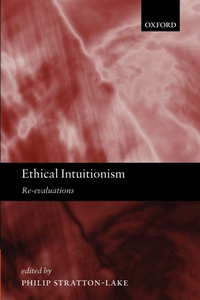
Ethical Intuitionism
Re-evaluations
Published on 15. August 2002
Book
Paperback/Softback
314 pages
978-0-19-825098-2 (ISBN)
Description
Ethical Intuitionism was the dominant moral theory in Britain for much of the eighteenth and nineteenth and the first third of the twentieth century. However, during the middle decades of the twentieth century ethical intuitionism came to be regarded as utterly untenable. It was thought to be either empty, or metaphysically and epistemologically extravagant, or both. This hostility led to a neglect of the central intuitionist texts, and encouraged the growth of a caricature of intuitionism that could easily be rejected before moving on to 'more serious' philosophical theories.
More recently, however, this hostility towards ethical intuitionism has subsided. A wide range of moral philosophers, from Aristotelians, to rule-consequentialists, to expressivists, Kantians, and deontologists, are beginning to look to the ethical intuitionists' work as a positive resource. It is, therefore, a good time to get clear on what it was that intuitionists said, and re-evaluate their contribution to our understanding of morality.
This volume is the first serious engagement with ethical intuitionism in the light of more recent developments in ethical theory. It contains essays by eminent moral philosophers working in very different traditions whose aim is to clarify and assess ethical intuitionism. Issues addressed include whether the plurality of basic principles intuitionists adhere to can be grounded in some more fundamental principle; the autonomy of ethics and self-evidence; moral realism and internalism; and the open question argument and naturalism.
More recently, however, this hostility towards ethical intuitionism has subsided. A wide range of moral philosophers, from Aristotelians, to rule-consequentialists, to expressivists, Kantians, and deontologists, are beginning to look to the ethical intuitionists' work as a positive resource. It is, therefore, a good time to get clear on what it was that intuitionists said, and re-evaluate their contribution to our understanding of morality.
This volume is the first serious engagement with ethical intuitionism in the light of more recent developments in ethical theory. It contains essays by eminent moral philosophers working in very different traditions whose aim is to clarify and assess ethical intuitionism. Issues addressed include whether the plurality of basic principles intuitionists adhere to can be grounded in some more fundamental principle; the autonomy of ethics and self-evidence; moral realism and internalism; and the open question argument and naturalism.
More details
Language
English
Place of publication
Oxford
United Kingdom
Target group
College/higher education
Professional and scholarly
Dimensions
Height: 234 mm
Width: 156 mm
Thickness: 17 mm
Weight
483 gr
ISBN-13
978-0-19-825098-2 (9780198250982)
Copyright in bibliographic data and cover images is held by Nielsen Book Services Limited or by the publishers or by their respective licensors: all rights reserved.
Schweitzer Classification
Other editions
Additional editions
Book
08/2002
Oxford University Press
€84.40
Shipment within 15-20 days
Person
Philip Stratton-Lake is Lecturer in Philosophy at Reading University.
Content
Introduction ; 1. Prospects for a Value-Based Intuitionism ; 2. Sidgwick and Intuitionism ; 3. An Unconnected Heap of Duties? ; 4. The Three Phases of Intuitionism ; 5. Pleasure and Reflection in Ross ; 6. Justifying Moral Pluralism ; 7. Intuitions and Moral Theorizing ; 8. Ethical Intuitionism, Ethical Naturalism ; 9. Knowing What to Do, Seeing What to Do ; 10. Prichard on Duty and Ignorance of Fact ; 11. Intuitionism and the Motivation Problem ; 12. A Wittgensteinian Approach ; Bibliography, Index