

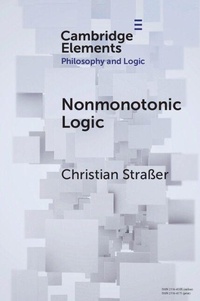
Nonmonotonic Logic
Published on 13. November 2025
Book
Paperback/Softback
136 pages
978-1-108-98686-1 (ISBN)
Description
Nonmonotonic logics serve as formal models of defeasible reasoning, a type of reasoning where conclusions are drawn absent absolute certainty. Defeasible reasoning takes place when scientists interpret experiments, in medical diagnosis, and in practical everyday situations. Given its wide range of applications, nonmonotonic logic is of interest to philosophy, psychology, and artificial intelligence. This Element provides a systematic introduction to the multifaceted world of nonmonotonic logics. Part I familiarizes the reader with basic concepts and three central methodologies: formal argumentation, consistent accumulation, and semantic methods. Parts II-IV provide a deeper understanding of each of these methods by introducing prominent logics within each paradigm. Despite the apparent lack of unification in the domain of nonmonotonic logics, this Element reveals connections between the three paradigms by demonstrating translations among them. Whether you're a novice or an experienced traveler, this Element provides a reliable map for navigating the landscape of nonmonotonic logic.
More details
Series
Language
English
Place of publication
Cambridge
United Kingdom
Target group
College/higher education
Illustrations
Worked examples or Exercises
Dimensions
Height: 229 mm
Width: 152 mm
Thickness: 8 mm
Weight
209 gr
ISBN-13
978-1-108-98686-1 (9781108986861)
Copyright in bibliographic data and cover images is held by Nielsen Book Services Limited or by the publishers or by their respective licensors: all rights reserved.
Schweitzer Classification
Other editions
Additional editions
Christian Strasser
Nonmonotonic Logic
Book
11/2025
Cambridge University Press
€75.60
Shipment within 15-20 days
Person
Content
Introduction; Part I. Logics for Defeasible Reasoning: 1. Defeasible reasoning; 2. Central concepts; 3. From knowledge bases to consequences and NMLs; 4. Defeasible knowledge bases; 5. Methodologies for Nonmonotonic logics; 6. A roadmap; Part II. Formal Argumentation: 7. Abstract argumentation; 8. ASPIC+; 9. Logic-based argumentation; Part III. Consistently Accumulating Defeasible Information: 10. Consistent accumulation: general setting; 11. Temperate accumulation: properties and some concrete systems; 12. Greedy accumulation: properties and Reiter's default logic; Part IV. Semantic Methods: 13. A semantics for defaults; 14. Quantitative methods; 15. A preferential semantics for some NMLs; 16. Logic programming and nonmonotonic logic; Appendix A. Proofs for Part II; Appendix B. Proofs for Part III; References.